Diamond Jubilee: Downtown St. Paul, MN

I ended up with one full day in St Paul. That meant I wouldn't even have time for Minneapolis. I had to make the best of it. After breakfast at the hotel (included), I set off to explore.
I re-visited the train station (to appreciate it more) [see: Union Depot, St Paul, Minnesota] and then found myself in nearby Mears Park, a lovely small square surrounded by modern office buildings. Complete with a faux babbling brook, the park is beautifully laid out. Next to it runs the Minneapolis/St Paul tram (the Green Line) which I could have easily taken to explore the "other city" of the Twin Cities, if I had time.


My walk then took me through a largely empty downtown (it was COVID) to the venerable St Paul Hotel and the lovely Landmark Plaza park in front of it.
In 1856, John Summers invited travelers from all over the world into his home, which eventually became the Greenman House, a 60-room hotel erected in 1871 and destroyed by fire in 1878. By 1878, Mr. Summers and John Baugh, an Eastern hotelier, constructed a much larger and more modern hotel named The Windsor, known at the time to be one of the finest hotels in Saint Paul. The Windsor Hotel was operated successfully until 1880 when Baugh withdrew and sold his interest to Charles J. Monfort. Summers resigned in 1891 and Monfort acted as President and Manager until his death in 1904. For the next two years the hotel was utilized as an arcade and theater. As the city of Saint Paul continued to grow, the need for a new hotel became increasingly important. In 1908 Lucius P. Ordway, a prime mover in the new hotel project, secured ownership of the property with the intentions of constructing a new luxury hotel. “St. Paul’s Million-Dollar Hotel” opened with much enthusiasm and ceremony on April 18, 1910, with guests such as James J. Hill, the builder of the Great Northern Railway, Lucius P. Ordway, businessman and early 3M investor, and John Ireland, archbishop of St. Paul.
I planned to enter and at least see the lobby until I noticed the sculptures scattered across the plaza - all Peanuts! Although born in Minneapolis, Charles Shulz grew up and starting drawing in St. Paul (never knew that). Landmark Plaza memorializes most of the main characters. I loved it! Then I realized there were two other large buildings on the plaza.


The Landmark Building (after the Hotel St Paul) dominates the square
Landmark Center in downtown Saint Paul, known historically as the “Old Federal Courts Building,” was completed in 1902 and served as the Federal Court House, Custom House and U.S. Post Office for the Upper Midwest. It took ten years to build at a cost of $2.5 million (in today’s dollars about $83 million). The building was designed by Willoughby J. Edbrooke, who served as Supervising Architect of the U.S. Treasury from 1891-1892, when building construction started. He designed and organized a body of public architecture, much of which, like this structure, was completed after his death in 1896. The building has a later addition that includes the imposing North Tower and the building’s largest historic courtroom. The addition was completed in 1908 from plans developed by Supervising Architect of the Treasury, James Knox Taylor, who served from 1897-1912. The building was intended to be impressive and instill upon the people of the Upper Midwest the power of the Federal Government. It was described as “a work of art in architecture.” The exterior is pink granite ashlar from St. Cloud, Minnesota, with a hipped red tile roof, steeply pitched to shed St. Paul’s snows and the roof is enlivened by numerous turrets, gables and dormers with steeply peaked roofs; cylindrical corner towers with conical turrets occupy almost every change of projection. In addition to the North Tower, there is a South Tower, which has housed a chiming clock since 1978, funded by the family of former Postmaster Charles Moos.

Although not as imposing as the other important buildings on the plaza, the old central library dates to the age when all large cities were constructing public libraries.
Under the leadership of Mayor Lawler in 1909, serious work began on building a new Library. A site was chosen on Rice Park,[4] and in 1910, the library board began discussing how to raise the $500,000 it was estimated the new building would cost. By 1912, railroad baron James J. Hill had offered to contribute $700,000 specifically for the construction and endowment of a reference library attached to the public library.
(Wikipedia)

I literally did not have enough time to visit the interiors of all three main buildings on the plaza (I felt frustrated), so I chose the Landmark Building. That ended up being a good decision - the interior was just as over-the-top as the exterior. Hats off to St Paul for maintaining such an architectural treasure so well (and making it mostly public-accessible).


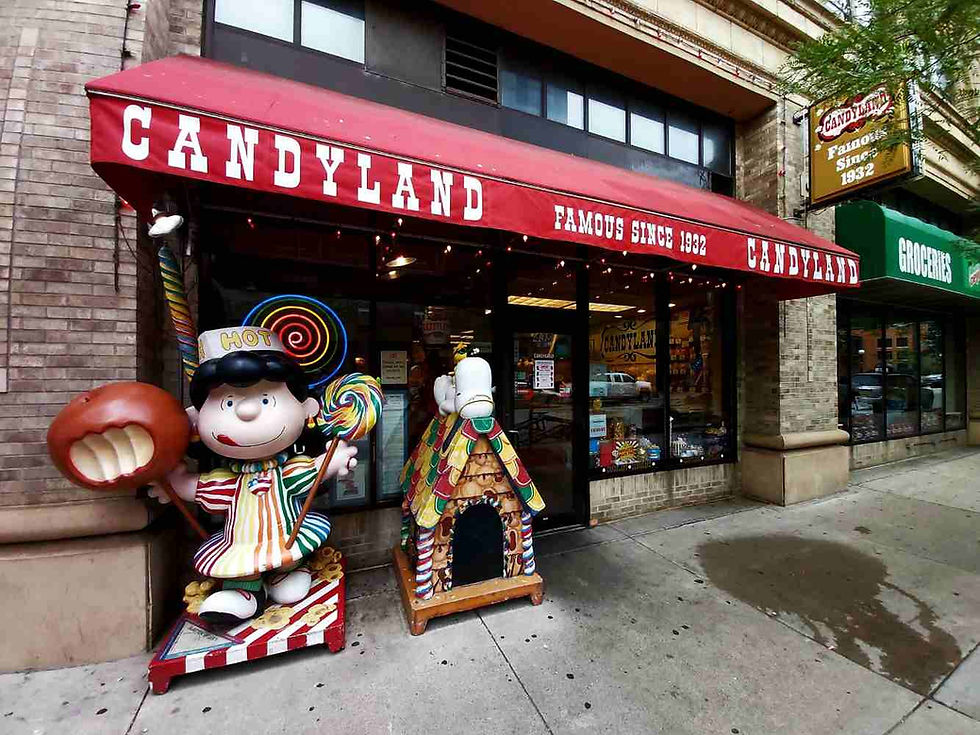
I had to stop at the locally famous, Candyland - a St Paul institution.
The first Candyland store opened in downtown St. Paul in 1932, originally named Flavo Korn selling just popcorn and fudge. In 1938, Arnie Kelsey became the sole proprietor. In 1950, a line of candies and chocolates were added to the variety of treats and the shop was renamed ”Candyland”. Arnie sold Candyland to Doug and Brenda Lamb in 1981. Doug began his employment with Candyland at 17 years old and was excited for an adventure in entrepreneurship keeping the nostalgia alive a true labor of love ever since.
No, I didn't buy any candy. My candy-eating days were long gone.
Finally, I passed by the historic Fitzgerald Theatre
Built in 1910, the Fitzgerald Theater is Saint Paul’s oldest surviving theater space. Originally named the Sam S. Shubert Theater, it was one of four memorial theaters erected by entertainment-industry leaders Lee and J. J. Shubert after the death of their brother Sam. In 1933, it became a movie house screening foreign films and was thus christened the World Theater. Minnesota Public Radio purchased the theater in 1980 and restored it in 1986 for the live radio program A Prairie Home Companion® with Garrison Keillor. The theater was again renamed in 1994, this time for author F. Scott Fitzgerald, a native of Saint Paul. The theater has, over the years, played host to Broadway musicals, vaudeville shows, film festivals, and concerts of all sorts. First Avenue purchased the theater in 2019.

July 2021
The whirlwind walk through the old downtown of St Paul left me impressed and wishing I had more time. Clearly, it was a place that warranted a closer look. My favorite discovery was the Peanuts characters - I loved them.
I looked up Wabash Street. There on the hill stood the State Capitol. I pushed on.

Comments