Italy: University of Padua

April 2017
The University of Padua was established in 1222, after a group of students and teachers decided to come here from Bologna. They set up a free body of scholars, who were grouped according to their place of origin into nationes, in which students approved statutes, elected the rettore (rector, or chancellor) and chose their teachers, who were paid with money the students collected. Defending freedom of thought in study and teaching became a distinctive feature which today lives on in the University motto: Universa Universis Patavina Libertas. The introduction of empirical and experimental methods together with the teaching of theory marked the dawn of a golden age. In the 16th and 17th centuries, Padua became a workshop of ideas and the home to figures who changed the cultural and scientific history of humanity. They included Andrea Vesalio, who founded modern anatomy, as well as the astronomer Copernicus, and Galileo, who observed the skies here. Padua also vaunts the world’s first university botanical garden and a permanent anatomical theatre, which was built by Girolamo Fabrici d’Acquapendente. William Harvey, who became famous for describing the circulation of the blood, studied in Padua, and in 1678 Elena Lucrezia Cornaro Piscopia became the first woman in the world to be awarded a university degree. The fall of the Serenissima Republic of Venice in 1797 marked the beginning of a dark age. Padua fell under the rule of first the French and then the Austrians, passing through Italy’s tumultuous Risorgimento, which also affected the University. Between the late 19th and early 20th centuries, the University expanded to include the faculties of Engineering, Pharmacy, and Political Sciences together with its traditional faculties of Law, Medicine, Arts and Philosophy, and Sciences. The advent of Fascism curtailed the University’s values of free thought and cultural independence. Its professors swore allegiance to the regime, after which the approval of Italy’s racial laws and the expulsion of Jewish professors opened one of the darkest periods in the University’s history. Rector Concetto Marchesi shook the University from its slumber and, at the height of the German occupation made a courageous appeal to the students to fight for the freedom of Italy. For its sacrifices in the name of Liberation, the University of Padua was awarded a gold medal for military valour, the only university to receive such an honour.
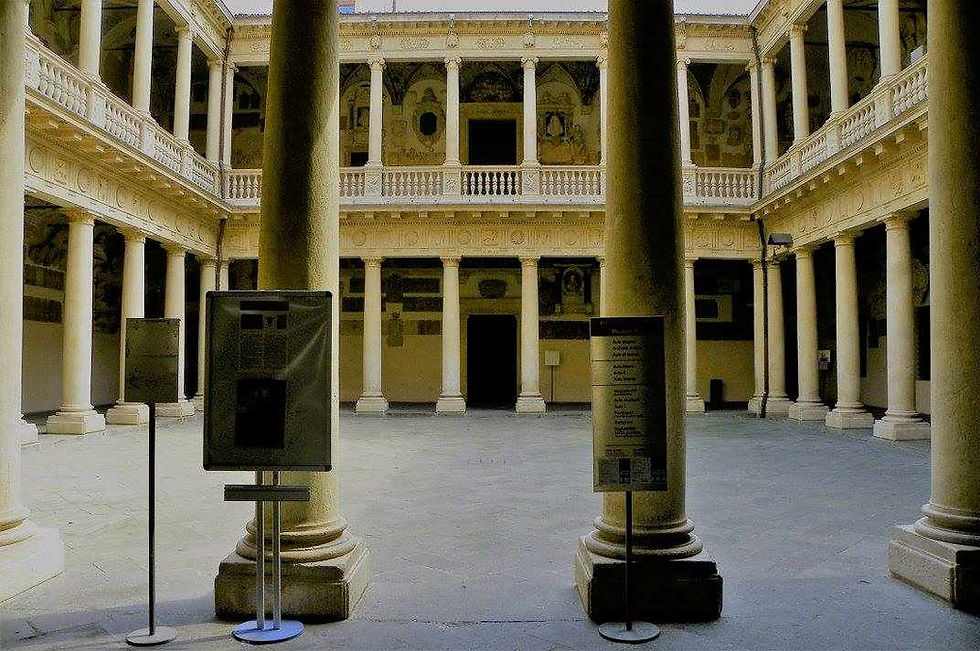
In wandering around Padua, I happened upon the university. Like Bologna, some of the buildings date back centuries. I could only wonder what it would be like to take classes in such ancient surroundings. I remember having a discussion with TFR when he was a student at East Stroudsburg telling him how important architecture was to create a "feeling" at a university. Georgetown was small, but its quad with several old buildings gave it a "vibe". I was certain students at neighboring George Washington University did not feel the same - GWU is just a neighborhood without any real signature buildings. Even Gallaudet has the iconic Chapel Hall with which students immediately identify. Architecture makes an impact on the university experience.
In Italy, the campuses of old universities are buried in mazes of medieval streets, but many of their buildings open into beautiful courtyards. I wondered if the architecture impacted students there as well. In my opinion, it most certainly had to.
Interesting also to note that University of Padua is the only academic institution that took a strong stance against antisemitism in Italy during World War II and won a medal for it.
If I were reapplying to universities in Europe as a youth, perhaps Padua would be my "safety school" (if I didn't get into Bologna or Salamanca).


Comments