Diamond Jubilee: Red Wing, Minnesota

While researching the area around St Paul, a small town downriver, was mentioned repeatedly - Red Wing. Since the train timings for a stopover were convenient (headed toward Chicago), I added it to the itinerary. Luckily, I managed to get seats.
The stopover in Red Wing might have been the best small town visit of the entire trip!
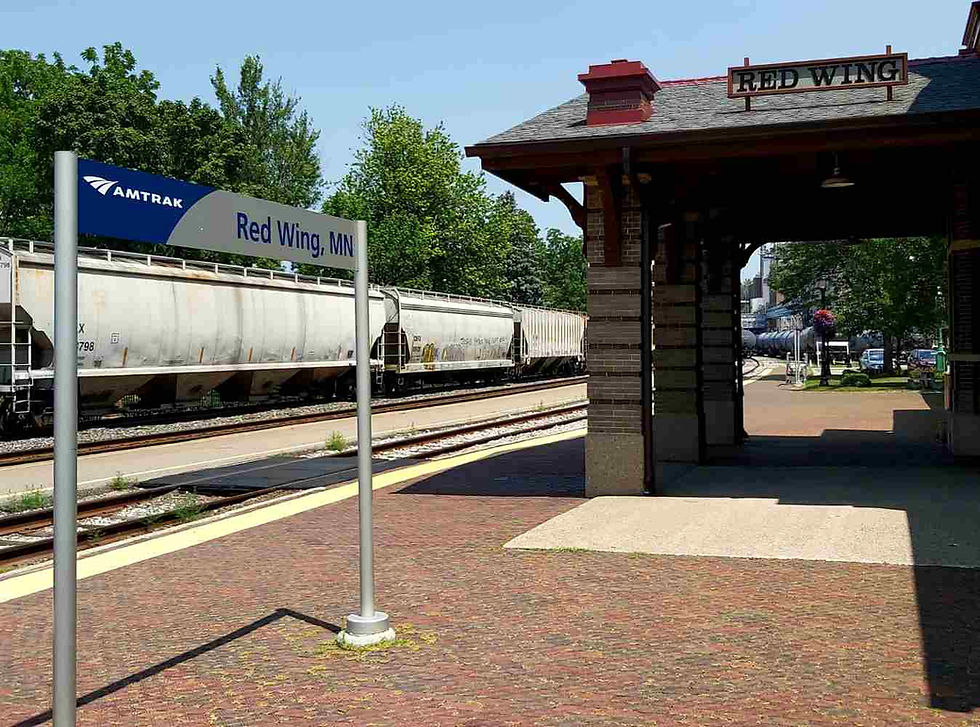
The train station was just a tiny building set amongst grain silos in an otherwise busy port on the Mississippi.

I stayed at the venerable St James Hotel which not only offered reasonable rooms, but is next to the station. The place is a classic old hotel that has been kept up. I loved the hotel and loved my room.
The St. James Hotel opened on Thanksgiving Day, 1875, after a group of 11 civic-minded businessmen recognized the need for a first-class lodging establishment in Red Wing, which was the wheat-trading center of the world at that time. Architects from the Minnesota firm of E.P. Bassford outfitted the four-story Italianate structure in grand style with handsome furnishings, Brussels carpets in the lobby and English velvet carpet in the second-floor ladies’ parlor. On opening night, guests marveled at the hotel’s modern features, including steam heat, hot and cold running water, gas on every floor and a state-of-the-art kitchen. Overnight, the St. James became the hub of Red Wing. The first floor included three timeless dining rooms, a kitchen, office and baggage storage while the lower level featured a parlor, billiard hall, barbershop, public baths and four water closets. The second floor featured a ladies parlor, bridal suite and two ladies’ water closets. An elegant ballroom occupied the fourth floor. Located within walking distance from the Red Wing Depot and the steamboat docks, the historic hotel was booked to capacity every night with travelers and boarders. The St. James chefs developed such a renowned reputation that the railroad adjusted its timetables to allow passengers to disembark and enjoy dinners here. Luminaries such as President Rutherford B. Hayes were among the more famous guests.


After getting settled in my Victorian, over-the-top room. I set out to explore. One of the first things I noticed was that Red Wing is filled with street art!

I also loved the "retro" leftovers in the city that have been preserved.

The civic buildings of the city underscore the city's far more prosperous past.

Courthouse


The city post office.
Most importantly, the city holds an almost extinct-in-the-US business, Red Wing shoes (in fact they own the St James Hotel). For anyone wanting to "buy American" in footwear, Red Wing shoes are still made in Minnesota!
The Beginning
In February, 1905, Charles Beckman and 14 other local Red Wing business investors organize the Red Wing Shoe Company. The first boots and shoes feature “pegged-and-nailed construction,” the industry norm.
1909
Welt Construction: Red Wing Shoe Co. begins manufacturing shoes using stitched-sole construction. Known as welting, this results in a much stronger bond between the shoe upper and sole.
1910
Comfort: Tredstrate shoes are introduced, featuring a manufacturing advance that improves fit and comfort. These shoes are built around a mold, also known as a “last,” that more closely represents the shape of a foot.
1914
Family Ownership: JR Sweasy is hired as superintendent, and by 1919 he becomes the first of four generations of the Sweasy family to own and operate the Red Wing Shoe Company.
1917
WW I: Red Wing makes footwear for WWI soldiers using the popular “Munson Army Last.”
1920
Footwear for Oil Fields: The Oil King (#804) makes an imprint in the oil fields of Texas, and Red Wing soon becomes a fixture in the oil and gas industry. Workers everywhere benefit from Red Wing’s purpose-built footwear for demanding jobs.
1921
Recreational Footwear: New styles are introduced and marketed specifically for hunting.


In the early morning, a mist rose from the river and crept into town. The effect was creepy - like from a horror film, especially with no people on the streets.

I was amazed at the size and length of barges plying the Mississippi. Americans underestimate how important the Mississippi (Missouri and Ohio) River system has been in the development of the country. So much freight is moved cheaply and easily down the river to New Orleans and onto ships.


Red Wing used to be the "Wheat Capital" of the USA.


On the "new" bridge crossing the river.


A longish walk downstream from town is Colville Park which has the town's famous "spectacles sculpture" as well as the local marina.

I loved the morning mist on the river (as opposed to in town)

The main thing to do in Red Wing is climb Barn Bluff, an rock outcrop right on the river overlooking town. It is a steep walk up (it was summer and hot during my visit), but the views from the top are incredible!


hot and sweaty

Another hill just outside of town, Memorial Park, offers a more complete view of the town, but I preferred those from Barn Bluff.

July 2021
In Red Wing I ate and drank well and took some fabulous walks. The town was cute but not overly touristic. I loved watching the river traffic. The hotel was amazing - a place I probably could not have afforded outside of the pandemic.
Red Wing for me was one of the highlights of the trip if not the best part. Unfortunately, time was running short. I had to catch the train back to Chicago and decide how I was going to spend the last few days of the trip.


Comments