Southern Africa: the safari trip

July 1998
Brian and I wanted to add "safari" to our list of travels. I wrote a short follow up to our whirlwind trip through Southern Africa. The main memory of that trip was an unseasonable cold snap. We were worried about malaria and tropical disease before we departed - I don't even think we saw a mosquito the entire time!
For the second time in two years, Brian and I rendezvoused in Zurich Airport. Brian had just spent the day in the city after his long flight from Chicago and I flew in from four days in Munich catching up with MAP and SFP. Brian and I were apprehensive about going to South Africa. Crime loomed largely in our minds as we heard that Johannesburg was becoming increasingly lawless. Also, the travel agent we intended to use in Jo'burg (via FAX from Jakarta) turned out to be incompetent, so we canceled our pre-arranged plans and were "winging it".
Arrival in South Africa
We arrived in the early morning. The pilot announced it was 32 degrees when we touched down. Neither of us had experienced cold in two years - our lack of preparation for the weather would dominate the trip. After some initial frustration, we found a hotel room in a Holiday Inn in the suburb of Jo-burg at the time, Sandton. The hotel was directly across from a huge shopping mall which turned out to be convenient. In fact, we never saw any of Johannesburg downtown - only the highway between the airport and the hotel. That was fine with us. Jo'burg turned out to be a place where stories were MORE exaggerated upon arrival. It seemed everyone was happy to tell us the latest gory details of a carjacking or robbery gone wrong. So, yes, we were extremely happy to walk across the street and into a shopping mall in a remote suburb.
We found another travel agent and she strongly recommended that we go to Victoria Falls, Zimbabwe (not terribly far by plane) first, then come back to South Africa. The cold front passing through was the coldest weather South Africa had seen in 40 years (what luck). So, we were off to Zimbabwe the following day having seen nothing in South Africa, our principal destination. Even though Victoria Falls is north of Johannesburg, it is warmer there as it is above the Tropic of Capricorn and closer to the Equator. Unfortunately, the cold front followed us there, too. Although temperatures weren't freezing, it was far from the hot and steamy Africa for which we prepared. In some ways, the detour to Victoria Falls turned out to be the best part of the trip.
Victoria Falls, Zimbabwe
We landed and were whisked off to the Victoria Falls Safari Lodge, outside of the town Victoria Falls. Far from a big city, it does have a busy shopping street and a main intersection with a few arcades. Our hotel was four kilometres outside of town bordering Zambezi National Park. A watering hole is located directly in front of the main entrance, so from the room balconies or the restaurant it is possible to see animals (like elephants) coming for a drink. The property is uber-luxurious - a five-star resort although built to look rustic. Signs are posted across the property "Do NOT go for stroll on the grounds"; it is dangerous and the danger of being attacked is real. The place is filled with monkeys (who came into our room and ate some candy from our bags while we stepped out for just a few moments!). Apparently, they had totally trashed rooms in the past so we were also warned to keep the windows and doors locked unless we were sitting on the balcony.
We had gone to several travel agents in town shortly after we arrived and decided the best course of action was to base ourselves in Victoria Falls and do day trips to nearby attractions (of which there were many). Victoria Falls is in a corner of Zimbabwe where Botswana, Namibia, Angola, and Zambia meet. The location is strategic, actually. Our plan was to visit Chobe National Park, Botswana; Hwange National Park, Zimbabwe; Victoria Falls National Park, Zambia; and then go white-water rafting on the Zambezi below the falls before heading back to Jo'burg (and hopefully warmer weather).
Our first activity that evening was to see some native dancing from Zimbabwe. Although all such things are contrived for tourists, it was the first time we experienced it. The variety of music, dancing, and costuming was extremely interesting and diverse. We finally felt like we were in "Africa" (even though it was a show).

Of course, the main attraction is the falls themselves. In the local language they are called "the smoke that thunders" - a much more lovely name. A similar experience to visiting the Grand Canyon of the Colorado in Arizona, upon seeing it, one is rendered speechless. No type of photography can do it justice. And, like the Grand Canyon, a visitor cannot see Victoria Falls until they are literally upon the place. The area surrounding is dry, scrub forest - most certainly not "jungle". Victoria Falls National Park mostly looks like Southern California or Arizona. The Zambezi is a large river with a lot of water even in the dry season. It informally forms the border between dry, Southern Africa (Namibia, Botwana, Zimbabwe, South Africa) and tropical, Central Africa (Angola, Zambia, Malawi, Mozambique). To picture Victoria Falls, imagine a canyon from Arizona or Utah, not huge, but very straight and deeply cut into the earth. That canyon has a river raging through it and the source of the river falls over the side of the canyon at a right angle - that is the amazing part of the falls. Victoria Falls is impressive because the water falls over the edge of the canyon and then turns to follow that crack in the earth downstream. The falls are twice as high as Niagara, one mile wide in flood. In the dry season (when we visited), it is impressive and beautiful. In the wet, at its peak, it is wild and powerful - its spray can be seen up to 30km away. Unfortunately, during that time the falls are not even visible - they are permanently shrouded in mist. The locals say a god named Nyami-nyami lives inside them. After visiting, we understood why. What is equally dramatic is that above the falls, the Zambezi is wide and winds lazily across the land giving no hint that nearby the water plummets so deeply. Below the falls, the gorge holds rapids (Class V for white-water enthusiasts), some of the best in the world. It is as if one world ends and another begins at Victoria Falls. The area adjacent to the falls is a tropical rainforest due to the constant mist and humidity - the falls creates a microbiome with its own ecology. A truly unique place, it is worth visiting at different times of day and from different angles similar to the Taj Mahal or the Pyramids. We loved our time there.
Chobe National Park, Botswana

Chobe National Park, Botswana is made up of the area around the Chobe River (a major tributary of the Zambezi) and the surrounding swamps. We booked a tour from Victoria Falls as the park is conveniently nearby - there aren't even any border formalities since so many tourists come across to see it. That visit turned out to be one of the best safaris of the whole trip - unfortunately, it set the bar extremely high for the subsequent safaris we took. Half of the trip was on a pontoon boat and the other in an open-air jeep. From the boat we saw lots of birds, crocodiles, buffalo, warthogs, and mostly - hippos. Hippos are extremely territorial and very dangerous - they kill more people in Africa than any other animal. That is amazing considering they are more like huge cows, animals that just graze and laze all day. It is only their extreme territoriality that makes them dangerous - they can literally snap a canoe (or a person) in half. As the pontoon boat was large, the hippos would not charge it. We felt safe getting close to the hippos who largely were unfazed by our presence. It was hard to imagine they were dangerous. We learned that African buffalo are also extremely dangerous. They will literally charge at anything. Since Asian buffalo are descended from African ones and Asian water buffalo are extremely docile, it felt strange to think of the ones in Africa as "dangerous". From the safety of the large pontoon boat, we came very close to a herd of buffalo as well.
The land portion of the trip took us into a herd of elephants. Again, the accent was on danger. If an elephant feels threatened, an open-air jeep is not the place to be. Fortunately, the ones in Chobe National Park are used to jeeps buzzing around, so they basically ignore them. We came upon a group blocking the road and patiently waited for them to clear off so we could continue. That gave us some very close up views - wow! We then arrived at a pride of sleeping lions (not exciting, but they were actual, wild lions). The park was thick with deer-like game: impala, kudu, waterbuck, and sable. All in all, it was an impressive tour.
Our first "safari" literally blew us away.
Hwange National Park, Zimbabwe
In the opposite direction (and a longer drive) from Victoria Falls lies Hwange. We appreciated its gorgeous and sometimes dramatic scenery, but compared to Chobe, wildlife was few and far between. Hwange is vast and we only saw a small part of it. In Chobe, the animals all come to the river to drink, in Hwange they come to watering holes. We sat at one watering hole and waited in hopes something would come (no guarantees). We saw some zebras and giraffes. It was in Hwange that we learned the Africa we expected to find - huge herds of animals wandering across a savannah - exists only in Kenya and Tanzania on the Serengeti Plain. Southern Africa is completely different. Too high of expectations from educational television growing up, I guess. We appreciated Hwange and our guides felt bad we didn't see more wildlife (how could that be their fault?). Chobe really had set a ridiculously high bar for the rest of the parks we visited.
White Water Rafting on the Zambezi

Our day of white water rafting was against my better judgement. It was my 35th birthday - what better way to mark "halfway to old" than doing a life-threatening activity? What was unfortunate was that the weather was so cold, each time the water splashed on us it felt freezing. The wind was blowing, too. The rapids below the falls is Class V - a place that neophyte rafters should not attempt, but we were in Zimbabwe where they only cared about accepting our money - not the risk. We decided against a boat where we would do the paddling - that was best left to a professional. We got on a boat with an oarsman, so the only thing we had to do was throw our weight in the direction shouted to us. Those paddle boats would have to work a lot harder (and stood a smaller chance of success). Brian and I thought, "We have done white water rafting - let someone else handle this" [read: we knew we were in over our heads]. The entire activity was dangerous and it was hard for us to believe that that on one of the most famous (and dangerous) rivers in the world the operators were taking first-timers. Most of the self-paddle boats flipped at the first set of rapids and those rafters felt terrified. A woman we took on our boat screamed and cried to be let out to shore. Our guide explained flatly, "That is Zambia, if you try to exit there, the border guards will shoot you". Yikes.
Our oarsman handled every rapid until the end (and it was terrifying - not fun). At the penultimate set of rapids, we flipped. I was thrown far from the raft and went deep under the water. I felt certain Nyami-nyami was claiming me for his own. I popped up to a chorus of SWIM, SWIM (easy to say for those back in the raft, not so easy in a life-jacket in the midst of rapids and rocks). I finally made it back to the raft, terrified and exhausted. I wondered if I had a "near-death" experience. In the end, it was good for us both. We realized two things: we were terribly out of shape AND we were no longer 22 years old. Finally, upon reaching the pull out point we were informed we had to walk out of the canyon. We were all exhausted already. First we froze, then I nearly drowned, and finally we had to climb a steep, narrow path out of the canyon straight up. Was it really fun?
That is what happened on my 35th birthday - perhaps my most exciting in all the wrong ways.
Some vans took us back to town and the hotel where were had something to drink and recovered.
Victoria Falls, Livingstone, Zambia
After shopping in town (inflation was so ridiculous that we paid in US dollars), we decided to walk over to the Zambian side of the falls (which also does not require passport control). The Zambian side offers a different view of the falls but more importantly, people were bungee jumping from the bridge and we wanted to watch. We felt ironically that bungee jumping from that height was safer than what we had been through the day before. We walked to the falls viewpoint and wondered at the view. Simply amazing.
Soon we were back at the small airport and headed to Jo'burg where we hoped the weather had improved.
Sandton (again)
Back in Jo'burg we stayed in the safety of Sandton once again and went back to the travel agent. We were pleased with the trip to Victoria Falls, so we trusted them for the rest of our tour. The weather had not really improved, unfortunately.
Our agent booked us with "Indebush Tours", specializing in shuttling small groups of tourists from Jo-burg to Kruger National Park with stops along the way. The van picked us up in the morning and before long we were zooming along a highway through what white South Africans call the "highveld". Between Johannesburg and the Drakensburg mountains, the scenery could be anywhere in the high plains states of the US or Canada - endless fields of grain on a gently rolling plain. Since it was winter (and still unseasonably cold), the high veld was not at its most picturesque. Our guide's name was Jeff - a South African of English descent. We found him a little "strange" (but not in a bad way). He was actually the first South African we met after the travel agent.
Our traveling companions were an Israeli couple, Amihai, a professor of Psychiatry from Hebrew University, and his wife, Dorit. Both were well-traveled and pleasant to spend time with (thank God). Ami slept for most of the first day. Brian and I found it strange since there is literally no jet lag between Israel and South Africa.
The Drakensberg Mountains

The plains gave way to some low hills which marked the edge of the Drakensberg Range. We stopped at Pilgrim's Rest - a gold-rush town. It had been carefully restored and was mildly interesting: however, we didn't care much about White South African history in a country of 4.5 million "Whites" and 45 million original inhabitants. Notably, the town information only focused on its European history - nothing about the local population who actually worked in the mines. Given South Africa's new government and agenda, I was surprised they didn't update the information (or perhaps burn it to the ground as a symbol of oppression).
Politics and racial agendas aside, we were in Africa to see animals, not a gold rush town. Jeff was so desperate for us to "understand" South Africa. I don't think he really understood the outsiders' perspective.
Soon we were leaving the high veld and descending toward Kruger National Park located in the "low veld" - a completely different landscape and climate.
The Drakensberg Mountains are not really mountains, but a long escarpment that marks the abrupt end of the the high plains of north-central South Africa. Below them lie the lowlands along the coast. The mountains are a series of sheer cliffs rather than mountains and the transition is dramatic. We literally drove to the edge of a cliff than runs as far as the eye can see in both directions. Stretched out below us were the "tropical" coastal plains where Kruger National Park (and many private game reserves) are located. The two climates could not be more different either: the lowveld is subtropical (with malaria), and the high veld is Mediterranean. We slowly wound down the mountains via scenic lookouts with lovely names (e.g., God's Window). We passed by the Blyde River Canyon cutting into the escarpment dramatically. The scenery was arresting.
Unfortunately, Brian was becoming increasingly ill. Apparently our dinner the evening before was not sitting well with him and all the twists and turns of the road were just making it worse. Most of his memories of the Drakensberg was holding out for the next toilet stop. Oh, the reality of travel...
The Low Veld
We finally made it to the bottom of the escarpment and witnessed the mountains glowing red in the late afternoon sun. It looked more like Sedona, Arizona than South Africa - absolutely gorgeous. Tolkien apparently spent time in South Africa and he found the mountains inspiring - were those the mountains of Middle Earth? We arrived at our "camp" for the night (Brian went straight to bed). We met the camp hosts who were Afrikaaners (South African of Dutch descent). Extremely hospitable and friendly people, they showed genuine concern for our comfort (in a "luxury tent") and Brian's stomach issues. Unfortunately, he missed out on our evening game drive through their private reserve and the following early morning walk (no dangerous animals). Brian recovered enough, however, to begin to enjoy himself again. I was relieved. After breakfast we went to an animal rehabilitation hospital and saw a lot of "game" that was being cared for for eventual return to the wild. It was both fascinating and bittersweet. A great deal of conflict exists among local white farmers, black villagers, the local reserves, and the national park. Everyone has their own agenda. Wild animals do not differentiate between what is domestic and wild - to a lion a cow is no different than a kudu. There was an effort to buy up land and move out the farmers and villagers so the remaining area will only be a network of private reserves and national parks, but moving out rich whites and forcing black villagers to leave (especially in the post-apartheid climate) was very difficult.
Perhaps the saddest part of the whole experience was seeing a leopard raised from a kitten which could not be returned to the wild. It could also not stay in the hospital forever. The government wanted the hospital to sell it so the local farmers could not complain in case it escaped. The irony was that the leopard had no desire to escape because it never learned to hunt. If sold, the leopard would not go to a zoo; it would go to a hunting reserve where it would be later shot by a "big game hunter" (still a big business in South Africa). Said hunter could return home (likely America, even more likely Texas) to regale his friends about his "big game hunt" in darkest Africa. Hardly sporting, besides, who could take pleasure in shooting such a beautiful animal? I felt certain such hunters would be reborn as game animals to be shot later by humans. How disgusting.
Kruger National Park

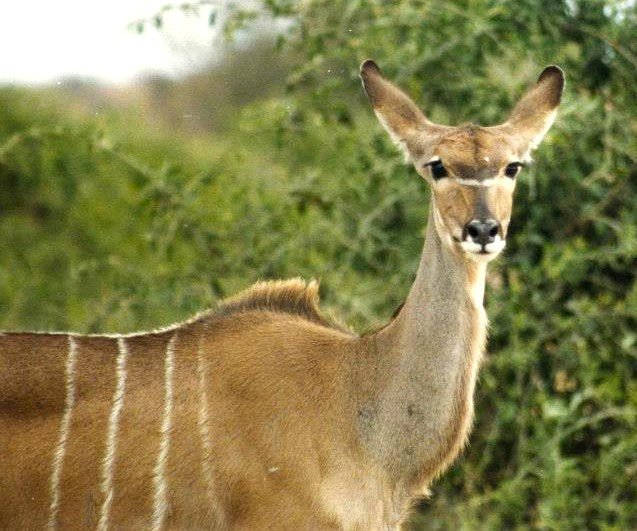
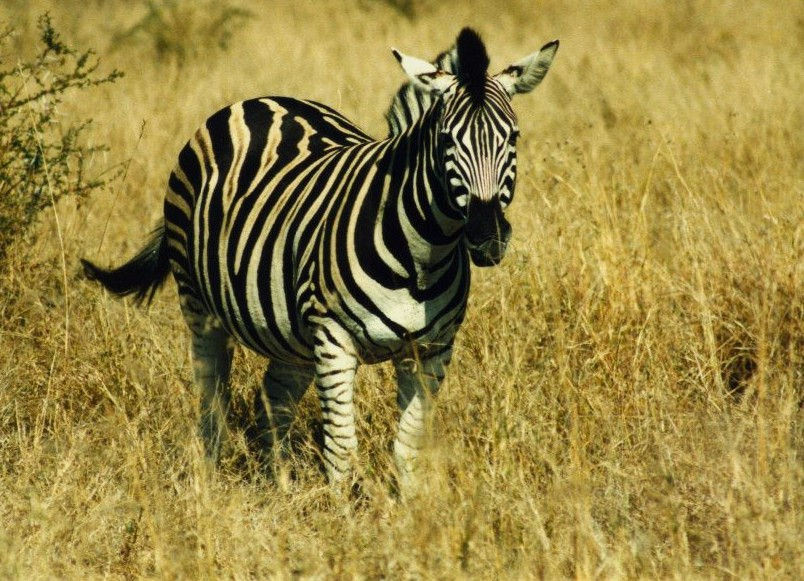
Finally, we were headed toward Kruger National Park. It is HUGE. The size comparison from the guide (quite ironic) was that it is the same size as Israel. What could Ami and Dorit have thought driving through a park the same size as their entire country! Since it was created during Apartheid, a lot of money was thrown into it. Kruger was white South Africa's place to take a vacation. In many ways, it felt like visiting Yosemite or Yellowstone - fully developed with little tourist villages holding supermarkets, restaurants, and park rangers. The good point about Kruger is that the animals are totally inured to vehicles. Visitors can get very close to wildlife. Because of its vastness, it is possible to get away from other tourists and experience the place in an almost natural state - sometimes we felt "alone" in the park. Unfortunately, with such good infrastructure and many guides (with walkie-talkies), any time there was a good game sighting, everyone would rush there and suddenly there was a "traffic jam". Seeing a pride of lions with 20 other vehicles (including buses) diminishes the experience considerably. In any case, we did see a lot of game and felt grateful for the opportunity to see it. The visit was simply too brief for such a large park, but our visit did give us a sense of just how huge it is.
That part of the trip had us meeting white South Africans who were eager for us to like their country - appearing to wish the past had never happened. Brian and I thought, "good luck with that". Coming from an America still dealing with post-slavery issues 150 years after, South Africa has a long road ahead.
Soon we were driving back up through the Drakensberg Mountains toward Jo'burg to prepare for our next adventure.
Phinda Forest Lodge
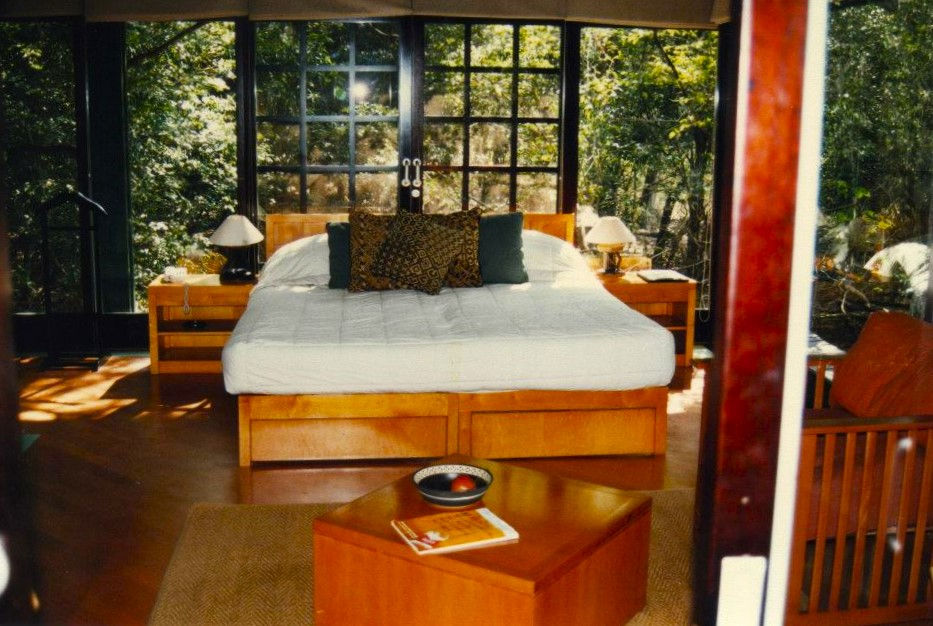
Our last week in South Africa was divided between Phinda Forest Lodge and Ndumo Wilderness Camp. We had no illusions - they were both "cruise ships on land" in that the properties were created for people with money who would be fed well as they sipped wine watching the sunset "in Africa". Phinda is a private game park that is slowly being restocked to include all of its original animals. The plan is eventually to acquire more land, take down all the fences, and have it run continuously between the two nearby national parks. Phinda is first class all the way. We flew a regular flight to a midpoint near the park and transferred to a chartered light aircraft to a private airstrip. We were chauffeured to its lovely main building and served a gourmet meal including exotic local meat. The rooms are all glass-enclosed bungalows set in the forest far enough from each other to give privacy. The intention is to make guests feel they are more connected to nature. Having a bathroom with a huge window (no shades) was unnerving at first until we realized there was nothing outside except trees and animals. The staff stuck to paths and no one was "wandering" about. In the end, we loved it. Brian took advantage of some nearby diving while I went on more game tours. One tour happened upon a pride of lions that had just made a kill - quite exciting. Phinda also has a large herd of white rhino which looks both amazing and dangerous. The setting of the place below the Lebombo Mountains on rolling hills near the sea is spectacular. We both thought that in the coming years Phinda was only set to get better and better. Phinda was our favorite "camp" - we didn't want to leave, but we had one more to experience.
Ndumo Wilderness Camp
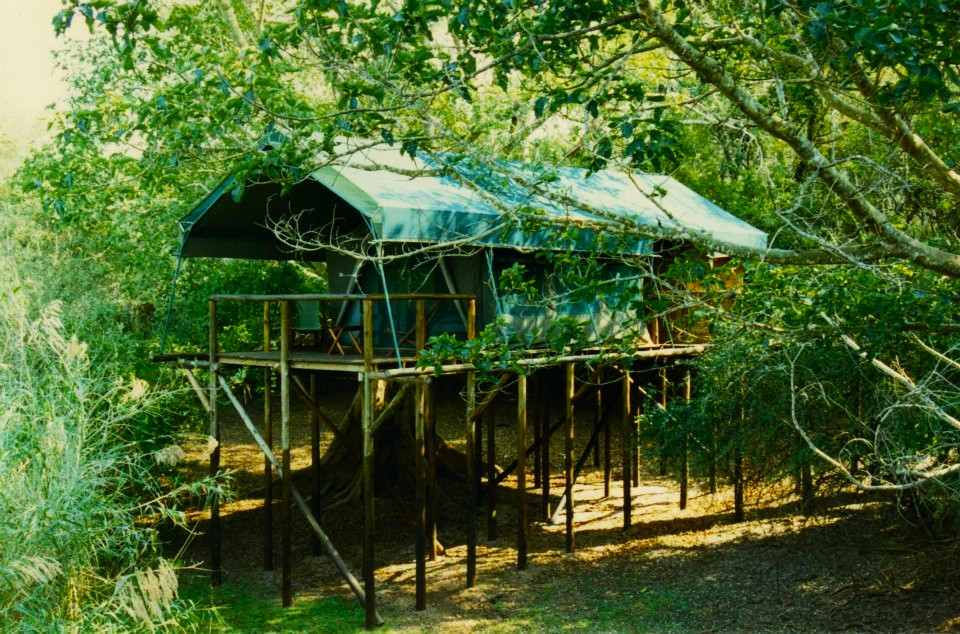
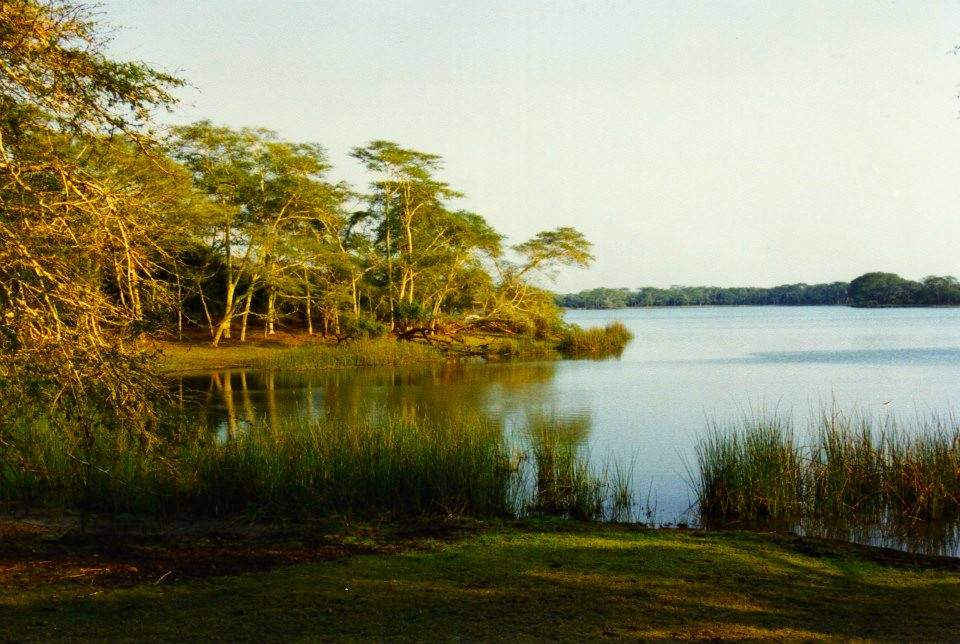
We were shuttled by jeep to the Ndumo Wilderness Camp right up by the border with Mozambique. A series of luxury tents built on stilts, it is adjacent to a river and vast wetlands. The tents felt luxurious and comfortable (amazing that tents could be made "luxurious"). The place is a birdwatcher's paradise and has a large population of black and white rhino. Unfortunately, we saw neither. However, we encountered loads of beautiful birds, hippos, along with the usual "antelope-type" game. The feeling was laid back and made for a nice break at the end of the trip. Being on the "edge" of South Africa, it has an end of the road feeling. There were few other guests - we literally had the place to ourselves - which we liked. After Phinda, it was hard to feel excited about anything.
Heading back
From Ndumo we drove the long distance to Durban Airport (more than five hours) where we caught a flight back to Jo'burg. The scenery along the way as we traversed part of the Lebombo Mountains (located mostly in Swaziland) is dramatic. South Africa has many places that resemble the American Southwest. A loquacious (and vacuous) British woman served as our driver - who got "lost" on several occasions. Brian and I were only focused on making it to our flight on time. South Africa appeared to attract a wide range of eccentric people from abroad over the years.
Back in Jo'burg (Sandton) we did a whirlwind shopping tour of the mall near our hotel before boarding a series of planes that would eventually take us to HOT Jakarta. After all the cold weather, we almost missed it. Overall, Brian liked the trip more than I did. In the end, in spite of all the fascinating experiences and discoveries, I decided I was more attracted to Asia than Africa. Perhaps our lack of preparation and the cold weather affected my opinion. Brian was ready to return in a few years - we never did. I would have accompanied him, but not to South Africa. I would rather see Kenya or Tanzania where the animal concentrations are higher (and the scenery matches what is in my head for "Africa").
Final observation
The racism we encountered in South Africa was very real and frightening. Given the attitudes of the white people we met, I could see the local population asking them all to leave - no mercy. Anyone with even a bit of social consciousness and human compassion would have felt as we did. Although the USA has its own profound problems, to us South Africa appeared to have a long and hard road ahead of them. As history would find, it did not fare well.
So ended another adventure. Brian and Matt visited all continents but Antarctica. We never really discussed the land of the South Pole seriously....
Afterthoughts
I am happy that I rediscovered this short journal of our time in South Africa. I had forgotten many details in my previous blog entries. I will note that later in life when I worked abroad, I ran into many white South Africans. They extolled how far the country had come and worried about increasing corruption. Interestingly, they rarely explained why they sought work abroad. Later two colleagues from Saudi Arabia (from SA) messaged me from their "fortified communities" back home and explained about the increasing danger of life there...
White South Africans are leaving in droves to work abroad. I am not surprised at all.


Comments