USA: San Juan, Puerto Rico (revisited)

March 2026
After the cruise on the Norwegian Epic [see: Norwegian Epic], I stayed in San Juan for an extra night so I could make a better connection to the next flight (and because my hotel stay before the cruise in Miramar had been underwhelming). If I can choose anywhere to stay in San Juan, it will always be Viejo San Juan, the oldest city in the US.
Because cruises typically end early in the morning, even delaying my departure from the boat to the last meant arriving at the hotel around 9am. Reception took my bags and I set off to walk around - I couldn't get in the room until late afternoon. The weather was sunny and warm. I was happy to have the day to walk at my leisure (and burn off some cruise weight!)
One thing I always wanted to do was walk the ramparts of the old city. I started near the hotel and followed them via a series of parks along San Juan Bay. The small island that holds Old San Juan is actually a hilly outcrop so the city is surrounded by sea and walls that were built right into the steep hillsides and cliffs. These days, with just a few interruptions, those old walls are walkable as a series of parks with breathtaking views of either the bay and mountains behind or of the Atlantic Ocean. The old bastions are impeccably maintained.


I passed by my favorite statue in the old city, La Rogativa [see: Old San Juan]


Of course, no one can visit Old San Juan without stopping at El Morro, a fortification so important, it was in military use up through World War II. Luckily, I had purchased my Senior Lifetime National Park pass before the trip with PM & DV so it was free!
Castillo San Felipe del Morro (also known as “El Morro”), perhaps the most iconic fortification built by the Spanish in the Americas, covers a 140 foot-high promontory at the entrance to the Bay of San Juan. This fortress consists of 6 levels facing the Atlantic Ocean, all of which were designed to create a devastating artillery fire over enemy ships. By the time of its completion around 1790, it had the reputation of being unconquerable and was the most feared of all the Spanish colonial fortifications. Construction of the fort began in 1539 on a site chosen for its strategic location at the entrance to one of the best harbors in the Caribbean area. During the late 16th and early 17th century the distinguished Italian military engineers, Bautista Antonelli and Juan Bautista Antonelli transformed El Morro from its original medieval tower shape to a thick-walled masonry stronghold, capable of fully resisting the impact of cannon balls. The new fort was put to the test during the early stages of its construction. In 1595, the one and only, Sir Francis Drake led an attack against San Juan. Drake had earned a reputation as invincible, and his attack was perceived as a major challenge to the still vulnerable first stages of the Spanish defenses. However, good fortune was on the side of the Spanish. A miscalculation by Drake, together with the bravery of the fort’s defenders led to a totally unexpected defeat for the English. Spain celebrated this victory and perceived it to be a portent of the importance of the fort and the challenge it presented to would-be attackers. Castillo San Felipe del Morro became the gateway to the Spanish empire.
El Morro with its views over the sea and the vast meadow that divides it from the rest of the city (popular for kite flying) is a beautiful place to visit on a sunny day. As it was Sunday, a lot of locals were around with their kids.


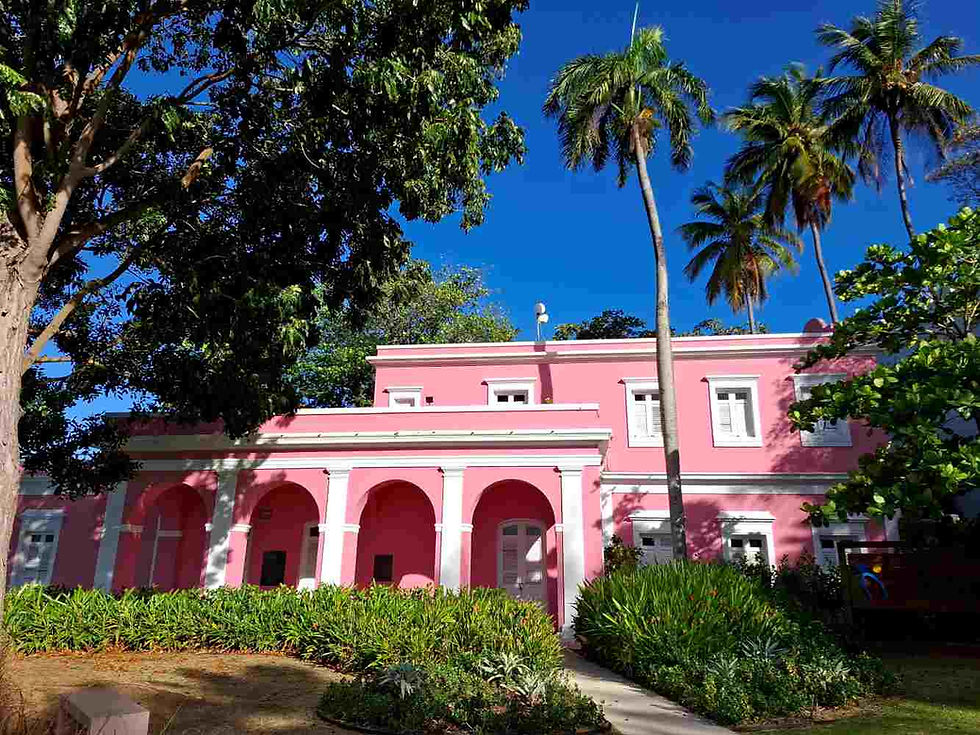
San Juan has seriously taken on restoring all its significant historical buildings, too. The Casa Rosa was under renovation as I walked by.
Casa Rosa or Casa Rosada, also known as the Pink House, is a historic house located in Old San Juan, Puerto Rico. The house was built in 1812 as a barrack for the troops assigned to the San Agustin Bastion. It was converted to an officers quarters in 1881 by the Spanish Army. The building was later converted to a museum used for Puerto Rican crafts. Today it operates as a day care center for the children of employees of the Government of Puerto Rico.
(Wikipedia)
The Old City Hall stands on the Plaza de Armas (also under renovation)
San Juan City Hall is the seat of government for the Autonomous Municipality of San Juan in Puerto Rico. The city hall is located in Old San Juan, in front of the Plaza de Armas and next to the Antiguo Palacio de la Real Intendencia, which today hosts the Puerto Rico Department of State. The San Juan City Hall was built in stages from 1604 to 1789. It went through numerous additions and expansions throughout its history. Its current structure and façade by the square, inspired by the Casa de la Panadería in the Plaza Mayor of Madrid, completed in 1840 and was designed by architect Pedro García.
(Wikipedia)

When I visited Old San Juan in the 1980s, some of its venerable old buildings had been fixed up, but many also were languishing in disrepair. On my second visit, nearly every old building had been lovingly renovated into a residence, restaurant, or shop. The entirety of old San Juan is beautiful to walk. I thought of the potential of the Zona Colonial in the Dominican Republic - it is about three times the size of Old San Juan! [See: Santo Domingo]

The wandering was wonderful. I finally walked all of the old town's new streets (it really doesn't take long). I saw El Morro's twin, San Cristobal Fort - the weather was so clear I could see the summit of El Yunque, a rainforest reserve on the other end of the island. I also walked under the walls along the Paseo de la Princesa which hosts an outdoor market (for locals, I didn't see any tourists). Other than being a long day on foot (the room was not ready until 4pm), it was wonderful.
After seeing Old San Juan again after so many years, I realized I had the same experience there as I did in Prague. After I first visited Prague in the late 80s, I told everyone that if they ever fixed it up, people would visit in droves. I thought the same of Old San Juan on my first visit, and I was right on both counts. The Old City is the city's heart and now is filled with visitors all the time (but not oppressively). The Zona Colonial of Santo Domingo and the Casco Viejo in Panama City could be the same - maybe better. Time will tell.
Viejo San Juan - I was so happy to meet you and walk your streets again.


Comments