USA: Honolulu, Hawaii

Honolulu was never on my radar as a place I planned to visit. Hawaii, yes - Honolulu, no. Yes, I had grown up watching Hawaii 5-0, and remember the famous Brady Bunch holiday episode there, but I never had any interest in the city. However, it was the Ruby Princess' first port of call [see: Ruby Princess] and a state capital. Of course, I felt obligated to enjoy a walkabout because the ship would stay in the city uncharacteristically late (11pm). Most cruises depart by 5 or 6pm. I literally had the whole day to explore.
The first issue was getting information about where we would be tying up. Amazingly, that was difficult to ascertain and I had to ask many crew members until I got the correct answer. What basic information that was not made clear to us! As it turned out, we were docking right next to the old downtown.
Our "Hawaiian Ambassadors" during their lecture on the city a few days earlier seemed reticent in giving us complete information about Honolulu: .... (pause) it's interesting, go see it for yourself and decide. It felt like there was more they wanted to say but refrained. I totally understood why after I got into town. As a bonus, the port was also near Chinatown (read: part of old Honolulu). I got off the boat and set a course for the "old downtown" (over 100 years old) and a nearby botanical garden. Honolulu's Chinatown is one of the largest and oldest in the US (yet our guides also seemed reluctant to recommend it).
First and foremost, Honolulu is dominated by tall buildings. Land is a precious commodity on an island (like Manhattan), so the only direction to expand is up. I was surprised how high-rise the city is compared to other US cities of similar size. Although the old (and lovely) Aloha Tower near the port is still a famous landmark, the formerly the highest building in the state is small compared to the high rises that dominate the skyline now.

Ahoha Tower
I noted the streets were eerily empty (and it was a work day morning). The old downtown hosts many early 20th century buildings (some of which are restored and still in use).

In a short time, I reached Chinatown proper. Like the ones in New York and San Francisco, it is run-down. However, many buildings are "Chinese style" (as opposed to just the signage in America's other two famous "Chinese" neighborhoods). The place was not very vibrant on my walkthrough, and most notably, it was filled with homeless people. That was my first shock in Hawaii - the number of homeless is staggering.

Wo Fat Building
I arrived at the river that flows through old downtown and turned inland. A nice walkway has been built along it (also filled with the homeless). Finally, I arrived at Foster Botanical Garden, the oldest in the state. Across the river stands the stunning and very true to form, Izumo Taishakyo Shinto Shrine. I never saw one in the US that looked so "correct" - down to the last detail.
Hawaii Izumo Taisha was founded in 1906 when Rev. Katsuyoshi Miyao opened a temporary worship site on Aala Street near Aala Park on 26 September 1906. A temporary shrine building was completed on 25 August 1907. A permanent shrine building was completed in 1922. By 1941, there were branches of Izumo Taishakyo operating in Hilo, Wailuku, Waipahu, Pearl City, Honouliuli, Ewa Lower Camp, Aiea, and Kakaako. The shrine was closed on 7 December 1941 at the outset of World War II. The shrine was illegally acquired by the City and County of Honolulu in June 1942. After internment on the mainland, the priest and family returned to Hawaii in mid-December 1945. A temporary shrine was consecrated in a residence-like warehouse in McCully area of Honolulu and served as a worship site from 1946-1968. The original shrine property was returned to the shrine organization in October 1961 as a result of lengthy legal and legislative appeals. The shrine building was moved in 1963 to its present location to make way for Federal Housing Administration redevelopment. The shrine was restored from 1968-1969 at a cost of $170,000. Funds were donated entirely by the people of Hawaii. The shrine was rededicated on 22 December 1968.
(Wikipedia)

The shrine's history reminded me of how selectively Americans remember history. The best way to ignore an injustice is to report it simply and factually - and then bury it.
Next to the garden lies a Chinese Temple. Like the Japanese Shrine across the river, it is a modern construction based on an older original.
A red-columned, green-tile-roofed gateway off N. Vineyard Boulevard accesses this temple dedicated to the Chinese goddess of mercy. Greeted by the scent of incense wafting in the air, visitors climb a set of stairs to a landing, make a right-angled turn, and climb another set of steps guarded by Fu dogs to reach the temple. A small brick guard house holds images of the earth deity and the deity of filial piety. The building evokes a Chinese sensibility in a modern mode. The openness of its interior is accentuated by a wraparound lanai. A green tile, flared, hipped roof protects the main body of the building, while a green tile pent roof covers the lanai. A clerestory, surmounted by a frieze with a lotus motif, mediates the space between the two roofs. Concrete posts painted red support the roof, and ornate rafter tails mimic carved wooden forms. On the interior, a recessed eight-sided mandala centers the ceiling. A large golden statue of Kuan Yin dominates the altar area, and shrines to Wei Tor Boddhisattva, the protector and guardian of the faith, and Kuan Tai, the protector and guardian of truth and justice, are to the right and left, respectively. This building replaced an earlier temple which stood on the lot, but was demolished when N. Vineyard Boulevard was widened.

I didn't enter the temple complex, but it has a stunning setting next to the botanical garden. Like the Japanese shrine - it felt far more authentic than anything I had seen on the mainland.
The Foster Botanical Garden is the oldest in the state, and although small, has an excellent collection of "things green" from around the tropical world. The bonus (due to the garden's age) is that the trees are all full-sized (some of which are massive!) I arrived just after opening and had the place to myself.
A garden in the midst of busy downtown Honolulu? Yes! And here at Foster Botanical Garden, visitors find a refreshing change from the chaos of the city. As the oldest of the Honolulu Botanical Gardens, Foster Garden displays a mature and impressive collection of tropical plants. Some of the magnificent trees in this 14-acre garden were planted in the 1850s by Dr. William Hillebrand. They marked the beginning of a heritage that became The Honolulu Botanical Gardens.


The garden was probably the highlight of my day in the city.
After exiting, I walked to the nearby government center of the city. The main attraction is Iolani Palace, the last residence of Hawaiian royalty before the islands' annexation by the United States. The Hawaiians feel proud that the palace is the only true "royal residence" on US soil (with the White House fast gaining ground as the power consolidates in the executive branch).
ʻIolani Palace represents a time in Hawaiian history when King Kalākaua and his sister and successor, Queen Liliʻuokalani, walked the halls and ruled the Hawaiian Kingdom. The Palace complex contains beautiful memories of grand balls and hula performances, as well as painful ones of Liliʻuokalani’s overthrow and imprisonment. Since the overthrow of the Hawaiian Monarchy, the Palace has undergone many changes as it once served as the Capitol for almost 80 years and was later vacated and restored to its original grandeur in the 1970s.

I circled the building finding it strangely out of place. I wondered why the Hawaiians felt their last rulers needed such a Western-looking palace in which to rule? It is absolutely NOT Hawaiian in style.
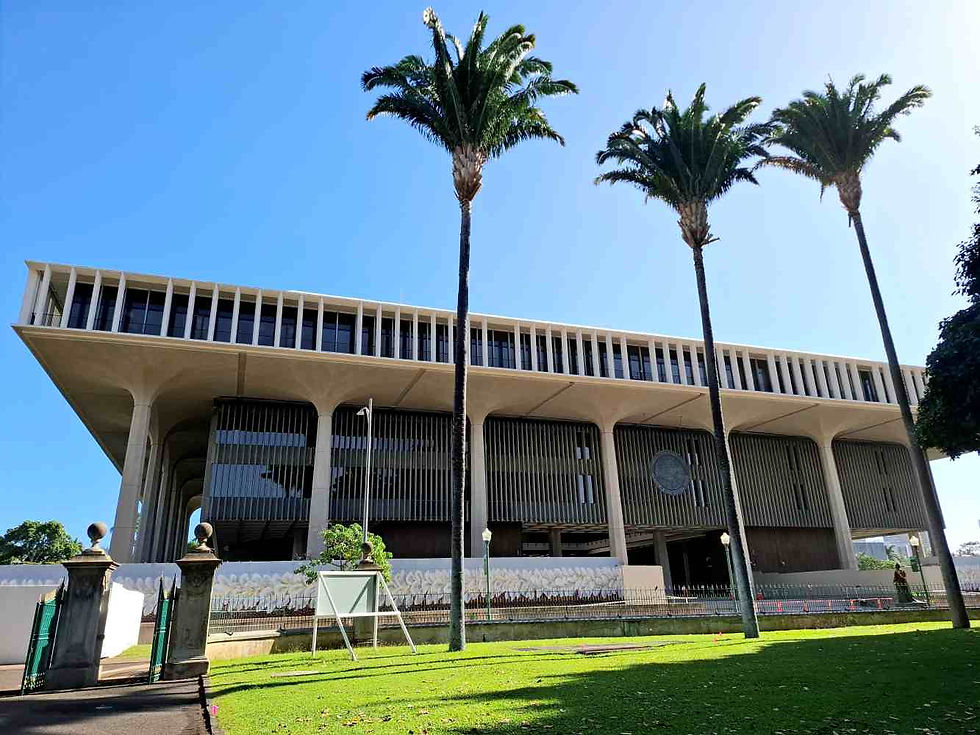
To the rear stands the Hawaiian State Capitol - a modern building that is filled with symbolism. For me, it looked 60s "futuristic". I wasn't swept away.
In front of the Old State Judicial Building (across from the palace) stands a famous statue of King Kamehameha, the unifier of Hawaii (except Kauai - it was too far away).

Continuing my wandering in the government district, next to Honolulu City Hall (also a well-designed building - California-Spanish in style), I found one of the original missions of Hawaii. It is maintained as an historical site. The simple buildings look out of place in modern Honolulu. The history of the place is so dark - I wondered why the Hawaiians hadn't chosen to burn it to the ground. Hawaiian culture was largely destroyed by American and European religious zealots.

Hawaiian Mission Houses: Historical Site and Archives
In a great irony, the Hawaiian Historical Society is located next to the site.
Having my fill of "old Honolulu" and government buildings, I was ready to see more of the modern city and hopefully take in a view of Waikiki Beach and Diamond Head (which are very far from the port area). My path took me near something called "the Aloha Monsters". I made a slight detour to see it.

Artist, Kevin Lyons.
On my walk-by I met a gaggle of Japanese tourists taking selfies and photos. I believe the location is "Instagram famous". I had to admit, the painting felt positive and whimsical.
I continued through an old warehouse district that is being converted to high-rises. It appeared to be part of the old port. Although I am not a fan of the newer buildings in Honolulu, the large footprint of the old, unused warehouses is a waste of space. If the city "must' build high rises, then that would be the best place to do it rather than create more urban sprawl.
Finally, I reached Ala Moana Boulevard which parallels the sea. I saw yachts and tour boats moored in the Kewalo Basin Harbor, part of the old port of Honolulu (where the passengers of the SS Minnow departed for their "three hour tour"). Finally, I reached Ala Moana Beach - a clean city beach with parking, showers, and lifeguards. Ala Moana is where locals come to enjoy the beach (especially with kids as it is waveless and sheltered) as opposed to the "for tourists only" Waikiki (with bigger waves).

After traversing the beach, I felt tired, but I was tantalizingly close to Magic Island, a city park that gives excellent views over Waikiki and Diamond Head. I realized I was never going to make it to Waikiki on foot (I was running out of energy anyway), so I pushed on to get the view.
From the end of the park - a small peninsula, beautifully maintained - I could see the high rises of Waikiki and far away Diamond Head. I had to admit, the scene was beautiful. When I returned to the ship, those passengers who traveled to Waikiki said it was absolutely beautiful (and extremely high end). I didn't regret missing it, though. I have seen many beaches lined with high rises in my lifetime.


February 2026
The counterpoint to the beach and park's beauty was, of course, the ever-present contingent of homeless people who camped out there. I was surprised how tidy even they appeared in that park.
My feet were tired and it was a long walk back to the ship. I considered taking a city bus, but I needed the exercise after four sea days. Hawaii's premier shopping mall was only a few steps away, Ala Moana Center, but I passed. In a city filled with Costcos and Walmarts, what could it possibly hold of interest? I was still in "America".
I arrived back to the ship tired, but satisfied I had seen a good chunk of the city. I elected not to explore further. I didn't think I would find anything more of interest (and my feet hurt).
Note: I elected not to see Pearl Harbor. Pearl Harbor is something that was definitive for the generation before mine, not for me. I lived and worked in Japan. The Japan I grew up with was not the Japan that attacked Pearl Harbor. A large portion of the ship's passengers were older than me - they almost all visited Pearl Harbor. The historical event that changed the world in my lifetime occurred in New York City, not Honolulu.
Final analysis;
I didn't like Honolulu. The old part was too run down and empty and the newer bits felt soulless. I am sure having such beautiful beaches and views at one's doorstep is quite amazing, but how long would that novelty last? Honolulu thrives on being the main port of entry for both cargo and tourists. The city exacts its pound of flesh from everyone and everything that enters. Above all I felt that Honolulu exists to squeeze money out of everyone - tourists and locals alike.
Some people bemoan the place as "paradise lost", but I wondered if those "wonderful years" to which locals refer ever existed in the first place?
I looked forward to visiting Kauai the following day.

Comments