Japan: notes of discovery

Prologue
I kept a journal of my first year in Japan. Although it does not cover all the trips I made while living there, it does record many of my experiences and impressions from the time I arrived in Tokyo until I started to feel more settled (and less inclined to write as everything "normalized" around me).
I had graduated from university with a Master's degree and uncertain job prospects. The US had just experienced a recession in 1981-82 and, although from 1984 onward "Reaganomics" started to have a positive impact, most people were graduating from university still worried about securing employment and starting life. Many of my friends were going abroad to teach English and Japan was a hot spot. I found a job posting (YCMA of Japan), interviewed in New York City, and got the job.
My life was about to change dramatically.
[additional explanatory notes in brackets]
August 1984 (Tokyo)
After many hassles with customs, I arrived in Japan. Haneda might as well have been in New Jersey. What industrial blight. I can't say my first impressions of Japan were wonderful.
[After Narita Airport was built, for a time, the Japanese government only allowed a handful of flights into Haneda. Air China (Taiwan) was one of them.]
Then, the monorail ride into Tokyo proper: why it was called a "monorail" was beyond me. It looked like any other train. We arrived at the next transfer point and took the JNR (National Railway) train to Mitaka. That is when Japan really started to unfold before my eyes. Houses were built literally on top of each other and neon seemed to be everywhere giving the whole evening scene a carnival atmosphere. It looked very dirty, but also spotless at the same time. When we passed through Shinjuku, I couldn't process the number of people and all the lights. I found it amazing that I could recall it later considering how severe my jet lag felt.
[The YMCA of Japan had a program that brought young Americans and Canadians to Japan to teach English in their "Conversation Schools" across the country. The YMCA Training Center was in Mitaka, outside of central Tokyo. A group of us arrived and spent a week in Mitaka getting prepared for life in Japan and our jobs]
Some time later we journeyed back to Shinjuku on a Sunday which turned out to be a big shopping day. There were easily a million other people milling around with us. That was my first big culture shock - PEOPLE. I had never seen so many in my life! Shinjuku was such a mixture of sights, sounds, and smells - most of the smells were bad, too. We saw gambling on the street, brothels, gay bars... everything (I thought). It was an "experience"...
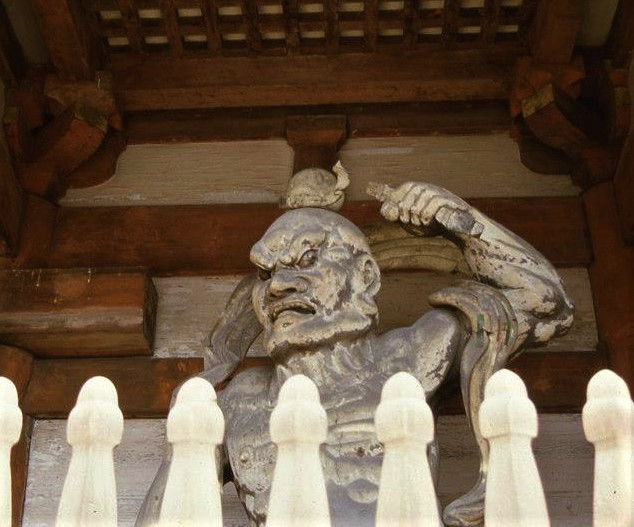
Then, the last day in Tokyo (for orientation and training), I went to Asakusa Temple with the group of new teachers. The entryway featured two large demonic-looking people.
[Nio-sama - temple guardians]
After passing through, we walked down a narrow shopping arcade filled with mostly souvenir junk. The temple complex was nice, but also confusing. We experienced so many new customs: fanning incense on oneself for luck, washing hands and drinking from special ladles, fortune-telling boxes. We had so many questions for our guides back at Mitaka afterward. Above all, the temple appeared to be as commercial as the surrounding area and not very religious-oriented.
Later that day, we trekked out to Ueno Park where we saw a shrine and visited the zoo. Memories of that visit included the famous lily-chocked pond around the shrine with its bright green water. It didn't appear very healthy. The zoo was also interesting - how strange to see "exotic" animals when I myself was in an exotic location (Japan). Seeing the North American animals was especially strange (e.g., raccoons in a zoo?).
I don't think I appreciated Ginza as much as I could have as I was so tired upon arrival. It looked like a fun place to explore some time later. After traveling around the city, Tokyo began to took the same everywhere. I still preferred Shinjuku. I decided to give Ginza another try some other time...
[At the end of the orientation, we were all dropped off randomly (alone) in a part of Tokyo and had to find our way back to Mitaka. It was like our graduation test for the program. It made sense: they were about to send many of us into the outback of Japan and they wanted to know if we would be OK]
September 1984 (Tokyo to Sendai)
The train ride from Tokyo Station to Omiya was incredibly long and boring. It seemed Tokyo would never end. Boarding the shinkansen was a breeze, but I was disappointed to find the seat did not recline. Tokyo continued to stretch on indefinitely, but gradually the scenery gave way to rice fields and eventually low hills. Then the train entered the mountains!
[The Tohoku Shinkansen (bullet train) had just opened a few months before my arrival. At first, it only went as far as Omiya on the northern edge of the Tokyo Metro Area]
The train literally exploded from one tunnel into the next. I caught fleeting images of lofty, clouded peaks and narrow river valleys. We blasted through the final ridge and entered the Sendai plain. I had arrived.
September 1984 (Sendai)
My first impressions of the city were that it was huge and its shopping streets ran on forever. That view later changed....
Aoba-jo
After a long walk we finally reached the summit of the castle hill with a gorgeous view of the Pacific and nearby mountains. There is a shrine as well, but it appears very new and polished. Outside of the views and the sagging old castle walls, the place was too touristy for my taste. We happened upon a wedding - my first view of one in Japan.
[The castle was just a short (steep) walk from my first house in Sendai. I didn't go often because it was hard to access and little more than a viewpoint over the city]
Osaki Hachiman Jinja
Many steps led us up to the torii and a crude stone path. The shrine itself was smaller than I expected, but it was so old and so well kept up I was impressed. One the whole, I found it a pleasant place...
[That old shrine ended up being my favorite in Sendai (and maybe Japan)]
Matsushima
The train ride from Sendai Station to Hon-Shiogama was not noteworthy. The train did pass through some rice fields which broke up the monotony (briefly). Shiogama did not look like a place worth visiting outside of its temple (or shrine?)
[many temples had been converted to shrines during the lead up to WWII. Sometimes the distinction between the two was blurred - especially for a newcomer]
to which I would like to return. The ride to Matsushima on the ferry was not as great as I expected, however, there were some interestingly shaped islands and trees along the way. I felt disappointed that Shiogama Harbor literally extends to the edge of Matsushima Bay and detracts greatly from the natural beauty. Nor was I impressed with the great amount of fishing in the area - there was hardly an open stretch of water anywhere. Matsushima itself was horribly touristy, like someone had put a part of San Francisco's Fisherman's Wharf in Japan. The historic places were well-kept, but located too close to the hustle and bustle of it all. An island connected by a toll walking bridge was nice to explore and it had some very comical swans. The island has a tower for viewing, but it looked like just another tourist rip off. We didn't have a enough time to see everything, so another trip was already in order. At least the train ride between Matsushima and Shiogama was pleasant on the return.
[Matsushima Bay is one of the "three best views" in Japan. For most Japanese, Sendai = Matsushima]
Zuihoden
After a rather impressive walk through some towering cedars and up a flight of colossal stairs, I was faced with a 500 yen entry fee. Fortunately, it was closing time and a kind old guy working there let me go up and have a quick look. It was all just restored from wartime destruction, so it looked great. However, it looked "too new" for my taste (considering how old the site is). I preferred the trees of the entrance. The style of the structure (a tomb) appears almost baroque - I wasn't overly impressed.
Zuihoji
Just below Zuihoden is an interesting temple that I walked around. It is still in active use, too. Some major construction was going on around it - I decided to return at a later time.
[The Mausoleum of the Date Clan who ruled over Sendai was lost to WWII bombing and the subsequent fires. They had been rebuilt fairly recently]
Sakunami
After a long tunnel ride out of the city, we emerged into the mountains. As we traveled west, the rice fields grew smaller and smaller and the mountains appeared taller. I was spellbound by the changing scenery and felt in awe of the gorges of the Hirose River as we passed through them. The town officially begins at Kamakurayama, a striking bald mountain radically different from the rest. I was amazed to see that most of the mountains were forested with second-growth trees, all arranged in neat rows. The mountains to the west loomed ever larger and then I realized Sakunami was really only their beginning.
[Sakunami Onsen is a hot spring resort close to Sendai. Due to its proximity it is a focal point for locals traveling into the mountains]
Zao-san
The day was gorgeous for my first journey into Japan's rocky interior. The traffic plagued us all day, yet did not deter from a good time. We drove south from Sendai to get on the Tohoku Expressway. The drive on that road alone was incredible. The mountain views were spectacular - it reminded me of Puerto Rico as the mountains were forested yet maintained their volcanic severity. We exited the highway to pass through endless rice paddies with Mt Zao looming ever before us. Finally, we turned off the main road and onto a narrower one. The "Zao Echo Line" passed through a large torii gate and crossed a bridge. The journey upward had begun.
We snaked and slithered our way through the mountains making a brief stop to see "White String Falls" (in excess of 300 ft high). It looked so graceful and beautiful. The higher we ascended the more crazy the angles of the road became. Before we reached the summit, we passed through volcanic tablelands that betrayed the long ascent. Some of the lava flows were so vast that hotels had been built on them. We finally reached the highest point via road, parked, and walked to a chairlift for the remainder of the journey.
The very top of the mountain was already showing fall colors and held a strange mixture of shrubbery and volcanic aftermath. At the top of the chairlift, a short walk took us to the crater lake a few hundred feet below. The colors of the volcanic rock as well as the green hues of the lake were gorgeous. Mt Zao has two summits - we chose the lesser one which sports a shrine with a great view. The higher summit is farther away and in the cold, thin mountain air seemed too far to walk. Our stay on the roof of Japan was wonderful.
We continued our journey downward on the Yamagata side of the mountain with a brief stop at a ryokan
[A ryokan is a traditional Japanese inn which focuses on hospitality: a good evening meal and a typical Japanese breakfast. They are expensive, but staying in one is a true Japanese experience]
with a pond filled with trout. The descent took us through terraced rice fields which were being harvested (in "Yamagata style" rather than "Miyagi style"). We passed through Kaminoyama and saw its small castle in the distance. Finally we turned toward Yamagata-city on the way home.
Yamagata is a small, prefectural capital that appeared very backward compared to Sendai to say the least. There are even rice fields in its small downtown. The city is located right beside the mountains - very scenic.
Our journey back took us through the Sayayama Tunnel (very long) and more mountain scenery. The last stop of the day was at Akiu Falls (Miyagi). Although it was already getting dark, we poked our way along the entry path by flashlight and arrived at the overlook where I saw a lovely mountain waterfall in the fading light.
We fought out way back to the city through heavy traffic. All of us felt tired after a long day of exploring
[The Zao Massif is a large volcano that separates Miyagi and Yamagata Prefectures. The mountain top is part of a national park and some of the best skiing in the area is located there. Numerous hot springs dot its slopes. Traveling up and down Mt Zao is part of living in Sendai (or Yamagata). The only way to the summit is by car and the road is often filled with cars stuck in hours-long traffic jams. By the time I left Sendai, I refused to visit the place on weekends for that reason]
October 1984 (Sendai)
Rinnoji Garden
After a long walk from Osaki Hachiman, we arrived at the entrance to the temple. It had a typical "entry through a row of cedars". At the top of the stairs we found a funeral in progress. It looked interesting, but as it was not the time nor the place to ask questions, we continued around to the rear of the temple. Alongside the main hall was a continuation of the cemetery that seemed to stretch from Tohoku University Medical School the whole way to the small hill on which Rinnoji was located (quite a distance).
The gardens there were quaint, but the water was drained from the pond. It wasn't as beautiful as it could have been. Apparently in the fall when the leaves change color, it is supposed to be great.
[The most beautiful traditional garden in Sendai, I did not visit Rinnoji often, but I made sure to take visitors there]
Kokuzodo
After finally seeing all of Zuihoden (it wasn't much better the second visit), we leisurely walked down the opposite side of the hill to the main road which led us to a temple. The whole area sits atop a cliff along the Hirose River. Kokuzodo was slightly difficult to find and after a few failed attempts (which led us by some lovely homes), we finally found the temple complex. The buildings themselves are old, but I didn't find them interesting. The views, however, were breathtaking and, in some ways, surpass even the castle hill. Even though it is not as high, the vistas of the mountains are unobstructed. The walk down to the main road took us down a very long staircase that we felt happy we didn't have to climb.
[Sendai was built amongst some hills (generally not built up) and inside those forested patches were often hidden some amazing old temples and shrines]
October 1984 (Yamadera, Yamagata)
This place was the best so far. The train ride through the mountains beyond Sakunami was breathtaking. Yamadera is just on the other side of the tunnel that goes between Miyagi and Yamagata and the city of Yamagata is not too much farther down the river valley.
The little town is quaint and touristy. After walking across the river and up some steps, one finds an entrance to the temple. That area is of limited interest with yet more touristy stuff. After paying (200 yen), visitors start their ascent up more than 1000 stairs through towering cedars. To the left and right stand small, eroded Buddhas and gravestones adding an ancient feel to the walk. Just when my energy reserves were nearly depleted (I felt almost dead), the main entrance for the complex came into view.
The paths split upon entry: the center one leads to the main buildings which were a let down after such a great build up. The other path leads to a small viewing pavilion with the best viewpoint of all the buildings. Continuing on from the viewing pavilion there is a rough path up the mountain to the best outlook - one can see from the dividing range of Honshu down the valley to Yamagata-city. The town below is surrounded by rice paddies that look like a patchwork quilt.
To the right of the main entrance are paths that lead to "Buddhist treehouses" (small temples perched on the edge of the rocks). Traveling on from there is another overlook but not as impressive as the one to the left.
[Yamadera ended up being one of my most favorite locations in Japan and I visited frequently. Japan's most famous Haiku Poet, Matsuo Basho, wrote a poem about the place that all Japanese children learn in school]
October 1984 (Sendai)
Matsushima
After repeating some of the things I did on the first visit, we went to Oshima Island - by far the best of all the islands close to shore. It holds caves with Buddha images and is off the main tourist track so there are fewer people. Shintomiyama is a well-hidden viewpoint and after a few false starts, we finally arrived to see an excellent view over the entire bay. A small platform was even constructed to allow visitors to see over the treetops.
Back in town, Zuiganji was beautiful with the usual towering cedars surrounding it. Some caves and religious images are carved into the surrounding rocks. The thatched-roof houses in the complex give a good taste of "old Japan" (even if they are just tourist shops selling "junk").
Okunikkawa
After an unusually crowded train ride on the Senzan line
[the main train line between Sendai and Yamagata. I frequently rode that train],
we disembarked at a tiny mountain village. Our group walked down a dirt road and then descended into the river valley. The foliage was, of course, spectacular and the footpath to the riverbed a marvel in itself (it was quite old). When we reached the river, we crossed on a very unsteady looking bridge and started on another path that paralleled the river. The path alternated between following the gravelly river bed or using small ledges that had been cut into the rock. I was impressed.
About one mile later we arrived at the place where I would experience my first Imonikai (lit. potato party). The food was OK and the company ranged from one pompous ass who wanted to argue about everything to a very sweet young woman majoring in English Literature. The traditional stew that was made in a metal pot (that we brought with us) certainly had too much of a build up for me - it tasted like any other stew I had eaten in my life. Additionally, it featured my dread enemy food, Konyaku!
[Konnyaku is virtually flavorless on its own, acting as a neutral, gelatinous, and rubbery ingredient that absorbs the flavors of the dishes it is cooked in, such as broths, soy sauce, or miso. Known for its bouncy, chewy texture, it is often described as having a cartilage-like or firm jelly consistency]
[A traditional outdoor party, an Imonikai was something groups of co-workers and friends did in the fall during the last warm days when the trees still had some color. The first one was an adventure, but after attending them repeatedly - I became bored. As noted the actual stew that was cooked was extremely unremarkable. It was one of the first examples for me of how doing the same thing over and over again in Japan took something fun and rendered it "boring"]
October 1984 (Yamadera, Yamagata)
On what was unquestionably the best time and the best day to visit, we saw Yamadera at peak colors in the fall. The view was beyond description...
November 1984 (Misawa, Aomori)
Sendai to Misawa
As the shinkansen pulled out of Sendai Station, I could see the mountains all the way to Zao. They were already snowcapped. The mountains stayed in view for a long time and eventually gave way to a different set of mountains (also snow-covered). We passed rice fields and valleys as we burst through tunnels - all showing fall colors. Then we arrived in Morioka.
Behind the city loomed a huge volcano that was obscured in cloud even on an otherwise clear day. It looked like a small Mt Fuji in a way.. After Morioka the ride deteriorated quickly because we had transferred to an old style train following the old, curving tracks. It wasn't until just before Hachinohe that the ride became pleasant again as we passed mountains with some spectacular cliffs.
Hachinohe itself looked like a dump and Misawa was just a small, country station.
Misawa Town
Nothing to scream about as a town, Misawa is also in the middle of nowhere - the train station is out of the way, too. Anyway, the place has one attraction, a US Airforce base. I am not a huge supporter of US military presence abroad, yet I had to admit it felt nice to "go home" for a few days while staying on base with the parents of a Georgetown friend who were stationed there. The officers' club, the BX, and the commissary all felt too good to be true. I ate doritos!
Those people living on base were very "down home" types and rarely went outside. I am not sure I could have lived there, but a short visit was great. The base itself looked a lot like Roosevelt Roads in Puerto Rico: twisty roads through low hills with lots of brush on either side. The very large Lake Ogawara was beautiful (mostly inside the military zone). It looked like it would be a fun place to return in summer.
[Georgetown friend Tim C.'s parents were stationed at Misawa AFB where his father had a job as a civilian contractor. Tim had visited Japan and encouraged me to look up his parents. Given my initial culture shock was severe, I was happy to meet some other Americans. I ended up returning many times and was shown great courtesy and hospitality by Tim's parents. Finally, they left Japan, and I made one final visit after they were gone staying with friends of theirs. By that time, I no longer needed to go on base as I had made my peace with living in Japan.]
Oirase River/Lake Towada
My friend's father graciously took me on a long drive off-base to a famous river valley and lake near Misawa. The drive there was dull at the outset - not much to see except the short Towada railway line with its tiny stations. The town of Towada certainly was nondescript despite its association with one of the most beautiful places in the region.
After leaving Towada town, we rapidly entered low, rolling hills on either side of the Oirase River. The river is rock-strewn and cuts through rice fields on either side right up to the base of the hills. The valley slowly narrows as the mountains draw near. Finally, all that is left are cliffs and the river itself with barely any space for the road. The last few kilometers were the best - the leaves changing color, waterfalls, green ferns and mosses, and the swift flow of the river water.
After the river valley (it started to rain), we burst upon Lake Towada (source of the river), covered in mist. It was gorgeous. The lake is so large it looks like an ocean surrounded by mountains. We drove along the coast catching glimpses of rocky promontories into the clear water that appeared to float in the mist. Then the road starts a series of switchbacks to a point where the lake can be seen in its entirety. Even in the rain, it was lovely.
The drive to the other side of the lake was just as beautiful - I even saw a few fields in a valley adjacent to the lake (surprising because at times there seemed to be barely enough room for the road itself). On the other side, the road passes behind the small peninsula/island that juts into the lake. It is severe looking with huge cliffs. The view from the tourist area nearby is superb as the entire lake can be seen along with some snowcapped mountains in the distance (luckily the rain and the mist had passed). Rather than Japan, I thought I had been dropped into Switzerland.
[Lake Towada is the deepest lake in Japan and the main tourist attraction in Aomori Prefecture (similar to Matsushima for Sendai). The Hirose River valley is part of the same national park complex]
November 1984 (Sendai)
Sakunami Onsen
After entering a dull, concrete building, I was surprised to find the interior was actually lovely with a view of the river valley below. We paid for the spa and then walked through a jigsaw of corridors and buildings ending in a long set of enclosed wooden stairs leading to the spring. Just above the spring at the foot of the stairs was a changing room - one for men and one for women. After stripping down, we proceeded to one of the four pools available for day use. They were built into the cliff, so they were covered from the elements and gave a magnificent view of the gorge below. It must be fantastic in the snow. Needless to say, it felt wonderful.
[Hot spring bathing is an important part of Japanese culture. Luckily for me, I got into it right away. Experiencing "onsen" all over the country is one of the best memories I retain of Japan]
Toshogu Shrine
After a bike ride through a little-known part of town (much like everywhere else except I noted TWO pet shops in close proximity), I arrived at the shrine. As such places go, it was quite nice. Although the building is old, the gilt edges appeared "fresh" providing a great contrast to the old, dark wood. The inner doors were beautiful. Unfortunately, it was mostly closed up and I could manage only limited views. I needed to return when more was open.
November 1984 (Tokyo)
Once again I found myself in the capital city. The train ride seemed less majestic than I first recalled, but it was still beautiful. The relay train from Omiya to Ueno was an experience in itself, but as of the following March, that would no longer be a problem and the shinkansen was scheduled to enter directly to Ueno Station. The Washington Shinjuku Hotel was nice and, although expensive, I would stay again. Its ultra-modern rooms were great even if they were small. I was attending the JALT (Japan Association of Language Teachers) Conference at Tokai University.
The university was a dump. What a place to call a "school"! I also walked through some of the infamous "seedier" parts of Shinjuku (my curiosity was satisfied) as well as the neighborhood favored by Tokyo's young people, Harajuku - definitely an interesting place. I visited the Meiji Shrine, but what made the place worth the stop was the nearby park (Meiji Jingu Gyoen). It was so near the high-rises of Shinjuku that it reminded me of Central Park in New York.
The rest of the trip was enjoyable, but nothing out of the ordinary (except I had my first experience with "subway packers')
[I purposely avoided going to Tokyo often mainly because it was an expensive place for a casual visit. I had the entire region of Tohoku at my feet in Sendai and I was rapidly learning how beautiful it was]
December 1984 (Sendai)
Kokubunji Yakushido
A once large temple complex, I thought it was sad they never tried for more of a reconstruction. The temple (what's left) is dull and not much remains but a very old gate. The place must have been something in its time.
[The oldest temple complex in Sendai (largely in ruin), it was my first "very old" place I visited in Japan. The place was established in the 8th century, although its remaining buildings were largely from later periods]
Tsutsujigaoka Park
The difficult-to-pronounce park was beautiful and held more temples than Rinnoji. The park itself was lovely for me only if because it was the largest open lawn I had seen in Sendai. The views over the city were excellent, too. I decided to go back for a picnic in the spring (it is famous for azaleas as the name means "Azalea Hill")
December 1984 (Pacific Ocean off Honshu)
[I started my time in Sendai at the same time as a colleague/friend from Georgetown had been invited for a teacher exchange at Hiroshima University. He begged me to come visit and twisted my arm into flying to Hong Kong with him. I had to travel there the cheapest way possible]
Getting to Sendai Ferry Terminal was much easier than expected. I arrived more than an hour before departure, so I had a lot of time to kill. For some reason it reminded me of the many Greyhound Terminals I had seen on the way to California the year before. The day was overcast, but it appeared that the boat was moving into clear weather. The coast was pretty - I guessed we were traveling about 2-3 miles offshore. It was NOT spectacular.
Economy class was a great deal. I had the whole space to myself (and fellow passengers avoided being near a "gaijin" - foreigner - anyway). The ferry had TVs, video games, and in general, a lot of space to roam. I felt like I was taking a cruise on a beat-up, old ship for a fraction of the cost. I took seasick medicine, but still felt a little queasy If I did it again, I think I would prefer to be with a friend.
[The ferry service from Sendai to Nagoya was a cheap (but slow) way to travel to points in Japan beyond Tokyo. Just arriving in Tokyo and changing trains and leaving was a confusing and time-consuming process. I took the ferry several times in my travels around Japan - once in heavy seas which made me incredibly sea sick]
December 1984 (Nagoya, Aichi)
Entering Nagoya Harbor, my first impression was how huge its bay is. It took the ship more than one hour just to pass through the lines of shipyards and factories. After passing under a suspension bridge (interesting design - looked new), the ship finally docked.
I felt proud of myself that I could actually find the way to Nagoya Station on my own! A bus to the subway, and then I stopped at Nagoya Castle. Being my first castle in Japan, I was very impressed. The interior was a museum (rather boring), but the view of the city from the top was excellent.
[Japanese castles have not fared well historically. Many were destroyed during the Meiji Restoration (which took power from the local warlords and gave it back to the Emperor) and what remained were lost in WWII bombings. Nagoya Castle is a faithful reproduction (in concrete)]
December 1984 (Nagoya to Osaka)
The ride was beautiful, but Nagoya Station was the worst yet - so difficult to navigate due to its size. On departing I even caught a brief glimpse of Mt Fuji! I got my first impression of Kyoto as the train passed through. Too brief to make any comment, it looked much like any other city in Japan from the train.
MA met me at the train station in Osaka.
[Georgetown bestie, MA, was the one who actually recommended I look for jobs in Japan. Ironically, I landed one officially before she did. She ended up in Takarazuka near both Osaka and Kyoto. It was great to catch up with an old friend - we had a lot to talk about. We visited a few more times during my stay and she came to Sendai once to visit as well]
December 1984 (Osaka)
A huge city - after seeing Tokyo everyone thinks that the rest of the cities in Japan have to be smaller, but, in fact, Tokyo is not that much bigger. Perhaps in population and urban sprawl Tokyo is the largest, but as a city, Osaka has one main business district and one big nightlife area as opposed to Tokyo which has many. Osaka felt massive.
Osaka Castle appeared identical to the one in Nagoya, but perhaps the one in Osaka was a little more ornate. The view from the top was also beautiful, but the weather was extremely cold on our visit. Namba, the nightlife neighborhood, was the best I had seen in Japan to that point. That made Osaka feel much more livable than I ever thought it would be. I decided I needed to visit again - the city had so much more than I expected.
December 1984 [Osaka - Hong Kong - Osaka]
[see: Hong Kong - first trip]
I was traveling with Bill C who was on a one year teacher's exchange in Hiroshima University. We returned to Osaka from Hong Kong and immediately left for Kyoto (just a short train ride away)
December 1984 (Kyoto)
Day One
Kyoto was truly what everyone said it was - sensory overload. After two days there, I wasn't sure if I could bear seeing another temple or shrine as long as I lived. We missed out on Nijo Castle and the Imperial Palace because of the upcoming New Year holiday. They were both sadly closed. The other temples and shrines, however, were all open.
We stopped at Nishi and Higashi Honganji, both huge temple complexes. The building sizes were astonishing - one held over 170 tatami mats.
[Tatami mats are traditional Japanese flooring and meant to be sat upon directly. Walking with shoes on tatami is almost an unpardonable transgression in Japan. They are also used as informal measurements of rooms]
As they were the first temples we saw, we found them especially impressive. Next, we saw Toji - the tallest pagoda in Japan set in a large temple complex. I found it dull although Bill and his friend from Australia (who had joined us) liked it a lot.
After that, we visited Kiyomizudera. Famous for its hillside location and being built on stilts, the temple was also a letdown for me. In actuality, the temple and setting were very beautiful, but after such a huge build up, it did not meet expectations (also parts were under renovation which was a shame). The streets leading to the temple were lined with shops that sold every Japanese handicraft under the sun. Some were extremely colorful.
We exited the complex down a different street past many temples, large and small. That led us to another pagoda famous for the view over the city and its huge image of Kannon (a memorial to unknown soldiers).
[Kannon (Avalokitesvara) is one of the main Buddhist deities in Japan. The image appears everywhere: Avalokiteśvara is the Mahayana Buddhist Bodhisattva of Infinite Compassion, embodying the desire to alleviate the suffering of all beings and postponing their own Buddhahood to do so]
We continued to Chion-en, a huge temple complex. We explored the interior and walked its famous "nightingale floors" (the ultimate in squeaky flooring).
[The Nightengale Flooring was constructed so that intruders could be heard in advance upon entering a palace or castle. Hence the Ninja's careful way of walking to avoid make a sound].
The last place we stopped was the Heian Shrine, which looked so out of place to me (due to its bright orange color). It was so "Chinese".
And that ended Day 1.
Day 2
We started with Ninnoji. For me, it was the best temple complex I had seen in Japan. The place is old, beautiful, huge, and (most importantly) not crowded at all. Just out of range of the tourist masses, it was largely overlooked. Additionally, the place is full of cherry trees - I thought it must be gorgeous in the spring.
Next stop was Ryoanji (a huge disappointment) with its famous rock garden that is raked into a different pattern each day. The garden is a place of meditation for the monks and has become world famous. It is so small, I couldn't believe it - nothing like the photos (which make it look vast). The grounds of the temple complex, however, are absolutely gorgeous. I would return to see the temple area (and skip the rock garden).
The last temple we saw in that area was Ginkakuji (the Silver Temple). The building was very small and looked worse for wear. It is partially silver-leafed (very worn). HOWEVER, the sun happened to be shining on it directly and it appeared dazzling. Had we not seen it in such ideal conditions, I am not sure I would have liked it as much.
We caught up with MA and headed off to Mt Hiei. It felt hard to believe that a short train/cable car ride would put us on the roof of Kyoto so quickly. The weather was cold but the views over Kyoto and nearby Lake Biwa were stunning. We even saw a few skiers on small ski run at the top! It made for the perfect ending to a whirlwind tour of the city.
[I did not visit Kyoto many times mainly because I became increasingly drawn to rural Japan and nature. Overall, I found the city to be a fascinating place to visit with its long history, but not much more. For me it was still a modern city with only a few old streets and a lot of old temples and shrines. Kyoto overall appeared modern - end of story. It is nothing like an old European city with a preserved historic center]
December 1984 - January 1985 (Hiroshima)
the city
The first day in Hiroshima was partly recovery from the trip to Hong Kong (and Kyoto) and getting a sense of what I might want to see. First and foremost, I took the tram to the Atomic Dome. Riding Hiroshima's streetcars was like a trip back in time. I liked them (although they made slow progress through the city). The dome was impressive, but not as awe-inspiring as I anticipated. The rest of the Peace Park was very nice, but "modern". I appreciated traditional gardens much more. The statue of "Mother and Children in the Tempest" was extremely moving. Most unfortunately, due to the New Year Holiday the Museum was closed. Walking around the park was OK, but I felt a little disappointed. The iconic view from the Peace Flame was marred by construction (of course, always my luck).
The city's castle was just OK - not as nice as Osaka or Nagoya, but the sun was setting and I took in some great views of the sky reflected on the moat with both black and white swans. The adjacent park was pleasant with a lot of open space. The park connected to a river walk.
Hiroshima on the whole was very nice - the city is surrounded by mountains. As it is built on a delta, Hiroshima has a LOT of bridges. On the way back to Bill's place, I stopped at Toshogu Shrine (not so interesting), but from there I found a way up to the Peace Pagoda. The climb was long and steep, and it gave a beautiful view over the city and the Inland Sea. On the return, I got lost a bit, but I finally found Bill's apartment again.
Downtown Hiroshima seemed chopped up to me. I saw no long shopping arcades, only many short ones. It was quite different from Sendai. I visited the port where ferries departed every few minutes for different islands in the Inland Sea as well as another main island, Shikoku. I kept that transportation option in mind for future travels. The Inland Sea was gorgeous. Finally, I visited Hijiyama Park (supposedly wonderful) and found it just ok. There were at least some more good views over the city.
All in all, Hiroshima is as faceless as most Japanese cities, yet does hold a unique charm (beyond the Atomic Memorial Museum).
Miyajima
On a day that threatened rain, we headed to the port. We boarded the "Galaxy", an "exclusive" ferry to the island. The rain clouds cleared and low clouds and mists lingered on all the mountains and islands. The scene was breathtaking. The Inland Sea looks more like a series of submerged mountains sticking up out of the water between Honshu and Shikoku. For me, it had a Caribbean feel rather than Japan. The boat ride (cold) was pleasant.
Miyajima is a gorgeous island of itself. The lesser shrines aren't that exciting, yet it is clear they are tremendously old. The torii on the water - the symbol of Miyajima - was everything I imagined it would be. The tide was out and I walked out to it on sand and gravel. The shrine nearby (Itsukushiima) was just so-so but is greatly enhanced by the surroundings. Additionally, it is built on piles driven into the water so it appears to be "floating" at high tide. While at the shrine we were lucky enough to see a Noh performance (they are quite famous there). The costumes and masks were amazing.
[Noh is a traditional Japanese theatrical form that is highly stylized without a great deal of action]
We walked up a path to a cable car (Japanese: "ropeway") through a lovely park. I thought it must be beautiful in the spring and fall. The cable car ride was exciting and the gave breathtaking views of the Inland Sea. It was definitely worth the effort to get to the station. The top gave views over the sea as far as Shikoku. There we had our first encounter with the island's famous monkeys (they looked ugly). I continued to the very top of the island for the view, but it was partially obscured by clouds - still breathtaking.
Miyajima felt very much like "Japan". In spite of the crowds who visit, the place has mountain and sea, shrine and temple, and crowds and solitude.
I definitely wanted to return.
[Miyajima is another of the "Three Best Views of Japan" - along with Matsushima. I thought Miyajima was far more scenic. The Inland Sea (Setonaikai) is the water between Honshu, Shikoku, and Kyushu. It was among the most beautiful places I visited in Japan]
January 1985 (Hiroshima - Tokyo, shinkansen)
The ride was not as great as I expected, yet it was satisfying passing through another part of Japan. I think what struck me most was how much more populated that part of the country was than in the north. The ride between Hiroshima and Osaka might as well have been one tunnel - I only had brief glimpses of mountains and the Inland Sea.
Osaka to Kyoto was very dull - flat with endless buildings.
Kyoto to Nagoya, however, was a spectacular ride and after Nagoya, the Fuji-Hakone area was downright gorgeous. Mt Fuji even showed itself as we passed, my second time to see it from the train - I was extremely impressed. Fuji is one of those mountains that draws people to it; it is hard to describe.
[Mt Fuji is not only a nearly-perfect cone, but it also rises from a plain with few other mountains obscuring the view. Add to that, it is the tallest mountain in Japan at 3776m]
January 1985 (Tokyo)
I met my friend Kenji and we headed to Yurakucho to see the latest Godzilla movie. Not only was it great to see a Godzilla film in Tokyo, but we were watching it in a building that actually got destroyed in the movie!
[We saw the Japanese 1985 film (Return of Godzilla) which was a darker remake of the original]
January 1985 (Yokohama, Kanagawa)
the city
After meeting Ron and Barb C (fellow YMCA teachers with whom I arrived), I had three full days in the Yokohama area. First, I went to the city itself. The weather was beautiful, but I wasn't impressed. The famous Chinatown didn't appear all that different from the rest of the city since all the signage looked the same (for me - not for Japanese). Additionally, it was hard for me to know at a glance who was Japanese and who was Chinese. The Marine Tower gives an excellent view over the harbor and city, although Fuji was not visible (sadly). The waterfront park, Yamashita, and the nearby Silk Center were a pleasant diversion, but not really worth a special trip. Overall, Yokohama did not seem different from any other place in Japan.
Miura Peninsula and Jogashima
After some confusion over how to get there, I took a train to Misaki-guchi through the urban sprawl of Yokohama and Yokosuka Ports. The ride was OK, and the end of the line deposited me in a place where I was sure they grew all the daikon (radishes) in Japan. I had never seen so many.
I arrived in Jogashima (by bus) after navigating a traffic jam on a winding road to the very tip of the peninsula. The island itself was nothing that special, but I happened to arrive at sunset and the view was incredible. I saw some incredible lava flows into the ocean - very out of place. I was lucky enough to hit the perfect time of day to visit. Although it was touristy (and "near" Tokyo/Yokohama), it still felt tranquil. I found it hard to believe that a city of millions was only a 40 minute ride away.
Shonan and Enoshima Island
Once again I met Kenji at the Ofuna Station, the terminus of the Keihin-Tohoku Line, coming from Tokyo. From there we transferred to a monorail (at Ofuna there was a HUGE statue of Kannon) which dropped us at Enoshima. The island has two shrines - one on shore and one on the island itself (connected by a footbridge). The beaches were a little dirty, but acceptable. That was where millions of people from the Tokyo/Yokohama metro area head to the beach in the summer.
After gorging myself at Wendy's in Enoshima, we rode the tiny Enoden line along the sea (very scenic in parts). We alighted at Hase Station to see the famous Daibutsu (Big Buddha) of Kamakura along with another temple which has some caves and a huge, wooden statue of Kannon. It was all very good except for the crowds. The Daibutsu was NOT a letdown - it was everything I anticipated. We even went inside the statue (unexpected, very interesting). The sun was brilliant that day and made the statue look great. After that we walked the path to the main shrine of Kamakura at the end of a cherry tree-lined boulevard. The place was mobbed and the focal point shrine wasn't that great. Likely I would have enjoyed it more if I hadn't been so tired after all the traveling and in sensory overload after seeing so many temples and shrines.
[The Big Buddha of Kamakura is iconic for Japan. I kept in mind during the visit that it had once been housed in a huge building that was swept away by a tidal wave (leaving the statue intact). The statue is far from the sea. It was a sobering thought]
January 1985 (Yokohama to Sendai)
The ride from Yokohama to Ueno Station filled me with the usual terror of "will I miss my train?" The ride did give a lovely view of Mt Fuji on the way around Kawasaki. The ride to Sendai from Ueno on the Joban Line was long and uncomfortable overall. It is the old coastal line that predates the shinkansen. Once we left the Tokyo metro area the scenery was beautiful, but the train ride only provided glimpses of the sea (I thought it would be right along the shore). It really was not worth the discomfort of it all. I did see some great beaches that looked worth exploring the in summer months (if I could figure out how to get to them).
[The Joban Line was closed from 2011-2020 due to the aftereffects of the tsunami and the Fukushima Power Plant meltdown]
January 1985 (Iwamatsu Ryokan, Sakunami)
After leaving Sendai on a cold, sunny day and arriving to Sakunami in the midst of a snowstorm, I felt surprised to say the least! I met the other YMCA staff there and we were off. Being at the Iwamatsu Onsen in the snow is the perfect time: naked, outside, in a hot tub. What a mixture of sensations! The water felt more bearable (not so hot) on that visit as well...
January 1985 (Misawa, Aomori)
I returned to Misawa AFB for some R & R. There was a LOT of snow, so there was no sightseeing. I planned to stop in Morioka on the return trip, but could not as it was snowing heavily.
February 1985 (Yonezawa, Yamagata)
After a boring ride on the Tohoku Expressway (far less spectacular than the train ride), we arrived at the exit for Yonezawa (right before Fukushima City). The entry into the mountains was both spectacular and abrupt. The skiing was a complete disaster (my first attempt), but it was a cool, crisp day out on the slope. The wind created wisps of snow among the mountain peaks - I could have been in Switzerland.
[Working at the YMCA of Japan had some perks. One of the main ones in winter was ski instruction. I got reduced (or free) trips to many great ski resorts. I took full advantage of it]
March 1985 (Yamagata)
Yamagata City
The day was exquisite and I looked out the train window the entire journey. If I could have, I would have stopped in Yamadera - it looked so beautiful! After arriving at the anti-climactic Yamagata Station, I proceeded to the old castle grounds. It is mostly just walls and a moat, but does create a lovely urban park. Unfortunately, it is marred by the new sports center - yuck.
The jewel of the park is the Meiji-era hospital build by a German who practiced medicine there. The building was strange because to move from room to room required exiting the building! In the center, there was a nice courtyard - I thought it must be lovely when the flowers are blooming. The building is a museum and wasn't that exciting. In fact, some of the medical exhibits are extremely graphic (too much for my taste).
I set out into the city and it appeared like any other except for the number of remaining Meiji-era buildings. The temples and shrines were not noteworthy. I attempted to located a Heian Era (extremely old) gate, but completely missed it. Maybe it was so understated that I did see it and didn't realize.
I hopped on the train to Kaminoyama.
Kaminoyama
The train from Yamagata to Kaminoyama was spectacular - the ride is totally dominated by Mt Zao whose peak was covered in white. In the city itself there isn't too much besides the reconstructed castle (nice enough, but the museum was strange) and an onsen. Since I had no money for a day pass for the hot spring, I walked around the castle and then wandered in the town. It was a sleepy kind of place and I actually liked it. Sadly, due to no returning train when I was ready, I ended up with too much time there. I even saw some thatched-roof homes from the samurai era, but I was disappointed that they had been "modernized". A heritage home with a TV antenna sticking out of a thatched roof was too discordant for me. On the whole, though, I did enjoy the time in Kaminoyama.
March 30 - April 9, 1985 (The first trip to Kyushu)
The notes of the first trip to Kyushu have been appended to the end of that post.
[See: the first trip]
March 1985 (Fukushima/Yamagata)
Fukushima City
Although it was only cloudy in Sendai, by the time I reached Fukushima City it was raining (yuck). I made for the mountain park in town to see some famous carved buddhas. The place turned out to be quite interesting - a series of a few hundred Buddhist icons carved into the cliffs. In spite of the rain, it was an amazing find. The entire mountain park looked worthy of further exploration (in better weather). It certainly made for a nice place to walk around in the middle of the city. Otherwise, Fukushima looked like an average Japanese city.
Fukushima to Yonezawa (train)
Snow was still visible in the high mountains, I was surprised since the weather on the plains had warmed considerably. The Ou Main line goes through a series of switchbacks through the mountains - a very unique train experience. The poor weather was disappointing; I was certain in clear weather it would have been gorgeous. Some of the drops from the train line were severe!
Yonezawa, Yamagata
The weather continued to be cold and wet, so that didn't give me a great first impression of the town. The castle ruins covered only a small area (still snow-covered). Given better circumstances (and weather), it might have been enjoyable; however, it felt like a lot of effort to reach a place with little to see. Such were the risks of travel to unknown places with little information.
April 1985 (Tokyo)
The first weekend of Golden Week, I set off for Tokyo.
[Golden Week is a series of holidays in Japan all near each other. Many people end up taking the entire week off work and travel. It is a very busy time across the country.]
Tokyo Disneyland
The first day (Saturday), I went to Disneyland (on the outskirts of Tokyo). Luckily, it rained prior to my arrival which kept the usual crowds away. I saw everything and rode the rides I wanted with minimal waiting. Honestly, I can't say I was impressed - maybe it is an experience that should not be done solo. The highly-touted Space Mountain was really a letdown. I had expected far too much. The Haunted Mansion was impressive, and it was funny to see a lot of very "American" stuff translated into Japanese. I didn't see Mickey Mouse, though. I was shocked how close it is to Tokyo Bay. After the visit, I went back to the city and checked into a nice ryokan, north of Ueno Park. The location was excellent in a very quiet area. That evening I went to Shinjuku to meet a friend for drinks and ended up missing the last train back. I had to take a taxi back to the room (very expensive mistake)!
Exploring Tokyo
The following day I was such a tourist. I visited Ueno Park, Asakusa Temple, the Imperial Palace grounds, Tokyo Tower, Ginza, and the Meiji Shrine. As I had seen all of them before, it was mostly just quick stops to take photos (with my camera purchased in Hong Kong). Tokyo Tower was a huge disappointment. Not only was there a huge line to go to the top, but the price was 1,800 yen. Forget that. I met another friend in Shibuya for drinks that evening.
Bonzai, Bonzai
The following day the weather was gorgeous. I went to the Imperial Palace to see the Emperor on his birthday (one of the days of Golden Week). The experience was interesting although the modern royal palace did not impress me (it is not visible from the outside). We passed through multiple security checks. Considering how gorgeous some of the old castles were in Japan, I thought the imperial residence was downright ugly. We waited for HRH Hirohito to exit to a balcony and all shouted "bonzai" three times. Then the crowd dispersed.
Later on, I passed in front of Akasaka Palace (for visiting dignitaries) and found it fabulous (it was also completely Western).
After the "royal visit" I went to Shinjuku and visited both the Meiji Shrine outer garden and Shinjuku Gyoen. I stopped by the National Stadium - an old Olympic leftover. Shinjuku Gyoen was the nicest park I had come across in the city (with the Meiji Shrine's a close second). I actually saw people lying in the grass. I missed doing things like that - Japan always felt so scripted. "OK, this is the correct season for lying in the grass"
Later I met my friend again in Shinjuku for an all-you-can-eat Korean barbeque - it was great! The visit to Tokyo greatly improved my opinion of the place. I might just come to like it!
May 1985 (Sado Island, Niigata)
[My roommate David had begged me to come along on one of my "adventures" and I avoided it as best I could. David was not cut out for "roughing it". Finally, he wore me down and I agreed he could come to Sado Island with me]
Sendai to Sado (train, boat)
After much discussion, David G (my roommate) joined me on the trip to Sado Island, in the Sea of Japan.
The train ride to Niigata was such a bad experience it made me think if I ever wanted to travel in Japan again! We stood in a packed and uncomfortable train for TWO HOURS from Sendai as far as Yonezawa. Finally, we could sit (with David staring at me "why are we putting up with this?") The scenery was far less spectacular than I anticipated, too.
For a small part of the journey passing through the mountains, the rails followed a river valley which made for some good views. However, from Yonezawa to the mountains and then from the other side of the mountains to Niigata the ride was through a flat and uninteresting landscape. We arrived to Niigata which did not appear to be that interesting either (we had no plans to stay anyway).
The fast boat to Sado (hydrofoil) was packed and sold out due to the Golden Week holiday. That meant we had to take the much slower car ferry (also packed with passengers). The weather was hazy, so we couldn't even see Sado on the horizon (usually it is clearly visible from Niigata). Upon arriving in Ryotsu, we literally had to jump on a bus and STAND for an hour to reach the youth hostel. We arrived just about 12 hours after departing Sendai and checked in.
Aikawa
The following day we explored the coastline immediately near the youth hostel and took a glass-bottomed boat ride. Unfortunately, a bank of fog moved in (quickly) and obscured everything. The views from the boat would have been better in clear weather (likely extremely beautiful). The coast was striking - mountains that dropped to rice paddies which in turn dropped in steep cliffs into the sea. After seeing the coast we headed for Kinzan.
Although the location was not that spectacular, the mine itself was fascinating. The place was the main source of gold in Japan for centuries. and the entire mine was constructed before modern machinery. That museum was one of the most interesting we had seen in Japan to that point.
On the way back to the hostel we stopped at Ishiyaguchi - famous for its scenic views. Unfortunately, with the fog coming and going we couldn't see much (although when it cleared for a short time it was gorgeous). The village there was completely captivating - it was traditional in that there were no shops nor restaurants. The place was surrounded by rice paddies being planted in the traditional method (by hand). With the backdrop of the sea and mountains at sunset, the famous Soto Kaifu coast lived up to its scenic reputation (in spite of the fog).
Onogame
The following morning we met some nice guys at the hostel who gave us a lift around the top end of the island and back. That saved us a lot of time waiting for the infrequent buses. Onogame was impressive: a huge rock/mountain near the northern tip of Sado joined by a grassy strip of land. The large stone outcrop stood in great contrast to the surrounding area. We climbed to the top (it appeared easy - it was NOT). The exercise was refreshing and the views amazing.
The next stop was Nitsugame (two turtles). We walked down to the shore and out to the islands via a sandbar. Along the coastal walk was a temple tucked into cave in the cliffs. The temple was a surprise find although not that interesting. I was happy we had stopped, but we preferred our walk around Onagame.
The drive back to Ryotsu was pleasant through many small villages along the coast. Some of them were built on stilts over the water due to the steep drop. We had never seen anything like it in Japan.
Ryotsu
A pleasant small city to walk around, Ryotsu was nothing that special. Luckily, they were having a festival so we saw the Shishimai (Lion Dance) and even participated (because of David's great interest). We saw the local o-mikoshi (portable shrine) being carried through the streets on bamboo poles by a host of young men. The festival was incredibly traditional and the people were extremely friendly with us. We also saw two traditional dances connected to the festival. All in all it was a "this is REALLY Japan" experience - that made the entire journey to Sado worth it!
Ryotsu to Tokyo (ferry, shinkansen)
We boarded the ferry and headed back to Niigata where we caught the shinkansen to Tokyo. David had finally accompanied me on an adventure, but as per agreement, we would spend a few days in Tokyo. I am not sure if David actually liked the trip, but it certainly was an eye-opening experience for him. I loved how traditional Sado was and thought a more relaxed return trip would be worth it.
May 1985 (Kinkazan, Miyagi)
[Tohoku has three holy places: Kinkazan, Mt Osore, and Dewa Sanzan. I visited the first two and they were some of the most rewarding destinations in my travels in Japan. It is said that if a person travels to Kinkazan and prays at its shrine for three consecutive years, he/she will never have financial worries]
Under cloudy skies we departed for Kinkazan, one of the "three holy places" of Tohoku. The ride from Sendai to Ishinomaki was a repeat of the Matsushima trips, and after the station Matsushima Kaigan the rails actually follow the shore closely giving excellent views over the bay.
Ishinimaki was not much to speak of and we only stayed long enough to find the bus to Ayukawa, a village near the tip of the Oshika Peninsula. The bus ride felt like a roller coaster of up and down on twisting roads (the ride to Sata Misaki in Kyushu revisited). Due to rain and coastal fog, we also didn't see too much of what must have been a very beautiful ride. The peninsula holds a great lagoon as well as tiny villages tucked into its many indentations - quite scenic.
Ayukawa was nice, but not nearly as impressive as some of the villages we passed through along the way. We got off the bus and boarded a small ferry. Soon we were plowing the sea on the way to Kinkazan Island. The sea was rough and the skies were gray - very little of the coast was visible. When it did come into sight, the rocks and twisted trees clinging to them were amazing. We arrived to a Kinkazan totally obscured by fog.
Just then it poured so we had to wait to walk to our accommodation. After the rain let up, we made our way to the big shrine on the island (the only buildings) and checked into their youth hostel. We set off to explore the complex and found it nice. However, my view of "yet another shrine" deeply diminished my impression ("oh, another shrine/temple").
We headed down the coastal path from the port and soon found ourselves walking through a thick forest with occasional views of sheer cliffs. The sea was extremely rough due to a typhoon brewing off the coast. In the forest we heard the cries of the deer and monkeys - the feeling was one of absolute melancholy.
We returned to the shrine, had something to eat, and the went to their bath (a public one with all glass walls on one side: beautiful views of the grounds and ocean, but anyone could see inside) I thought it was the best bath location I had ever seen! After that, we just relaxed in the chill atmosphere of the shrine. We slept early because there was nothing else to do. It was so quiet.
The next morning the weather cleared up and it was a stellar day. We followed the trail to the peak of the island's mountain and were rewarded with breathtaking views of the island, the Pacific, and the peninsula. It would make a great place for a picnic, but it was one hell of a climb. The path down the other side was far less well maintained (and sign-marked). Eventually we arrived at a coastline that looked straight out of Maine. The rocks had big fissures that extended deeply into the island. The sea was still rough, so the waves crashing on the rocks were spectacular. They were so thunderous the rocks shook.
We continued around the southern side of the island to the lighthouse and then back to port. The walk was extremely peaceful - we met no one else on the trail.
The ferry ride back to Onagawa was wild. At one point we passed near some rocks where thousands of seagulls were nesting. They engulfed the ferry, begging for snacks (many people brought something). I felt like I was in a scene from "the Birds" - it was overwhelming and a little creepy. The sea and sky were absolutely gorgeous. We landed in Onagawa, a nice little town tucked into the mountains.
[The trip was before I became close with MS and his family. In fact, when I first met him he was shocked I had actually traveled to his hometown]
From Onagawa we took the train to Ishinomaki and then transferred to the train to Sendai. Kinkazan really was a great place to relax. I felt happy that it was so close to Sendai.
June 1985 (around Akiu, Miyagi)
Akiu Falls
After some initial difficulty locating the bus stop (ironically near my house), I was soon onboard and whisked off toward Akiu Falls. The ride was over an hour although most of it was in the valley leading to Sakunami (which I had traveled many times). At Shirosawa, the road cuts across to the next valley and then continues as a very small road to the falls (much smaller than I remembered from my first trip).
I got off the bus and walked to the overlook. There I discovered a path leading down to a point where the falls could be viewed from the base. After walking for 15 minutes, I found myself in a magnificent grotto with the falls thundering down nearby. A group of locals were frantically trying to make a commercial for the local snack, sasakamaboko. The water spray was not cooperating. In spite of the film crew, the location felt both beautiful and serene.
Akiu Onsen
On the return to Sendai I stopped at a place that looked interesting on the tourist map by the falls. I didn't understand what it was, but since it was on the map, I thought it had to be noteworthy. It ended up being a marvelous, narrow gorge in the mountains. I absolutely loved it. Surprisingly, for such a famous location, I was nearly alone there, too - except for a few guys fly-fishing. Even though it was clearly indicated on the map, unless a visitor was specifically looking for it, it would have been easily overlooked. The gorge was literally a cleft into the surrounding flat rocks. I definitely thought I should return.
As was often the case, I met two very nice people who drove me back to the railway station in town. It was so much better than taking the bus!
June 1985 (Fukushima City)
Although the weather did not cooperate (it was the first day of rainy season), I had a nice break from work at my friend TM's house in the suburbs of Fukushima City. Her family house was nice, comfortable, and very Japanese. I experienced a lot of culture, that was certain (plus we ate very well). We arrived very late Saturday night and stayed up and talked a lot.
On Sunday we took a taxi (!!) for about 4-5 hours on a grand tour. At first we drove up and up on the nearby Bandai-Azuma Skyline to the volcanic cone of Mt Azuma. The drive there was completely clouded over, but just at the end we broke out of the clouds to see a small volcanic peak on the side of the larger Mt. Bandai. Walking to the crater was interesting, but the views of Fukushima City below were completely obscured. We were lucky to hit a patch of clear weather on top of the mountain at least.
The return trip was cloudy and rainy without much to see. We did stop at a park, Minka-en, a collection of traditional Japanese homes set in a forest. Finally, I was seeing thatched-roof homes in a "captive" and beautiful setting. I took a lot of photos. Even in the rain and mist the place was lovely. As it was a museum, I also learned a lot about life in Japan in the pre-industrial age (very similar to the US in its pioneer days). The houses were open and we walked in and out of several. I learned so much more seeing old tools in context than I ever would have at a traditional museum. It was one of the most informative museums I visited in Japan to that point.
The final stop was at a quiet, small garden - Jorakuen. There we sipped ocha under a pavilion and fed the carp. It was a very relaxing way to end the day.
[Like MS, TM's family became a second family for me in Japan. I visited their lovely old house countless times. TM's mother was a darling of a person and when my mother and aunt came to visit, they stayed at TM's family house one night. They had a fabulous visit]
June 1985 (Tsukuba Expo, Ibaraki)
Another "catch the shinkansen at 6:14am day", I made it to the main gate of the expo by 10am with no delays, confusion, or crowding. In spite of the fact that it was rainy season (and actually raining in nearby Tokyo), I had no rain at all. In fact, it felt blisteringly hot after cool Sendai.
I entered the complex and put my bags in a locker. Then it set off for the one pavilion I knew required advanced tickets, Hitachi. After obtaining my ticket for later, I roamed the disappointing American Pavilion (a bunch of computer terminals and it was all in Japanese??). After that, I experienced the Hitachi Pavilion which felt more like something from Disney's Epcot. I sat in a seat and the whole room moved around me. It was my first experience of an animated 3-D movie. I was impressed!
I ended up "stuck" in that section of the park most of the day. I saw the "gas", "coffee", and Ibaraki pavilions. Ibaraki created a great movie. The foreign pavilions (besides the US) were nice (mostly empty), but nothing dazzling. I was still happy to walk through them. Some of the Latin American pavilions offered "pseudo-Latino" food (gross). It didn't even look authentic.
The SONY Jumbotron was huge, but disappointingly grainy. The company needs a few years to perfect that technology. The park and the pond were muddy due to the rains - not much to see. In the amusement park area I rode my first "standing" roller coaster. Wow! That definitely seemed to be the next step in "roller coaster evolution". The electric company, Daiei, and Suntory pavilions were all predictable (and not so interesting). Most of the pavilions strayed quite far from the Expo theme "Man and His Surroundings".
By contrast, the Asian pavilions were all amazing. Korea, Thailand, and Indonesia's were extremely well-done. The Soviets were just a bad as the US (with a better gift shop). The Expo's main "theme pavilion" was very well done - tasteful (and the only one that really matched the whole point of the expo).
I had to rush back to Tokyo to meet a friend - I only saw about one-third of the complex. However, I left feeling that my impression would not have changed had I seen "all" of it. I don't think I was interested in seeing the remaining parts anyway.
Final thoughts: the Japanese do not know how to do anything "international" very well. There was an extreme lack of English signage and most pavilions were not on theme whatsoever. Nonetheless, it was a real "expo" and I was happy to have had the chance to go.
[It was a longstanding dream to see a "World's Fair" but by the time of the Tsukuba Expo, such events were only shadows of their glory days decades before. In spite of the disappointment, I felt lucky to say I had attended a "World's Fair"]
July 1985 (Matsushima, Miyagi)
Otakamori
With GH visiting from Australia, I decided to try the boat from Shiogama to Otakamori - it was fantastic! The boat is not for tourists, but for locals who actually live on the inhabited islands of Matsushima Bay. We passed through many small fishing villages - I saw the Matsushima of before mass tourism. We passed by so many unspoiled beaches - I couldn't wait to make a return trip to explore them.
Otakamori gives an excellent view of Matsushima and the nearby Oshika Peninsula (not visible due to haze). The view is much better than from Matsushima itself. I was very happy I took G there: maybe Matsushima truly is one of the three most scenic places in Japan.
[GH was working in Australia and came to Japan as it was a long-held dream of his to visit. We had a good time for those few days. Before the era of mass travel, it was not so easy to get to Japan. Besides my brother and my mother & aunt (two separate visits), I didn't have any other people come except for GH]
July 1985 (Matsukawaura, Fukushima to Marumori, Miyagi)
Matsukawaura
The train ride south was about an hour, so I took a book and read. I had seen all the scenery before. Soma station was small and the town itself, not exciting. I boarded a bus to a small fishing village and the driver announced "Matsukawaura". I got off and proceeded to look for the beach. The village was great - it reminded me of Matsushima without all the touristy stuff.
The bus had dropped me at the head of a very long inlet. I asked at a hotel and they gave me directions. I was extremely disappointed to find a small beach filled with construction. The jetties and breakwaters from the fishing port detracted from the feeling of being on the ocean. I could see on the other side of the inlet that a long peninsula stuck out into the sea - that looked interesting, but no public transport existed.
Marumori
A bus ride from Soma lies the little town of Marumori. The countryside was very pleasant to pass through - low mountains and many old houses. The town turned out to be a quiet place and the train station was uncharacteristically located on the edge of town. One attraction for visitors was a boat tour on the river (surprisingly large) flowing through town. Unfortunately, I didn't have the time. I did, however, take a relaxing walk along the river. The day was misty and cloudy with small bits of cloud clinging to the mountain tops. It all appeared very Japanese....
July 1985 (Miyagi)
Iwadeyama
The morning started with rain and I very nearly cancelled the whole trip, but I decided to try anyway. Luckily the rain stopped and it cleared up (although it remained hazy) - that caused a later-than-usual start for me. I took the shinkansen to Furukawa (to save time) where I would transfer to the Riku-to line. I had an hour to kill so I stopped by the tourist information center and got some maps and brochures. That helped a lot to prepare for the day.
The ride to Iwadeyama was flat through many rice fields. The station was out of the way, but I managed to walk to the main attractions of the town. The Yubikan, Date Masamune's Samurai-era school, was pleasant, but not fantastic. It was possible to walk inside - the gardens were tranquil and had a pond filled with carp. Had I never seen a thatched-roof building in Japan, I would have been more impressed, but I still enjoyed it.
I walked up the path to Shiroyama - the site of Date's first castle - and got lost at the top (in search of remains). Apparently, the only thing that is there now is a park. The view over the surrounding countryside was nice. For me, one of the nicest parts of the visit was the swift-flowing stream through the town.
Narugo
After Iwadeyama, the terrain quickly became hilly and finally gave way to mountains. Narugo lies right at the base of the "real" mountains. The place is amazingly scenic. From Narugo Station I walked past a lot of touristy stuff into its famous gorge. The walk was very long - I thought, "next time I should take a taxi one way". The buses were very infrequent (I had missed one of the few). However, the gorge was beautiful and got better the deeper into it I walked. I did make it to the very end and found myself 5km from where I started. I was tired. A kind man in a kokeshi shop called a taxi for me and then I returned to the station.
I found the public hot spring bath, Taki-no-yu. It was an amazing experience, but I decided to return in cool weather: summer and a hot bath are not a great combination. While I was there I learned about a hiking trail "Oku-no-hosomichi" that goes from Narugo into Yamagata Prefecture (over the mountains). Apparently it required three hours, but I was certain the walk would be worth it.
There was always next time...
[Taki-no-yu remains one of my favorite onsens in Japan because it is very retro and entirely made of wood. It is also public which draws a different kind of crowd. Oku-no-hosomichi is the name of Matsuo Basho's collection of poems he wrote while traveling through Tohoku. It seemed an appropriate name for a hiking path through the mountains.]
August 1985 (Aomori City)
Nebuta
Under duress I rode the series of local trains for 8.5 hours from Sendai to Aomori. We had a good time talking and the scenery was pleasant. The "new" stretch for me was between Noheji and Aomori. I found it beautifully scenic along Mutsu Bay and it looked worthy of further exploration later.
Aomori city was just another faceless Japanese city for me, but we were there to see Nebuta. After a quick bite at Lotteria, we watched the first few floats of the parade wind their way through town. Troupes of dancers performed on the streets dressed like those I had seen on Sado Island. One of the dances was a crazy one-legged hop. The floats were amazing - they looked beautifully crafted but did not truly come into their own until after dark. They were all made of painted paper and internally illuminated - wow! After I took photos, we joined the throng of dancers (our first attempt actually failed - too many people!) We danced the "rase-ra" in the street. Although fun, it was also exhausting. At the end of the parade route, we exited the mass of people to return to the station and get our bags. That was followed by a night of drinking in a very festive town. Finally, we went back to the station and slept (with many other revelers). We returned to Sendai on the express train at 5:00am. What an adventure!
[Tohoku has three big summer festivals: Tanabata - Sendai; Kanto - Akita; Nebuta - Aomori. Nebuta is the only one that is "active" and feels like a true festival (akin to Carnival or Mardi Gras. It remains one of the best festivals I have ever attended anywhere. I even returned the following year!]
August 1985 (Sendai)
Tanabata
The fireworks before the Tanabata Festival begins were spectacular (although the gap between each set was very long). The festival itself was overrated: hundreds of decorations on bamboo poles and seemingly millions of tourists. The most comfortable place to view everything was on Ichibancho - Chuo-dori felt too closed in and claustrophobic. The celebration is static - nothing happens.
Arahama
South of Sendai Port, the beach is quite long (more than 10 miles). The crowded area is near the breakwaters - the rest is too dangerous for swimming. The waves sweep in from the Pacific strongly. Unfortunately, because of that the beach was also filthy (with garbage washed up on shore). The wind was strong and kicked up the sand as well. It wasn't pleasant to sit because it felt like a constant sand storm. Finally, rather than sit on the beach, I took a long walk away from the crowd and just took in the scenery.
August 1985 (Koriyama, Fukushima)
Lake Inawashiro
On a weekend visit to Koriyama and my Canadian friend James, we rode from the city to Lake Inawashiro by train through some lovely scenery. Unfortunately, we got off one station AFTER the one where we should have stopped. We were very far from the lake's beachfront and wandered along some swampy area for a time until two young guys "rescued" us and drove us to the correct place. Lesson learned: Inawashiro Station is not the correct station to see the lake and its beach.
Mt Bandai dominates the entire area with smaller mountains hemming in the rest of the lake. It is incredibly scenic. Swimming felt refreshing on a hot summer day as the water was clear and calm. For a man-made beach, it actually wasn't too bad. "Swan Boats" were available to tour the lake. As with Matsushima, I found them incredibly tacky for such a lovely place. Ignoring all that, the place is truly idyllic. Bandai is also touted as a great place to go skiing in the winter.
Iwaki
The car ride to Iwaki from Koriyama was dull - only simple countryside with very low mountains and endless rice fields. The main city, Taira, was dull, too. Finally we arrived at the beach area. Even though it was overcast, the strand of beach we chose was remarkably clean and beautiful. The waves were huge. We all did a lot of body surfing. As with other places, it was easy to walk away from the crowds to find a quiet spot.
The whole area looked to be great for beaches. We saw a few cliffs scattered around hills by the sea, but mostly it was just beach after beach. The place felt like a cleaned up version of Matsukawaura near Soma to the north.
August 17 - 29, 1985 (Hokkaido, the first trip)
These notes have been appended to Hokkaido: the first trip
September 1985 (Komaki Onsen, Aomori)
On yet another visit to Misawa, I went to a locally famous onsen complex near the station with a friend from the Misawa AFB. The place was large and tacky, but also a lot of fun. The interior of the main hot spring was made to look like a jungle with four different pools and a waterfall. It was built so women could easily view the men bathing but not vice-versa. The men were endlessly trying to peek in the women's half which led to a lot of hilarious antics. Truly a humorous experience...
September 1985 (Morioka, Iwate)
After passing through Morioka many times I finally stopped. I only spent a few hours, but it was pleasant. I visited Iwate-san Park and a few other lesser-known sites. The views of Mt Iwate that day were superb. People were right when they said: it's a nice city, but hard to identify exactly why. I definitely wanted to return and explore some more. The overall feel of the place was relaxing.
[I never explored Morioka as much as I did Fukushima (it was farther away and an expensive train ride). I did, however, often travel into its nearby mountains for skiing (some of the best in the region) and for a snow festival]
September 1985 (Fukushima)
Koriyama (again)
I enjoyed another exciting interlude in Koriyama with my friend James. Besides the usual wild partying and dancing, we also did sightseeing in the city. Our first stop was a park near James' house that I saw on a map - he didn't even know it existed! The place was quiet and lined with traditional houses with good views of the mountains. After that we visited a more famous park in the town, Kaizeisan, which was equally beautiful and gave excellent mountain views, too. Our last stop was Nihoji, a temple near James' house that has a very old stupa (1200 AD or so). The temple was lovely, but the many cars parked directly in front of it detracted from what should have been a beautiful scene.
Fukushima - Inawashiro (car)
I met some friends in front of Fukushima Station and we set off for the Azuma Sky Line (my second trip). Although it wasn't sunny, at least more was visible than on my first trip with TM and her Mom. We enjoyed some good views on the way up. At Azuma Ko-Fuji, we climbed a peak on the opposite side of the small volcanic cone to give a good view of it. We were rained on occasionally and it was cloudy, but the visit was still successful. We saw a lot of beautiful wildflowers as a bonus - the colors were incredibly vibrant. The weather closed in again and we were back to zero visibility.
After exiting the toll road, we set off for an outside onsen we had heard about (Noji). We all took a bath and found it very cheap and relaxing. We walked to the changing rooms (divided male and female) where the indoor baths were sex segregated. We exited via a door that led to a path across a small sulfurous, steaming outcrop to an outdoor bath (mixed sex). The outdoor bath was lovely, and even in the cold rain, it felt wonderful to soak in nature. The cool rainy weather and the hot bath were a perfect combination.
After our hot soak we came down the mountain beside Mt Bandai and drove along Lake Inawashiro. We stopped for lunch at the site of the home of a famous Japanese doctor who had discovered the cure for Yellow Fever concurrently with Walter Reed. The sky was overcast and it was raining, so the lake was not as beautiful as that first visit with James.
Aizu Wakamatsu
After Inawashiro we made our way to Aizu through heavy traffic. A big festival was going on in town and not a hotel room was to be had. We tried a few places and then headed into the mountains to the Higashiyama Onsen where we found a place (after waiting in traffic again for a long time) for 13,000 yen for one night. That was simply too much money, so we returned to town and finally found a room for two (we were three) and decided that it was better than nothing. We drowned our disappointment in a nearby all-you-can-eat yakiniku restaurant.
The next day took us to Iimoriyama to see the site of the famous Byakkodai - where 19 young samurai committed suicide thinking their castle (Aizu) had fallen in error. The place was very nice, but it was completely spoiled by all the tourist trappings crowded around it. I was extremely disappointed (the place is revered nationally). I felt the Japanese did not care about ruining even their most sacred places with tacky tourist stuff. After the site (where it had rained adding to the somber mood), we went to the castle. The grounds were nicely laid out and created a lovely city park. The castle itself is a typical museum, but they have a collection of "real" samurai swords. Wow - they looked deadly. The castle (Tsuruga) didn't rank among any of the best I had seen to that point, but I noted it had many cherry trees. At cherry blossom time it must be beautiful.
Maybe due to the weather (and the crowds for the festival), but I found Aizu-Wakamatsu to be much less than I expected.
[I did return with another friend to Aizu for one weekend and we had a much better time there. I think the crowds for the festival put a damper on the experience]
Aizu-Wakamatsu - Goshikinuma (car)
After Aizu, we struck north toward Kitakata to avoid the festival crowds coming from the south. Kitakata looked interesting although we only passed through. The sprinkling of old style kura (storage houses) everywhere truly was lovely. I noted that I needed to return to take photos. Our stop was very brief, then we turned to Mt Bandai again.
[I made a purpose trip later to Kitakata to photograph many of its old buildings. The place is a photographer's dream. Of note: TM's mother was from there and she was very pleased I visited]
That mountain road was incredibly narrow (and treacherous) but it was also gorgeous. I thought it was the best mountain road I had been on in Japan. After a long ascent (passing a waterfall no one knew about), the descent to Lake Hibara on the other side was surprisingly short. We drove nearly all the way around the lake - nice, but not spectacular. Again, poor weather was dogging the journey.
Finally, we reached Goshikinuma late in the day. The place is a series of colored ponds (five). I thought they were just different shades from blue to green. The "red" one seemed only to be a bit muddy around the edges. Nonetheless, their setting in a forest with Mt Bandai rising in the background was beautiful, even in the rain. It made for a great place to end the trip. I would like to return to explore more - the national park is vast and requires time. We only saw three of the five ponds - there was much more to see.
[I did return to Bandai for cross-country skiing. It was a beautiful place in the winter and one of my best skiing experiences]
We returned to Sendai exhausted!
October 1985 (Daitosan, Miyagi)
Upon hearing there were many more trails in the mountains near Sendai than I knew of and recalling people had said Omoshiro-yama (from my skiing adventures) was climbable, I decided it was time for a mountain expedition. I ended up both loving and hating it.
After arriving at Omishiro-yama Station, with a little difficulty I found the path leading into the mountains. I changed my plans from climbing Omoshiro-yama to Daito-san as the latter was actually higher (big mistake, the other path was far easier). I followed mountain streams up and down, passed spectacular waterfalls and narrow gorges, walked through pristine forests, and finally located the trail to the summit. It followed a stream bed nearly the entire way and the final ascent was incredibly steep. The summit was already showing autumn colors.
The scene was beautiful but most unluckily a cloud passed over and I was rained on. Then it got cold. When the cloud boiled away, I could see all of Miyagi until the sea and much of Yamagata as well. It was spectacular.
The return, however, was not so good. Although it only took half the time, I managed to miss the train by only a few minutes and then had a long wait until the next one. I had fallen countless times and looked like a human mudball. I understood why mountain hiking was something that can be both an exciting and devastating experience.
[Solo hiking in Japan was easy but also foolhardy. Two times I made very long hikes and had some difficulties. Had I become lost or hurt myself I likely would not have been discovered for quite some time (even in crowded Japan)]
October 1985 (Tokyo)
I traveled to Tokyo on a rainy weekend for a YMCA conference. The highlight of the trip was actually the earthquake that occurred while I was on the shinkansen. The train was passing through Akabane just before the long tunnel into Ueno Station. The train shook a lot, the lights went out, and we stopped quickly. It was frightening - especially as we were on an elevated section of track. I had finally experienced a "big one".
Tokyo was rocked Friday night by its most severe earthquake in 62 years, a sudden jolt that halted trains and caused skyscrapers to sway. There were no reported deaths and only a few injuries. Property damage was mild. But even in this city, which is accustomed to seismic rumblings on a regular basis, the earthquake frightened many residents, especially because it closely followed the recent disaster in Mexico. A few hours before the earthquake struck, Prime Minister Yasuhiro Nakasone showed up on a street corner in downtown Tokyo to help raise donations for victims of the Mexican quakes. In the Ginza entertainment district, the audience in an 11th-floor movie theater clung to seats in fear as the large hall first bounced up and down and then rocked steadily from side to side. There was no screaming, however, and certainly no panic. Most Japanese, especially in the Tokyo area, have long braced themselves for a major quake and have learned from an early age what action to take. Moreover, in a technology-minded country like Japan, people take it on faith that the many skyscrapers built in the last two decades are indeed ''earthquakeproof,'' as advertised. The tremors Friday night occurred at 9:26, a time when Tokyo streets are usually filled with the crowds leaving restaurants and theaters. A much less severe earthquake shook the city at 6:30 A.M. Friday, and another small one occurred at 2:05 A.M. today. According to the Japanese Meteorological Agency, the big earthquake Friday registered 6.2 on the open-ended Richter scale and 5 on a scale used only in Japan. The Japanese system uses both subjective and objective criteria, so it is at best an imperfect guide to the intensity of seismic activity. On the Japanese scale, 7 is the top reading. The Meteorological Agency said the quake Friday night was the first since 1929 that had been assigned a score as high as 5, although there may have been instances of Richter scale readings of at least 6.2. The Japanese system was not created until the late 1920's, and the Richter scale not until 1935. The ambiguity of the numbers thus made it possible that these were the worst tremors since an intense earthquake struck the Tokyo region on Sept. 1, 1923, killing more than 100,000 people in the capital and in Yokohama to the south. Most of the deaths in that disaster came as the result of fire that raced through the cities' narrow streets and spread rapidly among houses that were jammed together and built largely of wood and rice paper. The Meteorological Agency tentatively placed the epicenter of the earthquake Friday at a point about 38 miles east of Tokyo, on the border of two neighboring prefectures, Chiba and Ibaraki. Seismologists said the epicenter was relatively deep, about 50 miles underground, so the shock waves were less severe than they might have been with a more shallow quake. As is normal during significant tremors here, service automatically stopped on high-speed ''bullet'' trains and did not resume for 30 to 40 minutes. Even then, the trains rolled at low speeds. Subway service also was halted in Tokyo for up to 40 minutes so maintenance workers could inspect tracks.Elevated highways and the city's two main airports were briefly closed.
October 1985 (Nihonmatsu, Fukushima)
After a stop in Koriyama to see James on the way back from Tokyo, I planned to see the famous kiku-ningyo of Nihonmatsu before returning to Sendai. The city holds a famous chrysanthemum festival, the highlight of which are human-sized "dolls" dressed in kimono made of flowers. The main exhibit was extremely expensive, so I didn't enter. I did see some of the "dolls" outside of the main exhibit area and was not that impressed.
I walked around the former castle grounds turned into a park. All that remains is the walls and gate - typical of such places that were damaged during the Meiji Restoration. The park was pleasant for walking anyway. It was a shame I didn't have more time to explore as it turned out to be a pleasant city. The mountains around Bandai were also clearly visible from downtown.
October 1985 (Kurikoma, Miyagi)
After a failed attempt to travel to Futakuchi to make a hike over the mountains into Yamagata (I missed the bus)
[I was successful with that hike later - one of the most difficult of my life! I actually hiked over the central mountain range of Honshu, the main island],
I took a local train north to Ishikoshi where I changed to a tiny electric line (very cute and old). I traveled to Hosokura at the base of the mountains. Finding nothing there, I continued by bus deeper into the mountains to Nuruyu Onsen (very rustic) and an old building from the time of Date Masamune, the Bansho. From there I hiked for 3km along a river to see a waterfall (Shiraito-taki). Expecting fall colors, I found I was about one week too early (I was disappointed).
At the waterfall I met two nice guys from Ishinomaki who drove me as far as Kogota. They were very kind to me (and saved me a lot of travel money). The views of Kurikoma were pleasant throughout the journey. That area had so much more for me to explore.
October 1985 (Miyagi Zao)
After so many plans and failed attempts, I managed to make a tour of Miyagi Zao with some friends. We started at my friend Akihiko's farmhouse near Shiroishi in little Zao-cho. His family lived in a wonderful, old-style place. They even still used an outhouse! After some greetings (and tea) we left to explore the area. We saw Zaimoku-iwa, a bunch of pillar-like rocks as well as a newly constructed dam. From there we drove to Togatta Onsen to see a few kokeshi shops and eat at the Cheese Shed (a restaurant dedicated to cheese - interesting).
Continuing on the local road after many twists and turns we reached the summit. There was already snow. The visibility was amazing, but it was absolutely freezing in the wind. We descended to Gaga Onsen and its famous outdoor bath. The bath was just ok, but the setting was incredible. The water was surprisingly "dirty" (I was put off), but that was due to the many leaves that fall into it. The trees on the mountains were already starting to show fall colors making the whole trip spectacular - it was one of the most memorable day trips I had made from Sendai.
[Actually, Gaga Onsen was one of my favorite in all of Japan. I ended up returning with other friends. Nothing beats sitting in hot water in a rock pool on top of a mountain]
November 1985 (Aomori City)
One yet another trip to Misawa I made a side trip to Aomori City for sightseeing. On previous trips I hadn't had time to explore the place. Unfortunately, there wasn't all that much to see. We saw a very interesting pyramid building (didn't know its function) as well as the Kyodo-kan, the Prefectural Museum. As local Japanese museums went, it wasn't all that bad. The rest of the city was kind of beat - I didn't feel very inspired to return.
Afterthoughts:
I stayed in Japan until April 1987 but stopped journaling (unfortunately) at the end of 1985. I believe the main reason was that the longer I stayed, the more familiar things became. I was no longer surprised by much (and my gripes never changed). I didn't see much point to continue writing if my observations about places were going to be similar. Maybe travel journaling made more sense to me if a place felt very different and "foreign". Then I had many comments and reactions. As Japan became more like home, I just didn't feel the need to document my experiences.


Comments