Round the World I: Sendai to Beijing (1)

Updated: Jun 8
** Note: all headings in italic and underlined indicate a travel journal entry which indicate the date written and location. At times they do not match the timeline exactly. Italicized passages are the notes I wrote on the journey.
PROLOGUE
Without a doubt, living and working in Japan completely changed my life trajectory. Above all, I was exposed to a culture radically different from my own. Equally important to my personal growth were all the travel opportunities available during that time. I saw not only Japan, but many neighboring countries. Just before leaving Washington for Sendai. I came across an article about taking the Trans-Siberian Railway between Beijing and Moscow. I kept it with me until I was ready to return to the US. The piece included the name of a travel agency in London.
I contacted Voyages Jules Verne and found a rail trip from Hong Kong to London leaving close to my contract ending date. I sent a deposit - I was psyched. Then the trip was cancelled (too little interest). I could pick up the refund in Hong Kong. I was disappointed yet undeterred. I could still do it - it would just have to be on my own....
Notes:
Back in the days when we all still read newspapers, the Sunday edition was best. At the end of my time in Washington, DC before I went off to Japan for my first "real job", I found an article in the Washington Post Travel Section about the train trip from Beijing to Moscow via a newly established Trans-Siberian route through Mongolia. I clipped it (literally) and saved it.
I kept it with me through my almost three years in Japan.
I managed to save a fair amount of money by the end of my time in Sendai. My last months I lived quite frugally because I had a big plan. I was going to get to Beijing (I was a China expert by that time - it would be my third trip to the Mainland) and somehow get all the visas necessary to get on that train to Moscow. It was going to be the adventure of a lifetime! (or my biggest folly).
Spring 1987
JAPAN
Nikko, Tochigi, Japan

One of the primo destinations for tourists in Japan is Nikko. Basically, it is a funerary complex for some of Japan's most famous warlords (shogun). The setting in the mountains near one of the most famous waterfalls in the country is spectacular. Nikko is near Senda,. yet I didn't visit during my entire stay. Was it because I thought "I can go anytime" and just kept pushing it off? Finally, I was leaving Japan. I had to see it! I made a hurried stop on my way to Tokyo.
Carrying a lot of bags was difficult and felt like a ball and chain - the longer I traveled the worse it became. To complicate things, in spite of being touristy, Nikko met the hype. For me it was far better than Kyoto, yet I had only allotted half a day. I felt cheated by the lack of time and my poor planning. Nonetheless, I loved it
Notes:
March 29 Nikko Line (Japan)
I left Sendai after spending my last night in Mark's apartment. Ironically, that was also the first place I stayed when I arrived. Ono-san, Shin-chan, and Hoshi-kun took me to the station and after an awkward amount of waiting, I was finally leaving. I must admit it felt good to get away, but even as I write this the fact that I will NOT return hasn't quite hit me.
I got off the train at Utsunomiya to see Nikko (a place I always meant to visit but never did). I had a helluva time storing my bags - there are too many and they are too heavy. Finally, I put them in a railway office with the help of a policewoman. Then, I was off to Nikko where I caught a bus to Lake Chuzenji and Kegon Falls. It probably looks better in the fall, but in the winter I wasn't that impressed. It is a pleasant place if one can avoid all the touristy stuff. Kegon Falls was a let down, but maybe after the earthquake, it really did change how the water dropped. There didn't seem to be that much water. Lake Chuzenji was much better.
The shrines that Nikko is famous for are splendid. Even I, who can barely stand to look at another shrine, was impressed. So much detail and color, yet tastefully done, the shrine looked amazing. Far more tasteful than those in China. Unfortunately, I was in a rush since everything was about to close. Daiyuin-byo was very nice, but I preferred Toshogu. The area holds a lot to see, but those two structures are the highlights.
I am rushing to Utsonomiya, getting my bags, and going to Yokohama to stay with David tonight. I am also to meet a guy named Take, too. I met him through his publishing company, Addison-Wesley. He seems nice enough, but I don't know what to expect. He has given me many mixed signals in the past. In any case, it looks like I will be late to meet him in Shibuya...
Tokyo/Yokohama, Japan
My ex-roommate from Sendai, David G, agreed to let me store most of my stuff in his place in Yokohama for one last burst of travel in Japan. He left Sendai after one year - David always wanted to live in or near Tokyo. He finally managed to transfer to the Yokohama YMCA. David was interested in traveling to Hong Kong and then onto China with me. I appreciated the offer of company - but he was the master of grand gestures that never came to pass. I sincerely valued his friendship and the offer to let me keep bags at his place while I traveled in Japan (and Korea). I made him promise to let me know before my return to Yokohama if he was going to join me or not.
The visit was just a pit stop. The following day I continued with a "clean up" visit inside Japan.
Notes:
March 31 Matsunaga's room, Iwakura, Kyoto (Japan)
I met Take in Jiyugaoka, Tokyo. We had okonomiyaki and talked a lot. He is sending more mixed signals. I said I'd call him on the way back when I pass through Yokohama again. Later I met David and went to a bar "3 Box" and we had some drinks. I met his latest fling who was pretty drunk. It was hard to made any kind of judgement about him. Anyway, David and I had some good conversations. He wants to meet in Hong Kong and go to China with me. If that is what he wants, fine, but he often changes his mind. I left the majority of my stuff at his place and planned to travel light through Japan and onto Korea.
Nagoya, Japan

Atsuta Jingu
As noted in other posts, the Japanese often regard the world in sets of three. The imperial regalia (sword, mirror, and jewel) are no exception. The home of the sword (representing valor) is inside the Atsuta Shrine in Nagoya. Although I had passed through the city before, I didn't have time to visit the shrine. As it is on the mainline toward Kobe, I made a break in the journey to visit.
I kept my bag in the station and set off for the shrine. The setting was lovely, but visitors could only enter the outer enclosure (I wasn't surprised). Another box checked for Japan. I had visited two of the regalia sites (the other was the Imperial Palace in Tokyo which holds the jewel). I wished I had more time, but at least I saw one of the most important shrines in the country,
I continued to K0be where I would meet Georgetown bestie, MA.
Notes:
The following day David and I woke late and talked some more. I got my act together and took the train to Nagoya where I finally took photos of the castle and Atsuta Shrine. The shrine was a letdown. It looks like Meiji Shrine in Tokyo except there is no entry past the main gate. The grounds were pleasant, but unfortunately I was pressed for time due to the late start.
Kobe, Japan
I arrived in Kobe late to meet MA. We met for dinner and discussed our post-Japan lives, MA had met J and they planned to marry. I talked about my travel plans and my concerns over returning the US without a job. We were both worried about those looming changes. I left Kobe late and took the train to Kyoto where I had a friend, Matsunaga, at whose house I would stay that night. [unfortunately, I no longer remember anything about Matsunaga nor how we met]
Notes:
I arrived in Kobe late to meet MA. We ate Middle Eastern food which made for a pleasant change. We discussed our upcoming travel plans and had a big discussion on marriage given her impending nuptials to J. I left Kobe late and arrived in Kyoto very late.
Kyoto, Japan
I can only guess that Matsunaga was a friend from traveling in Japan, He picked me up at the station in Kyoto and I stayed with him a couple of nights. High on my list of things to see was the old imperial palace, Nijo. On an earlier visit to Kyoto it had been closed due to the end of year holidays. I was greatly impressed by its scale - being mostly constructed of wood. The entire tour was "no shoes", too. The best part was the famous nightingale floors that squeaked very comically under the tour group's feet. I felt so happy I visited, Other Japanese castles have been renovated on the exterior while the interiors are just open museum space. Nijo is the only castle I visited in Japan whose interior has been preserved - wow!

The following morning I left for Kyushu where I would meet my friend Kimio from Sendai.
Notes:
Matsunaga picked me up downtown and we came back to his room for a small party with his friends Iga and Komori. It was quite thoughtful, but I was tired.
The following day we got up late and then ate even later at a very crowded Shakey's Pizza for their famous 550 yen lunch. After that we took in Nijo Castle and I was pleasantly surprised. I wished I had seen it before. The grounds are large and the buildings, beautiful with well-kept interiors. It looked far better than the usual castle, temple, or similar. Tonight is to be another party I think. Tomorrow I will meet Kimio on the shinkansen for our trip to Kyushu.
Karatsu, Saga, Japan
Part of the last pass through Japan was to see things I had missed. But also, I wanted to re-visit a few places I had liked. I agreed to meet my friend from Sendai, Kimio, at the end of the shinkansen line, Hakata, We would then visit Niji-no-matsubara, a pine-lined beach I liked, and continue to Hirado. I rode one of the double-decker trains to Hakata Station. They were new at the time and it felt exciting to flash through Japan from the upper deck (which gave impressive views previously unavailable).
Kimio wasn't at Hakata. We did have a plan B - meet at Karatsu Station.
The train ride to Karatsu was not as nice as my first journey due to gray skies, Niji-no-matsubara appeared less beautiful. After I reached the station, I grabbed something to eat and wandered the ceramic shops for which the city is famous, Yakimono (ceramics) had become my favorite among traditional handicrafts in Japan,
Luckily, Kimio arrived on the next train. He couldn't secure a seat nor berth on the Hakkoda Night Express, so he stood all the way from Sendai to Tokyo. He was exhausted,
We boarded the train toward Hirado - it rained the entire journey.
Notes:
April 1 (Hirado Youth Hostel, Nagasaki, Japan)
I woke up and got on the shinkansen, one of the new double-decker types - very nice. I slept on the train. Upon arrival at Hakata, Kimio wasn't there, so I continued on to Karatsu alone. That coastline was still very scenic, but it was cloudy and not as nice as the first time. I got something to eat in Karatsu and checked out its pottery shops (locally famous). Some of it was quite lovely. Kimio arrived on the next train. Apparently he had to stand all night as the Hakkoda Night Express was full. It started to rain after we left Karatsu and didn't let up.
Hirado, Nagasaki, Japan

St Francis Xavier
After Kimio and I got settled and rested, we were ready to explore Hirado. One of the centers of early Christianity in Japan, the visit was fascinating. Kimio was just happy to escape the cold spring in Sendai. The weather was disappointingly overcast and rainy, but I still enjoyed seeing all the old Christian remains. Kimio found it completely "exotic".
After a brief tour around the area, we took the train south toward Nagasaki. We passed through Sasebo, home to a huge US Naval base, and then along Omura Bay. The views were as spectacular as I remembered. The weather cleared off, too. I was excited to return to Nagasaki - my favorite city in Japan.
Notes:
We arrived at Hirado-guchi and ate in a small cafeteria. We called the youth hostel, but it was not possible for them to pick us up so we splurged on a taxi (actually not terribly expensive). If tomorrow is good weather (looking doubtful), this place will be great! The youth hostel manager has been extremely surly. It was nice to meet Kimio - I think we will get along fine for our trip.
April 2 (Nagasaki Prefectural Youth Hostel, Nagasaki)
Hirado City was pleasant with lots of leftover relics from early Christians. In some ways it felt better than Nagasaki. I liked it, but it was overcast. The cruise to Kyujuku-shima was pleasant, but not spectacular. Finally the weather cleared up.
We continued on to Nagasaki. Sasebo was surprisingly nice. We passed by the US Naval Base and I listened for a short time to FEN (the US radio station on base). The ride toward Nagasaki took in many views of Omura Bay which were pleasant.
Nagasaki, Japan

Glover Park
The following day Kimio and I roamed all over the city. The weather cooperated and we had a grand time. In those days, wine was a novelty in Japan which meant it was expensive. I had introduced Kimio and his girlfriend to it. I told him that we had to share a bottle at the Glover Park overlook. I found some rose wine and Kimio took one of my favorite photos from Japan. That evening we got sparkling wine and toasted the sunset above the city on Mt. Inasa. It was a memorable day in my favorite city.
The following day Kimio planned to do some shopping in Nagasaki while I made my way to the ferry at Mogi on the other side of the mountains. Kimio would take the train to Shimabara and meet me there. I wanted to explore the Amakusa Islands, another old Christian stronghold like Hirado.
I was surprised to see how far up the mountain the houses were built on the bus ride to the harbor. It felt so very un-Japanese since most homes are built on flat land. The bus descended the opposite side to the tiny Mogi port. Soon I was on the ferry.
Notes:
We arrived in Nagasaki and checked into the youth hostel. We walked to Glover Park where we enjoyed some rose wine followed up with sparkling wine atop Mt Inasa. We walked a LOT that day and felt dead tired. But, it was great to be back in Nagasaki!
April 3 (Shimabara Youth Hostel, Nagasaki, Japan)
We woke late (for a youth hostel - 9:00am). I went to call Mom and Dad at the Tokyu Hotel. I stopped at Oura Church again. I like that area in spite of the tourism. Still no news on a university .... no news is good news? I returned to the youth hostel, got my bags, bought a small souvenir of Nagasaki and boarded a bus to Mogi in order to reach the Amakusa Islands. The bus ride to Mogi was literally over the mountain. I was surprised to see how much Nagasaki had spread up the mountainside - the whole way to the top! It was so un-Japanese.
Amakusa Islands

The Amakusa Islands, one of the last places I visited in Japan, ended up being one of my favorites as well. I loved even the bus ride to the final destination of Sakitsu with its old church and crypto-Christian community. The weather was fair, the sea was blue, and the cherry blossoms were at their peak. Sakitsu appeared to be the perfect seaside village. As usual, words fail me when I find a favorite spot.
The return bus ride was just as wonderful. From a different ferry port the boat took me to the mainland where I caught the train to Shimabara. Kimio was waiting for me (I was late). He had spent the day on his own in Nagasaki. He made a good travel partner.
We spent the night in Shimabara with the intention of visiting Kumamoto and Mt Aso the following day.
Notes:
I barely made it on the boat, and then enjoyed a pleasant ride. The weather turned sunny. I met a student of Buddhism and we walked for a long time. We arrived in Tomioka and I boarded a bus for Sakitsu Cathedral (church). The ride along the sea was spectacular - all national park and I could see why. Even from the bus window the views were great, especially between Oe-town and Sakitsu. I would love to return for a swim.
The mountains surrounded a small bay with clear, blue water. The church is set in fishing village just below a shrine (whose cherry blossoms were in full bloom). The church spire stood in stark contrast to the traditional houses and masts of the fishing boats.
I returned via the same route and continued to Oniike port (which gave great views of Unzen). There I boarded another ferry to Kuchinotsu where I could take the train to Shimabara. I was late to meet Kimio. He had stayed in Nagasaki for the day to go shopping while I gallivanted around. He has been very understanding so far. Tomorrow up and early to see Mt Aso. Maybe this time it won't rain.
Shimabara, Kumamoto, Japan

We visited Shimabara Castle in the morning (festooned in cherry blossoms) and caught an early ferry to Misumi (near Kumamoto). The ferry ride was just as good as the one on my first visit giving great views of Mt Unzen and Shimabara-city.
Notes:
April 4 (Beppu Youth Hostel, Beppu, Oita, Japan)
After receiving rather condescending behavior from the staff at the Shimabara Youth Hostel and a quick (very quick) trip to the castle (in full bloom with cherry blossoms), we jumped on the ferry for Misumi. The ride was pleasant with great views as I remembered.
Kumamoto, Japan

Continuing with our good-weather luck, we arrived in Kumamoto to a perfect, sunny day of about 70F. Unfortunately, it was Saturday, so when we arrived at the castle it was mobbed with hanami (cherry blossom viewing) parties. It was Kimio's first "big castle" and he was duly impressed. For me, the place was just as I remembered. The black castle stood in stark contrast to the sea of pink cherry blossoms surrounding it. Wow!
Notes:
We had breakfast in Misumi while waiting for the train. We rode to Kumamoto and saw the castle. The grounds were at their peak for cherry blossoms and was as beautiful as I remembered. Unfortunately, it was a Saturday and the weather was perfect (70F and sunny), so the park was packed with partiers for "hanami" (flower viewing parties). We didn't stick around. We found a Shakey's Pizza for their famous 500 yen lunch, had a few beers, and returned to the train station. We soon were on our way to Mt Aso.
Mt Aso, Kumamoto, Japan

Since the crowds at Kumamoto Castle put us off, we headed directly to Mt Aso. My previous visit had been a total washout due to rain. We arrived to bright sunshine and took the bus to the steaming caldera lookout. From the summit, I could see the rim walls of the caldera - the place was vast! It was one volcano, too. Because it is still active, we noted very soberly the "eruption shelters" scattered about. It really could blow at any time. We returned to a less crowded, older volcanic vent shaped like a bowl filled with grass and soaked in the good weather and the views. Mt Aso truly is an amazing place.
[at the train station in Aso I called David. He had bought his ticket to Hong Kong. I was both surprised and relieved. I would have a travel companion through China!]
We boarded the train toward Beppu, our last stop in Kyushu.
Notes:
Upon reaching Akamizu Station and while waiting for the bus, I called David. He confirmed that he would meet me in Hong Kong and we would travel through China together. I couldn't believe he actually bought the ticket. I'll have to see how that develops.
On the way to the top of Mt Aso, we got stuck in a traffic jam. The bus was literally empty except for me and Kimio and three young women. The ride was wonderful with great views of the mountain and the outer rim of the old caldera. It was hard to believe it was all one volcano at one time. The top was packed with people, but we pressed on and took the cable car to the very peak and peered into the crater. It was exciting (and scary) to think it could blow at any minute (there were "eruption shelters" scattered all around for that very purpose. People have actually been killed there.
We returned to an older, grass-filled crater that resembles a large bowl. Kimio and I rested in the grass under the sun for about an hour. It was wonderful. We boarded the bus again to the train and continued on to Beppu. We were happy to reach its onsen and relax.
Beppu, Oita, Japan
It was not a long train ride to Beppu from Mt Aso (a little over two hours). We checked into the youth hostel. As with every hotel and residence in the town, it had a hot spring bath. We took a long soak and then slept. It had been a full day.
The next morning we couldn't pass up another free onsen dip at the hostel. Then we stored our bags at the station and went in search of the famous Takewara Onsen along the beach. Kimio had never had a "sand bath" (sunaburo) and was keen to try. I had done it and found it suffocating, but as my hemorrhoids were acting up, I thought the warm sand might help.
The older, female attendant was not shy at all as she shoveled scantly clothed Kimio and I into our shallow graves. She peppered him with many questions about me - he laughed non-stop. She also kept "accidentally" trying to open our robes to have a view of our "stuff". At first it was funny, but then became annoying. At least the experience calmed down my angry hemorrhoids.
We returned to the station, collected our bags. Our next train journey was bound for Shimonoseki, the very tip of Honshu.
Notes:
April 5 (Kampu Ferry, Sea of Japan)
We woke and had another hot spring bath at the youth hostel and then took a bus to the station. En route I was accosted by a young woman who insisted on knowing every detail of my past and future travels. We left our bags at the train station and went to have a famous "sunaburo" (sand-bath) at Takewara Onsen.
The woman attendant was not shy at all about seeing me and Kimio naked and chatted up a storm. She was nice but became bothersome. It felt very nice and since my hemorrhoids had flared up, it helped a lot. We returned to the station and decided to depart as we could think of nothing else to do in Beppu with limited time. Strangely, we found no eating place open and available near the station. It was Sunday and many shops were closed (we found that strange because in Sendai they would have been open). Finally, we located a lunch spot, ate, and then boarded the next train toward Kokura. We were headed to Shimonoseki back on Honshu.
Shimonoseki, Yamaguchi, Japan
The ride was about two hours from Beppu to the port where we would catch the ferry to Korea. The weather was glorious. Even if Shimonoseki was very industrial, in the fine weather, everything looked good. We found the ferry terminal and waited. Kimio was very nervous about his first trip out of Japan. I was excited to visit a new country (and also nervous).
Finally, we boarded the ship and Kimio relaxed. We met some fellow travelers onboard as well. We were soon passing under the Kanmon Kaikyo Ohashi, the bridge that connects Honshu and Kyushu. We entered the Sea of Japan - next stop, Busan, Korea.
Notes:
After a change in Kokura, we arrived in Shimonoseki to wait for the ferry to Busan, Korea. The weather was splendid and the area near the station in spite of its many factories had pleasant scenery. Kimio was suffering from a lot of anxiety about his first trip out of Japan. Once we boarded, he calmed down a lot. We met some fellow-travelers onboard headed to our first destination, too. They were very nice guys.
KOREA (April 6 - 12)

I have written about this portion of the trip in Korea: a blow through visit of the Hermit Kingdom. The original journal entries are appended there.
Shimonoseki to Miyajima/Hiroshima, Japan (train)

I recall feeling very nervous returning from Korea to Japan because I had exited on my work visa and was re-entering on a tourist visa. Japan's immigration was notoriously strict at that time. Luckily, I breezed through.
Kimio and I took the local train from Shimonseki to Miyajima. Although it saved money, the main reason to experience it was for better views over the Inland Sea. The shinkansen mostly blasted through innumerable tunnels and the views were often fleeting. The journey took three times more than the fast train (3.5 hours as opposed to 1 hour). Ultimately, it wasn't worth it and it only served to cut short our time around Hiroshima. The decision was regrettable.
When we arrived at Miyajima-guchi to catch the ferry, it was already nearly lunch time. Kimio saw the big torii on the water and we walked around the shrine. I was disappointed we couldn't take the cable car to the summit of the mountain-island, but there wasn't time. We caught the ferry to Hiroshima City after only a couple of hours' visit.
Notes:
April 13 (Hiroshima to Yokohama, Japan)
The ferry from Busan again waited a long time in the harbor before docking. We breezed through immigration and customs (I was prepared for the worst). I met some nice US Navy guys on the boat - they were on their way to Sasebo Naval Base. We enjoyed a few beers together. Kimio and I took the local train from Shimonoseki to Miyajima -ugh! 3.5 hours but we got a few good views of the Inland Sea not visible from the shinkansen. We talked a lot on the ride as those were some of our last hours together.
We only visited the shrine at Miyajima and had a bite to eat (oyster udon - yummy). Then we moved on to Hiroshima.
Hiroshima, Japan
Visiting Hiroshima is a big deal for Japanese as well as foreigners. For me, the real attraction of the area is Miyajima. Since time was extremely limited we only saw the Atomic Dome and the Peace Park. I felt far too rushed, but Kimio didn't mind. Japanese people often did "lightening tours" of places anyway.
Notes:
We headed directly to the Peace Park and Kimio ran (literally) around to see all the sights. I relaxed having seen it before.
Hiroshima to Nagoya to Yokohama, Japan (shinkansen)
Soon we were at Hiroshima Station again and boarded the fast train. It was one of the new ones (bi-level) and I splurged on the dining car for both of us. I always wanted to eat on the train and those were my last moments with Kimio. The food was expensive and unremarkable, but we enjoyed it anyway.
I had to get off in Nagoya and transfer to another train as the one we were on did not stop in Yokohama. Kimio and I had a typically awkward (for me) Japanese goodbye. He and his family had helped me a lot when I first moved to Japan. I genuinely like him and appreciated his friendship. No hugs, just a lot of bows and well-wishes.
I got on the final train to Yokohama. I would spend the night at David's before departing Japan for the last time.
Notes:
We were lucky enough to board one of the ultra-new trains on the way back toward Tokyo. We ate in the 2nd floor dining car - something I always wanted to do. It was expensive, but fun. The food actually wasn't that great, but still we enjoyed it. We parted ways in Nagoya because the train was not stopping in Yokohama, so I had to transfer.
We had a very typical Japanese goodbye - very drawn out. Kimio is a very good guy at heart and made a good travel mate. I was on my way to meet David G. It will be good to "relax" a little before heading to Taiwan
Yokohama, Japan
I arrived in Yokohama late, met David, and we went to his place.
The following morning felt cold after the warm days in Kyushu and Korea. I came down with the sniffles - the last thing I needed was a cold at the start of my voyage. I had mailed some things home from Sendai and realized after travel in Korea that I had to shed even more. Travel with a big bag is a curse. I truly learned that less0n on my first big journey after leaving Japan.
I also discovered it would take several days to get a Soviet visa in Beijing. I felt frustrated and suddenly had to rethink the itinerary (it would not be the last time).
My last night in Japan was uneventful.
Notes:
April 14 (David's apartment, Yokohama, Japan)
It was very cold all day. I mailed a package back home and made a few travel-related phone calls. I have the sniffles again - damn Japanese weather! It will take 10 days to get my Soviet visa in Beijing - shit. That means re-planning a lot of things. Tomorrow I fly to Taiwan. It is my last night in Japan, but it was uneventful.
David accompanied me to the bus station. From Yokohama it was far easier (and cheaper) to take the airport bus. We made our farewells and confirmed meeting in Hong Kong. I arrived at the airport very early (traffic was a potential problem with the bus so I left extra early).
The flight was smooth yet uncomfortable as my sinuses were clogged. Mainly, I was trying to figure out my itinerary in Taiwan. I had planned the last trips in Japan and Korea thoroughly and then spent so much time on the Beijing-Moscow train (and visas), I hadn't given much thought to Taiwan at all. I would arrived with only a list of "must see" places that my Sendai colleague Bill P. had recommended. Suddenly, I felt nervous about my arrival.
As the plane departed Japan I saw the summit of Mt Fuji above the clouds. It seemed a fitting farewell to two years and eight months in that country.
Notes:
April 15 (Taipei YMCA, Taiwan)
My sinuses throbbing I went to Narita Airport on the YCAT bus. As usual, I had extra time in the airport to kill. The flight was smooth and uneventful and the plane was half empty. I spent most of the time planning/worrying about the arrival in Taipei. I hadn't had much time to think about it previously. I caught one last glimpse of Mt Fuji as we flew by, a fitting end to my time in Japan.
TAIWAN (April 15 - 23)

I have written about this portion of the trip in Taiwan: the start of a long journey. The original journal entries are appended.
Taipei to Hong Kong
I have only been upgraded twice in my life. Once from Taipei to Hong Kong (very short flight) and once from Tokyo to New York (wonderful). My "very large bag" was becoming a liability and I hadn't even started the main part of the journey.
Notes:
April 25 (Posada de Coloane, Coloane Island, Macao) 30C!
I managed to leave Taiwan easily, but my bag is so heavy - ugh. My shampoo bottle broke and all all over everything (including this journal, staining the pages). What bad luck. However, I ended up getting bumped up to business class (nice!) I am certainly not used to such treatment.
HONG KONG/MACAO/HONG KONG
Hong Kong
I loved transiting Hong Kong by that time. I had visited multiple times and it felt familiar. While waiting for David, I started to plan the onward trip with some travel agents. In those days, the travel industry in Hong Kong was large and cut-throat. It was a great place to buy discount tickets and tours. In the early evening I met Lisa, a Hong Kong Chinese woman I had befriended on earlier trips. She was a single mom working at duty free. I found her brash but refreshingly up front (compared to "masters of indirection" the Japanese). We had dinner - she always knew good, cheap local places.
I traveled back to the airport to pick up David. We took a taxi to the Macao Ferry Terminal (it was late) and caught a late-departing boat. Over in Macao, we rode another taxi to Coloane Island where we would say a couple nights.
The journey had really begun!
Note:
Hong Kong was HOT. I went downtown and checked some information at STA (my favorite travel agent there). Later I met Lisa (whom I met at Christmas vacation) at the Duty Free shop. We had dinner later - she is an extremely talkative person, but nice - the only Chinese local I know. I finally met David (his flight was late) and we traveled smoothly to the Macao Ferry Terminal. We arrived in Macao late and didn't make it to our hotel, Posada de Coloane, until 1:00am!
Coloane Island, Macao

The next morning we woke to find the Posada de Coloane was set on a nice little beach. David and I took the bus into "downtown" Macao and saw the sights. We had lunch at my favorite place, the Bellavista, and ordered African Chicken, the most famous Macanese dish. The views and food were great - the service not so much. Little did I know that even more dreadful service awaited us on the mainland. [that old colonial leftover is now a government building - I am happy I visited when it was still a hotel/restaurant]
Back at our hotel, David flirted with the head water (Filipino) during dinner and found out he was gay. David was always certain of two things: one, everyone he met was gay; and two, they liked him. It was annoying although I admired his self-confidence. As it turned out, David hooked up with the guy that evening. I didn't care - it was his vacation, too.
I woke late the next day (it had been a long first day in Macao) and changed money. Although Macao had its own currency, Hong Kong dollars were accepted everywhere. We mostly relaxed at the hotel with its tiny beach at the tip of Macao. David fully enjoyed his short "relationship" with the waiter. That evening we feasted on a great seafood dinner (as recommended by the waiter). The following day we were going back to Hong Kong.
Notes:
The weather has been lovely. We woke up and I checked out the beach. I got sunburned (badly) - shit. David and I walked around Macao downtown and had a bite at the Bella Vista Hotel. The terrace was nice, but there was a chill wind and the service was abominable. The view made it worth it. We went back to the hotel for dinner where the Filipino head waiter turned out to be gay. I wasn't so surprised, but David was thrilled. David ended up with him (unsurprisingly). I found the guy conceited, but still nice - he was attractive anyway. We stayed up until 3:00am chatting. Shit, I was so tired and only slept a bit.
I woke up slowly the next day then got to the bank to change some money. Tomorrow we travel to Hong Kong. David and I have been getting along well all things considered. I just get tired of his commenting on every guy we see. He is out now tanning with the waiter!
April 28 (White Swan Hotel, Guangzhou, China)
We had a lovely last meal at the Posada, a seafood dish - delish! We said goodbye to our Filipino friends, Elmer and Robert. Before we knew it, we were back in Hong Kong and checking into the Waterloo Road YMCA.
Hong Kong (again)

The journey back to Hong Kong was cheaper since it was during daylight hours and we could use public transportation. David forever begged to take taxis, but even in cheap Hong Kong, they were far more than a bus or metro.
We stayed at the Waterloo Road YMCA (aka "the Chinese YMCA"). Next to a metro stop, it was clean and reasonably priced. The "English" YMCA down in Kowloon, where I stayed on my first visit, was always booked out and more expensive. I bought silk and a tablecloth as gifts for my mom - it was all so cheap, but I started to realize my cash was also finite! We ate well and shopped some more. Hong Kong was really a lot of fun in those days. That evening I took David on the Peak Tram for the night view. It never failed to impress even if it was a little cloudy that evening.
David was desperate to visit a gay bar, so we found "Disco, Disco" (recommended by several people). I thought it was DULL compared to bars in the US. David was absolutely desperate to meet and mingle with people. We missed the last MTR so we had to take a taxi to the hotel (ugh).
The next day was all about "business". We applied for Chinese visas, I found information on the Trans-Siberian railway, and David bought a plane ticket from Beijing to Hong Kong. No turning back - the big adventure was really happening! We had some good Indian food (not available in Japan at that time) - it tasted so exotic. We also purchased ferry tickets to Guangzhou (Canton) as it was far faster than the train at that time. Most importantly, I picked up the travel refund (600 pounds) from Voyages Jules Verne - I needed the money. We returned to the travel agent who handed us passports with visa stamps for China (we asked for express service). It was then I discovered that I would have to exit China and return to Hong Kong before taking the Trans-Siberian. I didn't mind returning to Hong Kong, but it also meant spending far more time in China than I had planned. (it briefly crossed my mind to try to reach Tibet...)
We had an early morning departure to Guangzhou so we couldn't make a late night of it. After meeting my friend Lisa for dinner, we shopped just a bit more. The following morning "last minute" David had me anxious about getting to the ferry terminal, but we made it on time.
The boat sailed up the Pearl River. We were on our way to China.
Notes:
Our hotel is nice and very convenient to the MTR. I bought a ton of silk and a tablecloth for my mom - maybe no more gift-buying or I will run out of money. I picked up shorts, jeans, and sunglasses quite cheap. David and I journeyed to the Peak at night. It was a little cloudy but the view was still lovely. Back in town we ate a good lunch at an Australian pub and then had dinner at a terrible spaghetti shop. We tried out "Disco, Disco", a gay bar recommended to me by several people. I found it incredibly dull. We missed the last MTR and had to take a taxi back to the room which ended up being a mess.
The next day was extremely busy getting visas and travel stuff together, I had little time to relax. We changed money, applied for our China tourist visas, and I finally got some information on the Trans-Siberian Railway. David bought a Beijing-Hong Kong plane ticket. The trip was really happening.
We had Indian food for lunch (tasted great!) but the service was S-L-O-W. We bought our tickets to Guangzhou and I picked up my travel refund from Voyages Jules Verne (600 pounds) wow! We got our visas back and I found out I have to return to Hong Kong before I take the Trans-Siberian (shit), but that means I will have LOTS of time in China. I was thinking of trying Tibet...
I met Lisa (my HK friend) again for dinner. I was so tired. We shopped a little afterward, but David and I turned in early to catch the ferry to Guangzhou early in the morning the next day. In the morning we had a difficult time finding a taxi and David, as usual, was doing everything at the last minute making me get a little testy. But, we made it to China, no sweat.
CHINA
Guangzhou, China

The White Swan Hotel was an over-the-top, modern property built in the old foreign enclave of what was then Canton. I had discovered it on the trip to Shanghai by boat the previous winter. At that time, hotels in China could be dire, so it was a great discovery. Since the price was extremely affordable, I told David we "had to" stay there.
As it turned out, the price was higher (due to an international convention) but still far cheaper than anything similar in Hong Kong. Guangzhou was actually just a short stop on the way to Guilin, so the main purpose of our stay was to buy plane tickets. We could have bought them in Hong Kong, but the prices were exorbitant. In China at that time all domestic plane fares were fixed-price and extremely cheap.
David and I loved the hotel after the spartan YMCA Hotel in Hong Kong, but neither of us was prepared to deal with CAAC, the Chinese national carrier (at that time there was only one state-run airline). The office was mobbed and chaotic. After a long wait, we successfully booked two seats for the following day in the late afternoon. That gave us more time to explore Guangzhou. On the return, we stopped by Qing Ping market only to find it mostly closed - apparently it was a morning place. I told David we had to return as it is one of the most fascinating markets in all of Asia.
That evening we had dinner along the Pearl River at an upscale restaurant. The cost was reasonable, the menu in English, and the service quite good - my first time to eat frog's legs, too! We had no idea that such places in China were a rarity. We both excitedly discussed visiting Guilin the following day.
The next morning we missed the great buffet breakfast at the hotel. Then we realized there was a time change between Hong Kong and China (and a daylight saving adjustment, too). No wonder we were showing up everywhere at the wrong time. We returned to the frontal assault that is Qing Ping Market. David was a trooper and didn't feel sick or nauseous (some people I know got physically ill looking at some of the things for sale).
We visited a Confucian Temple that was recommended in our guidebook. In fact, it is a "clan house" for the family Chen. Although related to Confucian beliefs, it actually honors the achievements of one Chinese family from Guangzhou.
Chen Ruinan and Zhaonan, Cantonese returning from America, first proposed raising money from the various Chen lineages to build a temple for worship of their ancestors and an academy to train their clansmen for the imperial examination during the late Qing dynasty. With money donated by Chens abroad and in 72 of Guangdong's counties, the hall was finished in 1894. When the imperial exam was abolished in 1905, the academy became a practical school for members of the clan.
(Wikipedia)
Dating from 1894, the place is recent in China's long history, but in 1987, Guangzhou's other temples were not promoted for tourists and did not even appear in our guidebook.
We rushed back to the hotel for the lunch buffet (sumptuous) and then realized we still didn't have our watches correctly set. In a panic we rushed to the airport to find the flight was three hours delayed anyway. The gate was filled with fellow passengers (mostly Japanese). When the plane arrived it was a prop-jet without any AC (it was HOT in Guangzhou). At least it was cooler after we got in the air.
We arrived in Guilin at sunset and had our first glimpse of its unique mountain landscape. In a word, it was magical.
Notes:
The White Swan Hotel has really gone up in price because there is a trade fair in town. We had to pay 333 RMB as opposed to just 120 last January. Nonetheless, it is a lovely hotel.
We had lunch and then went to buy airplane tickets for Guilin. The CAAC office was packed! What a nightmare. We felt certain we would never get a ticket, but after an hour's wait, we were successful. Tomorrow at 4:45pm we are off to Guilin. We came back to the hotel and then explored Qing Ping Market, but it was mostly closed. As it was afternoon, I assumed it was mostly a morning place. We could try again tomorrow. David must see it again crowded with vendors.
David is a little rude with his camera and can be a terrible tourist, but I must remember it is his vacation, too. If he wants to act that way, that is his choice. We ate a nice dinner at Yan Yan Restaurant near the waterfront: frogs legs and noodles was our exotic dish. The taste was good, but there wasn't much meat. The meal was delicious! My hemorrhoids have flared up with a passion, so my mood is off.
I have great expectations of Guilin.
May 1 (Li River, Guilin, China)
We discovered (thank God) that China was on daylight saving time and we hadn't changed our watches. No wonder everything was finished (like breakfast) before we arrived. Anyway, we woke up, missed the breakfast buffet, and went out to see Qing Ping Market. After that we saw a Confucian Temple. The temple was actually peaceful and a nice escape from the chaotic city. We returned to the hotel and took the buffet lunch (fabulous) - the turkey was excellent. Then we realized we still had the wrong time!
We rushed to the airport only to find our flight had been delayed for three hours. So we waited... Finally, on an old, non-aircon plane full of Japanese tourists we arrived in Guilin at dusk just in time to see all those jagged peaks before nightfall. It was exciting and impressive!
Guilin, China

Upon arriving in East Asia at the start of a new job, I was exposed not only to things Japanese but also Korean and Chinese. I never knew that China was such a cultural powerhouse in the region extending its influence over Mongolia, Central Asia, South Asia, and Southeast Asia. Some of the most influenced by Chinese culture and language were Japan and Korea. In Japan, I saw fanciful Chinese scrolls depicting ridiculously shaped mountains that looked more like fantasy (or a child's drawing). Guilin actually looks like those scrolls. It became a "must-see" destination for me. Given our plane was full of Japanese tourists, I knew we weren't far off the mark.
We landed and were immediately swept away by Mr Hu of CTS (China Travel Service, the company who had provided our visas). He helped book our hotel and then advised us on planning our itinerary (we had no idea about his service in advance). David was thrilled and I felt very dubious. David, in fact, scolded me for my cynicism until that evening when Mr Hu took us to dinner and we discovered that we were expected to pay for both his and the driver's meals! Luckily, the food was tasty. Mr Hu had put us on a city tour of Guilin the following day. At least we were being looked after.
The tour included some caves and viewpoints over the city. A few of them were beautiful, but we soon realized that most of the iconic mountains of Guilin were actually outside the city. The most famous cave, Reed Flute, was mobbed and bizarrely lit - sometimes so dark we were stumbling along the path and other times garishly lit up. We rushed through it in order to meet our bus (which was late anyway). We were unimpressed. Fortunately, we enjoyed some of the other, less famous caves more. The views from Reed Flute Cave were some of the best in the city. The oddly-shaped mountains were showing themselves, but not as dramatically as we expected.
Most of our travel-mates on the bus were Hong Kong Chinese and spoke some English. They were extremely helpful and kind to David and me. Lunch was included and after seeing a few more "sights", we were all dropped at our respective hotels. Mr Hu had booked us on the Li River cruise the following day. David and I were on our own for dinner and we found the La La Cafe (recommended in our guidebook as "the place to see and be seen" in the city). It turned out to have tasty food and the owner spoke some English. We began to realize that eating out in China was a crap shoot.
Tired, we slept early. The cruise the following day started early.
Notes:
We were met (attacked?) by Mr Hu of the Guilin City Tourist Association (a branch of CTS - China Travel Service who got our visas). He helped us check into a hotel and plan our itinerary. Very nice, but I didn't trust him. He was "too nice". David was certain I was overreacting until dinner when we had to pay for ourselves, Mr. Hu, and the driver. Luckily, the dinner was great (a snake-like fish and some other tasty dishes) and cheap. We were put on a city bus tour for the next day. We felt exhausted!
With an early start we were off to see the sights of Guilin City. The things to see and do in the city itself were tame: a few good viewpoints - Solitary Beauty was the best; some caves - Brocade and Whirlpool Hills were both good. The more famous "Reed Flute Cave" was crowded for our visit. Not only that, but the weather was hot and there was a line to enter. At least we managed to get a local-priced ticket. Due to the long wait, we literally ran through the cave (in spite of the crowds) because we didn't want to miss the bus. The driver then showed up an hour late, so we had rushed for nothing!
We got to know some others on the tour, most of whom were Hong Kong Chinese. Their English wasn't great, but they helped us frequently. We all ate lunch together, saw a few more sights, and finally returned to our respective hotels. Most of the city sights were dull - the best bits are out in the countryside. Even the famous Reed Flute Cave is poorly lit - too dark in some places and too bright in others. It actually is a nice cavern and the views from the neighboring hill are beautiful with many rice paddies on the plain below. We had dinner at the La-La Cafe as per suggested in the Northeast Asia guidebook. The owner spoke some English, the food was excellent, and (again) it was very cheap. We went to bed early to prepare for the river cruise the next day.
Li River Cruise

We woke and after some delays and confusion were on the riverboat. The Li River scenery started out nice but "tame". The interestingly-shaped mountains always seemed to be in the distance. Onboard we met two Brits and two Swiss - they were extremely nice. The Swiss people had traveled a lot in the USSR and gave me a few pointers. They had a lot of warnings about travel there which sobered my expectations.
Just as we were served lunch we entered into the thick of the famous mountains. I thought, "why didn't you give us the food when there was nothing to see?". We would eat and scamper off to take photos and then eat some more. All around us were the towering green peaks of Guilin's famous mountains. To me, they looked like baguettes of different lengths stuck into the earth, covered in trees and brush. I immediately understood why Chinese artists and poets had found them so compelling. The scenery was at that time the most otherworldly I had ever experienced. David and I were in awe. The boat ride ended in Yangshuo (it had not yet become a tourist destination) and we were bused back to Guilin.
David was getting on my nerves during the boat ride. He spoke about Japan with great authority. He often told others things I knew were not true. On balance travel with him was good, but he had moments that tested my patience. Add to that every other man we met David was certain was gay...
That evening we purchased our train tickets to Beijing. It was a two-night journey in those days. We spent most of the night hanging out and waiting. We tried (in vain) to find a metal mug with lid for David for the train journey (free tea was provided on long-distance trains), but all the shops were closed or didn't have them. One of those "English Attack" people tagged along to help us - he was annoying but also tried his best to find what we needed. David never got the mug.
Later, we met two of the Japanese guys from the boat tour who were desperately trying to reach Guangzhou as they had a flight back to Japan the following morning. We helped them negotiate a taxi ride (very pricey) - I could only imagine what kind of journey they faced. We wondered later if they made it on time.
Eventually the hotel kicked us out, too. We got to the station and waited some more. The train arrived very late at night. We entered a stifling hot carriage without AC nor fan. The only cooling to leave the windows open (the air of industrial China was quite dirty). At least we made it - we were on our way to Beijing!
Guilin actually exceeded expectations, but only after enduring a lot of "less-interesting" stuff. I didn't appreciate sharing each experience as a member of a tour group. If I returned (and I did with Brian), at least I knew what was best. The trip was worth any hassle though - Guilin met the hype.
Notes:
In the morning, the bus arrived late (of course), but we finally made it to the boat and got underway. At first, the scenery was tame and the interesting mountains appeared far away. We sat with 2 Brits and 2 Swiss. Everyone was very nice. The Swiss people had traveled extensively and gave some good pointers about travel in the USSR. It was not all positive, either. Lunch was good, but the Swiss people had not opted for it, so it felt awkward eating in front of them. The first 2-3 hours of the cruise were not so exciting, but just as lunch was served the views became fantastic. It truly was scenic and the weather turned sunny. Why did the best scenery come out just as we sat down to lunch? Anyway, we talked a lot and then relaxed. The scenery tapered off again and became just pleasant. At the end of the boat journey we were all bused back to Guilin City.
David has been getting on my nerves, but that is nothing new! It is still OK to travel with him. I am sick of hearing him talk about Japan (as if he is an expert). Some of the things he told the Swiss people were almost completely untrue. And the gay stuff, ugh. I know he can't help the way he is (and I cannot change him), but he just gets on my nerves.
We hope we can get our tickets tonight to Beijing without a problem.
May 2 (Near Wuhan, China -on the train)
We got the tickets for our (long) journey to Beijing.
The last night in Guilin was just lots of hanging out and waiting. After we got our tickets, we met the Japanese guys from the river trip. They had to take a taxi back to Guangzhou to catch their flight to Japan. Poor guys - a 10 hour ride (1,200 Yuan fare).
After dinner, we vainly searched for a mug for David (for the train ride) and met an "English Attack" guy who wanted to practice with us. He ended up being helpful at least. We never did find David's mug - the store had closed. We hung around the hotel until they told us we had to leave. Finally, we got on the train (very late). It was hot at first and we had to sleep with the windows open.
Final thoughts on Guilin: it IS great and the scenery IS fantastic, but for me sharing it with a host of others on a tour bus and then aboard a fleet of tour boats detracted. Still.... I am happy I went. Yes, it does look like a postcard.
Guilin to Beijing, China (train)
30+ hours on the train - it was the longest train ride of my life to that point. David was a trooper and saw it as an adventure. In our compartment was a grandma and grandpa who were extremely kind to us. Unfortunately, they spoke no English. As the journey wore on, we came to know Bee Cheng (we called him BJ), a guy about our age. He was so excited to talk to us with his limited English. He also translated for grandma and grandpa.
We had two nights on the train, and much of the ride was in darkness or in deep river valleys. In the final approach to Beijing, the landscape opened up. David said it looked like his home province of Alberta while I said Nebraska. I had no idea that Beijing sat in the middle of such a large plain.
Grandpa suggested a hotel before we arrived (we needed suggestions). Finally, we reached the station. We were in Beijing.
Notes:
The open window made the journey very noisy. We are riding together with a very nice grandma and grandpa. They have been very kind to us. We need to spend yet one more night on the train and then in the morning it arrives in Beijing.
May 4 (Tien tan Sports Hotel, Beijing, China)
On the train we befriended Bee Cheng (we called him BJ), a really wonderful guy about our age with terrible English, but an outgoing personality. We talked to him lots on the train (and grandma & grandpa). As we approached Beijing, the scenery was absolutely flat. David said it looked like Alberta and I said Nebraska. Such wide, open spaces. Grandpa suggested a hotel before we arrived.
Beijing, China
Arrival to Beijing was NOT a good experience and the full frustration of pre-modern China travel hit us. The first few hotels we tried from the guidebook (or on recommendation from others) were full. Our train friend BJ came with us to help (he really was a great guy), but he had just as little insight into Beijing hotels as we did. Finally, after a full morning search, we found the Tiantan Sports Hotel (near the Temple of Heaven). After all the hassle, the hotel turned out to be good (it was for international athletes) and well-located. What a hassle!
By lunchtime we were already feeling worn down - two nights on the train and then a several-hour hotel search had worn us down. We persevered. We wanted to see the famous Tiananmen Square and Forbidden City. Luckily, they were walkable from the hotel. Tiananmen Square is said to hold a million people. The space is vast to a degree I never experienced elsewhere. On the square we saw Mao's Mausoleum (we did not enter) with his portrait staring down on us. Stalin and Lenin were off to the side. David and I paused and looked at each other - China was Communist without a doubt.

We came to the great gate of the "Forbidden City" (a Western name - it is called the Palace Museum in Chinese) and passed again under the gaze of Mao to enter the interior. We were met with a large square flanked by buildings on all sides. In the center was a smaller, raised complex. We walked up the stairs and inside to find yet another interior square. At its center was the heart of China, the throne room of the emperor. I don't think I have ever been so impressed with a palace in all my life. It does not have the ornate "I am rich" trappings of the Thai Monarchy, the Habsburgs, or Louis XIV. Instead the home of the Chinese emperor employs an architecture of sheer power. After passing through each gate, I felt smaller. The only place that made me feel similar in later travels was the Temple of Karnak in Egypt. Officials coming from abroad at the peak of Chinese power must have been trembling by the time they reached the inner sanctum.
David and I wandered the complex, jaws dropped. We should have set aside an entire day with a guide to understand the place. After a few hours, we left due to sensory overload (and we were exhausted). Our visit was just zigzagging the complex taking photos and looking at each other incredulously. One thought became confirmed in my mind: The West has severely underestimated China.
Our last energy that day was spent on booking a taxi tour to the Great Wall the following morning. The expensive bus tours only made sense for solo travelers. David and I paid a bit more than the tour bus price for a private car to the other big ticket item near Beijing.
We collapsed in our room. I finally felt like I was really in China.
Notes:
BJ came with us to find a hotel. The one Grandpa suggested was closed or under renovation. The next one we tried was full. Then we couldn't find a taxi - poor BJ was trying to help us and was beside himself with anxiety. After a few more unlucky attempts and a horrible ride on the Beijing subway, we found the Tiantan Sports Hotel. It turned out to be a very nice place. I would likely stay again on my next trip through Beijing, too.
We had lunch (and felt exhausted) but we pushed on to Qianmen Street, Tiananmen Square, and the Forbidden City. For me Tiananmen Square was moving... The Forbidden City is the palace of the East without a doubt. Korea has done a better job of upkeep on the whole and its city gates are better, but for sheer magnitude, the Forbidden City trumps all. We walked through Tiananmen Square, saw Mao's Mausoleum, and later his portrait looking down on us from the main palace gate. Stalin and Lenin were off to the side. It was soooo Communist.
The Forbidden City was packed (it was a Sunday), but it literally swallowed up the crowds. To see everything would no doubt take an entire day, but half a day can give a good overview. The complex is just so vast.
We had a hell of time with transport - bus stops were so hard to find, but riding them was a breeze (if they weren't too crowded). We decided to take a taxi tour to the Great Wall the next day as it was little different from the price of two bus tour tickets. That ended up being quite an experience too -- more to follow.
The Ming Tombs
The following morning the taxi arrived on time and, after some drama over confirming David's return flight to Hong Kong (nothing was easy in China), we were on our way. It took a long time just to exit the city.
Bundled into our tour was a stop at the Ming Tombs. We were game as we had no idea what to expect and the site was important historically. At it turned out, they were a complete bust - we wished we had spent all of the time at the Wall. North of the city the landscape becomes mountainous and arid - quite striking. We passed through a couple of monumental gates and then down an avenue of statuary. We were impressed until we realized that what we had just seen was the best part.
The Ming Tombs were sprinkled over the nearby hills and looked to be largely in disrepair. Additionally, the most striking feature of each tomb was the entrance gate. We were immediately underwhelmed. One tomb had been restored and the driver dropped us there - it was mobbed and we needed to buy a ticket. We let the driver know we just wanted to eat lunch and go to the Great Wall. Soon we were on our way...
[The driver also let us know that he had to be back to the city by 5:30pm - something no one told us until we were on the tour. That left very little time to explore the wall let alone the Ming Tombs. Travel in China was just maddening.]
Notes:
May 7 (Taiyuan Station, Shanxi, China)
Oh my God, just get me out of China in one piece...
I need to return to David and my adventures at "the Wall". Our taxi arrived on time, but we were slightly late departing due to David's difficulties reconfirming his flight to Hong Kong. He had to do it in person. Anyway, it worked out and soon we were on our way to the Ming Tombs. They must be the biggest waste of time in all of China.
We drove to the base of some mountains north of the city where the desert begins. Passing through some marvelous gates and down an avenue of statuary, our hopes were high - then nothing. A dam nearby reduced the river in the area to a pathway of stones (not an improvement in an already desert region). In the foothills we could make out the gateways of various mausoleums. Some appeared in good repair, others not. That was the last interesting sight. We arrived at the one "open" tomb to find the ultimate tourist trap. We ate some lunch there. It wasn't bad but we also had to pay for the driver and the parking fee! Then he announced that he had to be back to the city by 5:30pm (which he told us after we were on the way and we had paid him).
We walked around the open tomb, but didn't go inside. For one thing, it was ticketed and the other, it was packed. All we cared about was the Great Wall and we wanted to get there as soon as possible. In retrospect, it might have been nice to explore some of the more remote tombs in the hills, but they all don't amount to much except one big gate - the remainder is underground.
The Great Wall of China at Badaling
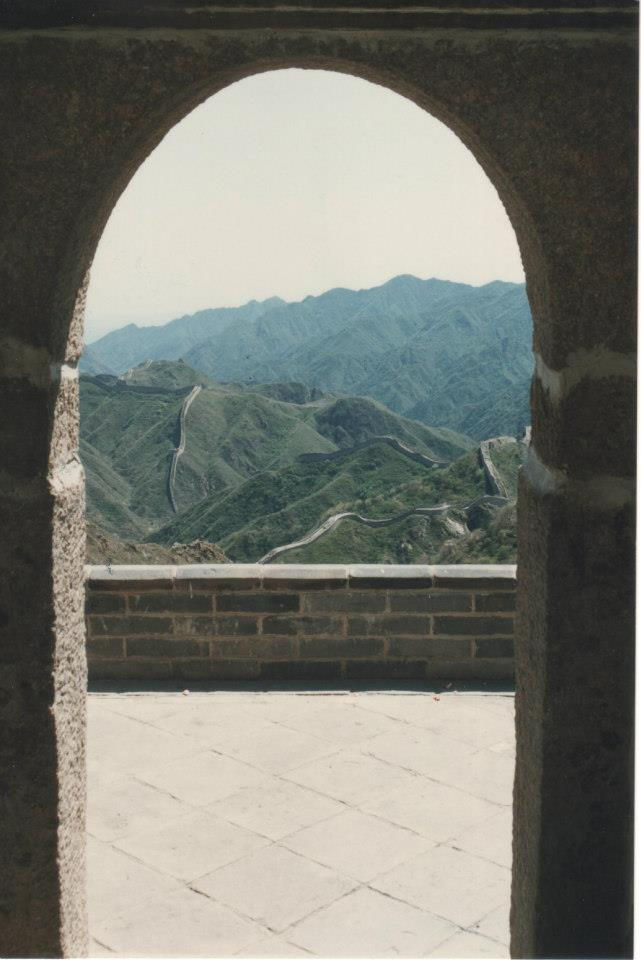
I used to love to play mix tapes in vehicles when I traveling (where possible). It felt like providing a score to what I was experiencing. When David and I first spotted the undulating Great Wall of China, Brahm's Academic Festival Overture was playing in the taxi. It was an amazing life moment.
The Great Wall of China (again, Western name - in Chinese it is "the long castle") at Badaling is not just one wall but a series of interconnected shorter walls that were cobbled together over centuries. Badaling had been chosen as the place near Beijing to restore the Wall simply because there was a LOT of it for visitors to see.
As we left the plains and climbed into the mountains, we caught glimpses of China's most iconic structure. Anticipation built as the mountains grew higher and the road penetrated deeper into them - it seemed increasingly unlikely any linear structure could be built there. We turned a final corner and there it was snaking in both directions as far as the eye could see. Amazing!
But...
We also entered a massive parking lot filled with buses and vehicles. China's number one attraction was popular with both local and foreign guests long before its economic boom. David and my hearts sank. The wall was filled with masses of people (mostly local tour groups). All other complaints about David aside, the man could be a trooper when necessary. We bought our tickets and climbed onto the wall literally PUSHING our way through the crowds until they grew thinner and thinner. Finally, we were on a section of the restored wall, alone - high atop a hill! Then the experience began.
The Great Wall of China is NOT big. In fact, it is disappointingly small. It is not its height nor width that astounds - it is the length (and path). The wall snakes through the mountains out of sight in both directions. Wow. Additionally, the Wall overall is in a terrible state of disrepair. Only those sections renovated back to the original are open to tourists. Frankly speaking, the rest of the wall is in such bad shape that, although visible, it would be extremely difficult to traverse. Our minds were exploding with all we saw and learned. Above all we realized the wall was actually a ROAD to move large numbers of troops quickly - it could have easily been breached in any section that was not well-guarded.
We climbed out of the repaired section and onto some of the "old" wall and felt completely alone in spite of the tourist masses just below us. We were enjoying an incredible experience - but the clock was ticking. We knew the taxi driver had to return to the city by 5:30pm and it was already getting late. In spite of the cold wind blowing from the north and being underdressed, I think David and I could have explored for hours.
We returned to Beijing on a travel high.
David was leaving the city the following day and I had genuine difficulty getting a ticket out of the capital. In one of my favorite China travel moments, at the foreigner ticket window in Beijing Central Station I watched people's requests get rejected over and over as the queue inched forward. Suddenly, I had another strategy - when it was my turn I asked, "What destination DO you have a ticket for tomorrow?" The woman said "Datong". At that moment my plans were decided (I had never even heard of the place). I was just happy to be able to leave a city that had both enthralled and frustrated me.
Notes:
The ride to the wall was exciting. The road climbs off the plains into the foothills. Glimpses of the wall appear on and off in the distance. In that section, the wall is a collection of old, smaller spurs rather than one, massive line. The mountains get higher and higher. Just when it seems they are far too high to hold anything like a wall, it appears. I had a mix tape of classical music for the taxi ride - Brahms' Academic Festival Overture was playing when we first spotted the Wall. It was an incredible moment to remember.
Unfortunately, that feeling was completely ruined upon arrival at the worst tourist trap in all of China. I couldn't believe the number of people. Did all of China show up for our visit? David and I paid the fee and we literally pushed our way through the masses until we were alone at the top of a ridge. It was a long, arduous climb. At the Badaling section of the wall, the right side from the entrance gives the best views. The wind was freezing cold, but we felt great.
The wall was not as huge as I thought it would be - in fact, it is small. The amazing thing is the location, the length, and the age. That combination makes it incredible. We saw fully, partially, and non-restored sections of the Wall. Some of the non-restored parts are difficult to make out. Overall the wall is in a total state of disrepair and only fixed up for tourists in some sections.
We had our fill and returned to Beijing (by 5:30pm) where I ran all over the place trying to find a ticket out of the city (and to change some money). I got a ticket to Datong for late morning the next day. After that, David and I couldn't find any place to eat. Every place was closed. At that point, I was completely sick of Beijing and truly wanted to leave.
Temple of Heaven
From the Palace in all four directions were built temples for ritual sacrifices throughout the year: Heaven and Earth; Sun and Moon. The Temple of Heaven lies south of the palace (near our hotel) and is the largest and best restored. It is also the official symbol of Beijing City.
The temple did not disappoint. I would rank it as a definite "must-see" in the city. Set in a large open space, when we visited it was filled with seniors having morning tea and chatting. Many were doing Tai Chi. It felt very - Chinese.

We returned to the hotel and checked out. David took a taxi to the airport, so we had a rushed goodbye. I had no idea that it was the last time I would ever meet him. Our paths never crossed again although we did stay in touch for a short time (enough to exchange some photos). I even met his family a couple of years later as I traveled across Canada.
I was filled with anxiety. I was alone in China traveling to a city about which I knew nothing...
Notes:
The following morning we visited the Temple of Heaven (Tiantan) across from the hotel. It truly was lovely and was crowded even in the early morning. But like the Forbidden City, it swallowed up the crowds with its vast open space. We saw lots of grandmas and grandpas hanging out playing games and singing songs. That really provided a lot of atmosphere to the visit. The interiors of the two main buildings were also marvelous.
Before I knew it, it was time to bid David a hurried goodbye. I was headed off to Datong. When would I next meet David? How would it be traveling alone in China filled my thoughts. As it turned out, none of those fears materialized, yet...
I must break again prematurely. I feel tired and tense and I have much left to relate.
Beijing to Datong, China (train)
The train slowly left Beijing headed northwest toward the mountains. In fact, we passed under the Great Wall again near Badaling and on the other side of the mountains the rails followed it snaking along the distant mountain tops. Never so far that it wasn't visible, it also wasn't close enough to see in detail. Like a new friend - the Wall followed me to Datong. A series of watchtowers along the Wall could send messages quickly to Beijing (akin to Lord of the Rings' message from Gondor to Rohan). We passed ancient, walled towns that looked almost abandoned. It was a China of which I knew NOTHING. I was absolutely enthralled.
On the train I met an incredibly pompous but friendly Brit, Frank, and his very "genki" (outgoing) Japanese girlfriend, Sachiko. I would spend the next two days with them. Also, in our carriage was the rudely condescending German interpreter for the EEC (the EU did not yet exist), Gunther. He hated the US and felt superior to everyone. I ended up sharing a space with him as fate had thrown us together as travel companions. In the end, Frank was actually a nice guy once I got past his bluster and even Gunther was an amazingly well-traveled guy who could be engaging and charming when he let his guard down. Gunther spoke of travel to places in China I had never heard of - I had so much to learn.
Notes:
May 8 (Taiyuan to Xi'an, train - steam locomotive)
The ride to Datong passed through Badaling and then out across a desert valley where the Great Wall snaked along the mountain ridge. Although it was never close, it could usually be spotted along the way. The section looked completely different from the part at Badaling - I wished I could have seen it up close. A lot of old watchtowers stood along the ridges, too, used to send signals back to Beijing in case of invasion. The train passed small, walled cities and ruins of old towns. There was so much to see - all of it from more than 1,500 years ago. The train ride was truly spectacular.
On the train I met Sachiko & Frank. They would become my traveling companions for the next 2 days. Frank was a fat, arrogant Brit who turned out to be a nice guy once you got past his exterior. He was a photographer. Sachiko, his live-in girlfriend, was a completely genki (lively) Japanese woman who followed him in his travels. They made a very interesting pair. He often seemed to bully her, but he also looked to be afraid of losing her approval. Frank LOVED Japan (ugh). Gunther from Germany was an interpreter for the EEC. He was the ultimate snob (with some very nice moments as a person). I found him pompous and at times, detestable. He was completely anti-American. But he had traveled... a lot! He spoke of cities I had never heard of on the Tibetan Plateau. In the end, we shared a room.
Datong, China
That "stab in the dark" visit to Datong significantly helped determine future travels for me. In spite of facing a lot of frustrations in those couple of days, I ended up discovering and experiencing places of which I had never dreamed. The seed of the idea "pick a spot on the map, go, and explore" had been planted. With rare exception it served me well the remainder of my traveling days.
I had already learned one lesson from prior travel in China (and elsewhere). The first order of business upon arrival in any place was booking a ticket to depart! I had seen far too many people get "stuck" with no option other than to wait for an available seat or pay through the nose to leave on a desired date. All of us bought tickets OUT of Datong upon arrival for two days later. I was headed to Xi'an (with a transfer). The others were returning to Beijing.
We all checked into the "tourist hotel" which appeared to be Soviet-inspired (or even built?), under renovation, and in absolutely dire condition. Frank & Sachiko only spent the first night there and then found something else. Gunther and I toughed it out for two nights. We located CITS and booked a taxi tour to the two famous sights nearby: the Hanging Temple and Yungang Grottoes. Dinner was in the hotel's restaurant - Gunther was appalled. I was disappointed, but had dealt with similar. Sachiko valiantly tried to understand the Chinese characters on the menu through her Japanese lens. She really could only tell us the different kinds of meat and some vegetables. In the end, it wasn't that helpful.
Over dinner we talked a lot - Gunther loved to expound on political evil, but when we diverted him to talk about his travels, it was enthralling. He had been to many countries. Even if I didn't like the guy, I admired where he had explored. Meeting Gunther challenged me to get out and see more - especially off the beaten track. We all retired to our awful rooms - we had a full agenda planned the next day.
The following morning after the usual confusion on a tour booked through CITS (the state travel agency), we were in a taxi headed out of the city.
Notes:
We arrived in Datong and, with some confusion, all bought onward tickets immediately. I was headed to Xi'an via Taiyuan (only hard seats available - shit). The rest were returning to Beijing. We checked into the hotel - Soviet built, under renovation, and dirty. Frank & Sachiko actually moved after the first night. We found CITS and arranged a taxi tour of the Hanging Temple and Yungang Caves. We had a late dinner in the hotel restaurant which appalled Gunther (he never ate in such places...). Then we had a lot of discussion about everything. Most of it was Gunther expounding on the evils in this world or his travels (the latter being quite interesting). Finally, we all went to bed, but I didn't sleep well - too much on my mind.
We were up early and had breakfast at the hotel with CITS. Gunther was attempting to speak Chinese and everyone was laughing. There was MUCH confusion over the taxi. The wanted to stick us on a tour with Hong Kong Chinese, but we finally got our own taxi for the day (which came with certain conditions which we only discovered later). We were off.
To be continued... (I am still not caught up. Too many things are happening and there is no time to write).
Datong to the Hanging Temple (taxi)
Gunther was of a mind that the taxi ride was "ours" and we could stop at will and photograph anything of interest. The taxi driver only wanted to take us to two destinations and return to Datong. We had conflict immediately - especially when Gunther demanded the driver stop randomly so he could photograph a few cows! I understood both points of view and tried to appeal to Gunther to be less demanding. It made for a tense situation in the car.
We stopped in a mud village (of which there were many). The landscape was desert, like the US Southwest. People built mudbrick homes into the sides of natural caves in the hills. It was fascinating, although the level of poverty was dire - even for pre-modern China. I was learning that China was absolutely diverse - a China of which I had never heard.
Finally, we arrived at the Hanging Temple.
Notes:
May 9 (Renmin Hotel, Xi'an, China)
That taxi ride was just great (not). The driver was on some mysterious timetable and complained constantly about our being "late". We stopped once in the countryside so Gunther could take photos of some cows. The driver was angry. Then we passed through villages built of mud right into the mountains. We convinced the driver to stop at one so we could take photos. It was fascinating. The scenery looked a lot like the American Southwest. Our final destination, the Hanging Temple, was a bit of a letdown.
The Hanging Temple
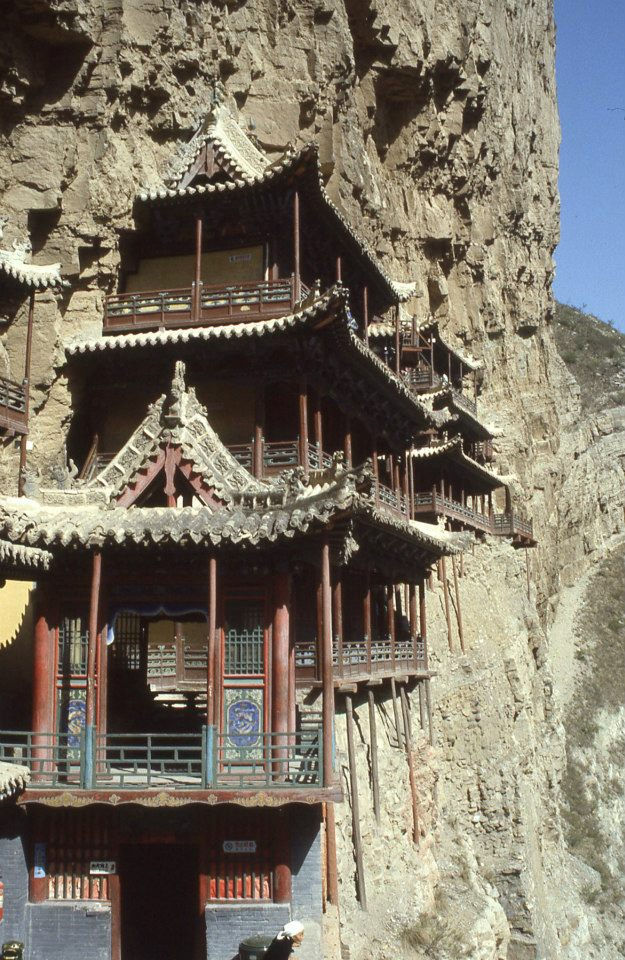
Upon arrival the Hanging Temple looked tiny clinging to the cliff face. Nearby was a massive dam to retain scarce rainwater (it was empty). Our first impressions were not good. However, after climbing the steeps stairs and ladders to the temple and (carefully) walking its dodgy wooden pathways (some were closed - too dangerous), it turned out to be interesting. How it was constructed into the cliff face was the most interesting part (and scary considering how old it was) - all made of wood. The temple was definitely the case of a place that looks far better in photos (and the imagination) than in real life. Nonetheless, I was happy for the visit.
We stayed on "too long" at the temple and the driver became fidgety and angry. He drove us back to Datong quickly where we had lunch. We complained to CITS about his behavior, so he appeared more "relaxed" in the afternoon. Lunch was included in the tour (and for the driver to have a break). Although we all requested "drinks only", they still brought us (bad) food.
Travel in China was tiring...
Notes:
The temple was very interesting but it was not nearly as high up on the cliff face as the photos show AND in the valley where it was built there is a huge dam (with no water?). As with other places, the ride there seemed to be more interesting than the destination. We explored the temple and overstayed our allotted time. The driver was furious and we rocketed back to Datong.
Upon arrival we immediately complained to CITS and the driver's attitude improved for the afternoon. We stopped at the hotel so the driver could eat lunch. We all only wanted drinks, but were served an entire meal (not that good). At this point we were completely sick of everything. The feeling we were constantly being ripped off in a situation out of our control was getting to all of us.
Yungang Grottoes

We drove to the Yungang Grottoes after lunch more leisurely as Gunther did not request we stop every few kilometers. When we arrived, the site didn't look like much, but once we started to enter the caves, we were all astounded at the detail of the carving and the sheer amount of it. The most striking feature, however, was that it was in the middle of nowhere (today). The 6th century and onward carvings had survived multiple Chinese dynasties, earthquakes, and renovations, but what it could not survive was the soot from Datong's factories slowly eating away at the stone. The government was making an effort to remediate the effects, but it was heartbreaking to see how many of the carvings were slowly dissolving.
More shocking for me was the discovery that the caves had been a target during the Cultural Revolution. Many carvings were defaced by gunfire. What country destroys its own heritage? It was the first place I came face to face with such destruction in China and I felt heartsick. Gunther also brought up that the British (and Japanese) had literally looted the more famous yet similar site, Longmen Caves. Sections of that place were literally chiseled out of the stone and now sit in museums in the UK, US, and Japan. Dreadful acts - Chinese distrust of the West certainly had merit.
To add to the fascination of the caves, atop the cliffs into which they were carved sits an old fort - part of the Great Wall/Signal Tower defense system. We explored the walls and climbed its old tower. We could make out several others fading into the distance toward the capital. China held so much - I knew literally nothing about it.
Gunther insisted on staying on and said he would find his own way back. Back in the city I hung out with Frank and Sachiko and then returned to the room until dinner time. Gunther never appeared. Again I found Frank and Sachiko and we decided to try a new place for dinner. As before, we had issues ordering and when the food arrived it was dire. It turned out Gunther showed up there for dinner, too.
We hung out at Frank and Sachiko's hotel lobby (far nicer than mine and Gunther's) and chatted late into the night. I had actually come to like Frank. Gunther was only tolerable when he told travel stories. We all loved to hear them and kept prodding him to tell more rather than ramble on about the world's political evils.
That night Gunther and I returned to find our hotel locked. We had to find the night security guard to let us in the lobby (he was none too pleased!)
Notes:
The afternoon we spent at the caves was very good. The caves are totally impressive. On top lies a fortress where we could climb the walls and its signal tower. Standing in the right place, I could see all the signal towers in a line fade into the distance. The purpose of the towers was to send a message quickly to Beijing in case of attack. Everything was at least 1,500 years old, too. We left Gunther there to take more photos (he takes many). On the way back to town we stopped at a temple with a famous dragon screen (Ming Dynasty).
Back in Datong I had a few beers with Frank & Sachiko and then switched to some tea. Frank is a talker... I met an English couple on the return to the hotel who were on their way to Lhasa. It was pleasant to talk to them. Back at the hotel, I waited for Gunther, but he never showed up. I went back to the Frank & Sachiko's hotel, picked them up, and we went for dinner at a "people's" restaurant across the street. We had a hell of a time ordering! We finally found a table and who happened to be there? Gunther. We drank beer out of bowls (not so unusual). The food ranged from utterly delicious to horrible. Frank (who is large) does not eat meat and that is a huge challenge in China. We all retired to Frank & Sachiko's hotel where we talked more. Gunther was his usual condescending asshole self. He was occasionally nice when he forgot to put on his "superior" facade. We talked until 1:00am. Gunther and I returned to our hotel to find the door locked and we had to track down the night watchman to let us in.
It had been quite a day.
Datong to Taiyuan to Xian, China (train)
The following morning our little, somewhat unhappy crew broke up. I never heard from any of them again.
In actuality, I had only booked a ticket from Datong to Taiyuan, a station on the main Beijing-Xi'an line. It was not possible in those days to book a connecting ticket. I figured I could get an onward ticket in Taiyuan - no sweat. What an adventure! First, I had to survive an eight-hour hard seat journey to Taiyuan.
I met an "English attack" guy on the train, but he turned out to be extremely nice - just desperate to speak with a native. In fact, he was on his way to Beijing to take a test that would allow him further study. He had never been out of Shanxi Province. Although oddly formal, his English was reasonable (lightyears better than my students in Japan). His parents were farmers and his brothers worked in the fields. He was the great hope of the family. He spoke of "improvements" in living conditions in China (wow) and the government's promise of better things to come. I learned more in that conversation than from an entire semester's course on "modern China".
I sometimes dozed by the open window. Eight hours is a long journey. My face and sleeve became black with soot from the coal-fired locomotive! The train again passed old walled cities and fortresses - I knew nothing about China.
I later me Hu Peng. Like Bee Cheng who helped David and me, his English wasn't good, but his desire to help was sincere. He also got off in Taiyuan where he was going to take a bus onward. He promised to help me buy the tickets to Xi'an. As with the case of Bee Cheng, his desire to help exceeded his ability to provide any real assistance. We roamed all over Taiyuan - Advanced Railway Booking, CITS, CAAC, all useless. I appeared to be stuck. I even looked into going to Guangzhou again and spending more time back in Hong Kong. I was very frustrated, but could not be angry with Hu Peng. The poor guy was beside himself with worry.
Finally, I got a hard seat for the long journey to Xi'an. I hoped I could score an upgrade onboard. We had a good lunch (Hu Peng found the place) and I paid. Even if I was unhappy, the guy had tried his best. He dropped me at the train station and went to catch his bus. About 30 minutes later, Hu Peng showed up again. He had missed the bus. I felt dreadful. He said he would sit with me and wait until the train arrived. He truly was a kind guy.
Finally, some attendants came to check my ticket (I was in the official waiting area) and Hu Peng explained the situation. I was immediately taken to the First Class Waiting Room and given some reading material. When the train arrived, the attendants took me to the conductor where I was promptly given a soft sleeper in First Class. I literally hit the bed and slept for many hours. Hu Peng had to wait for his bus alone, but I think he was happy he finally helped me.
All that worry and drama ended up being solved in the most unexpected way.
[In a complete irony, when I awoke on the train I found myself with some travelers from Voyages Jules Verne! They were on their way from London to Hong Kong - an interesting and nice group. However, having by that time done it all on my own, I wasn't sure if I could have really enjoyed the group dynamic for such a long trip. I felt satisfied the original plan hadn't worked out!]
Notes:
I got up early to catch the train (hard seat for 8 hours) to Taiyuan. I met lots of interesting characters on that journey. A local English teacher "attacked" me with conversation, but he ended up being a very nice guy. He had never been out of Shanxi Province - never seen Beijing nor the ocean! He was on his way to take a test to study more English in Beijing. His English was very stilted but good (lightyears better than most of my students back in Japan). He told me his parents were peasant farmers and his younger brothers (aged 18, 19) worked in the fields. His story brought the "real" China alive for me. He spoke of living conditions before and in the present and his hope for improvement in the future. I learned a LOT!
I felt exhausted on the train and in spite of the hard seat and the soot covering my face and arm by the window (the steam engine was coal-burning), I dozed. That shirt sleeve became filthy and never was totally clean again. The scenery had returned to desert. We passed old, walled cities and fortresses.
Then I met Hu Peng, another "no English but I'm trying" type of guy. He was very kind and wanted to help me get a sleeper to Xi'an. It turned out he did not know what the hell he was doing and we spent over two hours walking all over that city looking for train (or plane) tickets. At one point, I got so disgusted I tried to find transportation to Guangzhou and then leave China! I was getting very frustrated, but I couldn't be angry with someone who was sincerely trying to help. The Advanced Railway Booking Office, CITS, and CAAC were all useless. I ended up buying a hard seat on the train to Xi'an with the hope of upgrading it on board. We ate a great meal for next to nothing - I treated Hu Peng, and then we parted ways at the station. I sat in the station waiting room worried about the ticket when he showed up again. He said he missed his bus so he would sit and wait with me.
Some attendants came to ask for my ticket and Hu Peng explained my situation. I was immediately whisked off to the first class waiting room and given some free materials to read while I waited in comfort. The train finally arrived and a very pleasant young woman who worked in the station took me to the conductor and I got a soft sleeper! I climbed into it and immediately fell into a long, deep sleep.
May 9 (Renmin Hotel, Xi'an, China)
In a complete irony, I woke up on the train and met the people from Voyages Jules Verne who I originally booked to help with the trip. The group was coming from London on their way to Hong Kong - nice group. I don't know if I could have done it. Individual travel is such a bitch, but I also can't complain thus far doing everything on my own.
Xi'an, China

As with other travel in China, Xi'an was interesting, intense, and frustrating. It would have helped my impression of the city if I had fully understood just how important the city was in unified China's history.
Upon arrival I bought a ticket on CAAC to Hong Kong - the train to Guangzhou simply took too long. As usual, buying the ticket was a nightmare. Then at the recommended tourist hotel no rooms were available so I had to book into its dorms. The hotel was disgusting to boot. Those two major headaches (transport and hotel) out of the way, I focused on seeing Xi'an. What I saw was impressive, but being so ground down by China travel, by that point I didn't appreciate the city fully. That really was my loss.
I rented a bicycle in city filled with them. Getting around to see the sights took a lot of effort as it felt like every road was jammed. I saw the two famous Goose Pagodas (big and small) as well as the city walls (impressive) with their iconic Bell and Drum Towers. I expected Xi'an to be a kind of fairytale throwback city - China's Kyoto. Instead, it appeared modern and industrial with a lot of historical sites thrown in as an afterthought. On that visit, Xi'an's Great Mosque impressed me more than any other place in the city. The mosque was old and more importantly, completely Chinese looking - a marvelous study in syncretism. Xi'an was more tree-lined than Beijing, but it was no easier to navigate - even with my own transportation. A bicycle was not as "freeing" as I thought it would be.
I should have enjoyed and appreciated the city more, but my mind was already fantasizing about all the fun I would have in Hong Kong. I met fellow travelers in the hotel and at dinner - one guy was actually on the same Trans-Siberian train as me (never met him again) and I hung out with an engaging French couple whom I traveled with the following day. Xi'an wasn't all bad - I was burnt out.
Notes:
First I tried to book a train back to Guangzhou - two days! forget that. The plane was full. The flight to Hong Kong was far more expensive, but.... I took it. (shit). At any rate, I can leave China tomorrow for a few days. Getting the ticket was completely frustrating and finding a room was worse. The people at the Renmin Hotel told me there were no rooms. The hotel looked like the Hiroshima Atomic Dome #2. After a lot of hassle, I booked place for two nights in their dorm. It was cheap, but I am so sick of the hassle to do every single thing.
I met two British women and talked to them for a while. I later met some French people, Sophie and Jean-Louis (more on them to follow). Since I finally had the ticket out of Xi'an, I went out to see the city. I rented a bicycle and rode to the Big Goose Pagoda and the Small Goose Pagoda. I saw the city walls, some gates, the bell tower, the drum tower, and the Arab Quarter. Touring by bike was a challenge navigating the throngs of people.
My impression of Xi'an was not wonderful, although the streets are tree-lined and it feels far more atmospheric than Beijing. My expectation of Xi'an was "old and wonderful" when in fact it was modern and industrial. That night I met Sophie & Jean-Louis at dinner. I just didn't feel like eating alone so I introduced myself. We hit it off immediately; they were really great people. We discovered we were on the same tour the following day. Back in the room I met a German guy (I think he was gay) and a Dane who is on the same Trans-Siberian train as me.
It was a tiring but eventful day. I was simply happy to know I was getting back to Hong Kong. The next hurdle will be getting back to Beijing from there.
Terracotta Warriors - the tour
I joined a tour that would take in sights outside of Xi'an with the high point being the famous Terracotta Warriors. With me were Sophie & Jean-Louis (from the evening before), joined by Lee, a Korean-American studying in Beijing (who spoke some Chinese - very helpful). They made for wonderful traveling companions that day
Our first stop was at a hot spring - famous in the Chinese historical/political narrative, but less so as an actual place to visit. The guide explained the details, but as I knew little Chinese history and she informed us in painstaking detail, I soon glazed over. My one takeaway was that, among other things, it was the place that Chiang Kai-shek finally capitulated to the Communist forces (the Taiwanese would no doubt disagree). [Actually, it seemed even our guide at times was laughing as she presented the party line to the group]. Given how important the place was, it was loaded with local tourists (most tourist sites, besides the Great Wall, were not).
More interesting was the burial mound of the first Chinese emperor, Xi. A huge tumulus with stairs to the top, it provides a fine vista over the rice fields surrounding. I was astonished to hear the tomb had never been plundered by thieves nor archeologists. It is one of the most revered sites in China. Emperor Xi created China after all. Later in life I watched several documentaries on that tomb - it remains a place of great wonder and speculation. I wish I had appreciated it more.
The main attraction of the tour, the warriors, are housed under what looks like a huge airplane hanger (not beautiful, it totally detracted). At least the Chinese were taking the preservation of the site seriously. The place was only partially excavated. It would take decades to dig out the entire army (if indeed they ever do), and worse yet, upon exposure to air the vibrant colors of the statues immediately fade. Most of the figures were broken up due to the passage of time and require significant rehabilitation, too.
The place was crowded (mostly foreign tourists) but I was still happy for the visit. It was, after all, the main reason for anyone to visit Xi'an at that time.
Notes:
May 10 (Chungking Mansions, Hong Kong)
The terracotta warriors tour was more interesting for meeting the members of the tour than the tour itself. I met Sophie & Jean-Louis from France (from the evening before) as well as Lee, a Korean-American guy studying at Beijing University.
The first stop was a hot spring famous for a Chinese woman who was the equivalent of Cleopatra. It was also the place that Chiang Kai Shek was forced to capitulate to the Communists. We heard lots of political gobbledy-gook. What was interesting was that the guide didn't seem to believe it either as I caught her giggling a few times during the monologue. The hot spring itself was just OK, nothing fantastic. The place was loaded with local tourists.
The next stop was the tomb of Emperor Qin (who made the terracotta warriors). It is only a huge mound of earth which has never been excavated. The view from the top was nice. Finally, we stopped to see the famed terracotta warriors. It is impressive - the individual detail of each statue and size of the site is amazing. The warriors are housed in a building that looks like an airplane hanger and it was swarming with tourists (which dulled the experience). It was completely worth the visit though.

After the high point of the tour we all had lunch together. Our final stop was a "neolithic village" which was no doubt of incredible historical importance. However, after seeing the famous Terracotta Warriors, it was hard to feel excited about some prehistoric foundations in the earth. Admittedly, the region around Xi'an was truly OLD and worth more exploration.
Back in town, I suggested we all have dinner together at the "Xi'an Restaurant", recommended in numerous guidebooks. It was a total disaster of the usual Chinese proportions. When we (finally) got a tourist menu and realized we were being charged significantly more (Lee figured it out), we left. Other travelers recommended yet one more restaurant which was just OK but with the usual slow service. Poor Lee who had helped us so much had to leave before his food even arrived to catch the train to Beijing. My last meal in Xi'an was typical of the entire trip leading up to it - frustratingly bad. I was sad to bid farewell to Sophie and Jean-Louis, but otherwise I couldn't wait to get back to Hong Kong.
Notes:
We all had lunch together - the group was mostly French. After that we stopped at Banpo Neolithic Village to see an exhibit of stone aged dwellings. It was very well-presented (actually better than the warriors), but I had a hard time getting excited over the foundations of mud huts and arrowheads. Most of us felt bored.
Back in Xi'an I suggested we eat at the Xi'an Restaurant as recommended in some of our guidebooks. We arrived and the service was terrible. They even tried to cheat us with a more expensive menu. Luckily, Lee understood Chinese. We left (so did another group of foreigners). Those people suggested we try the restaurant where they ate the night before. We went there and the food was just ok and arrived very late. Poor Lee couldn't even eat because he had to catch the train back to Beijing! Some of the others at the table were quite bizarre, but that is China - it seems to draw very eccentric people. Finally, we had a drink at the hotel and I said my goodbyes to Sophie & Jean-Louis. I hope to meet them in the US - they said they might come one day.
HONG KONG (final visit)
Since I had been in and out of Hong Kong several times during my time in Japan, it was known, comfortable, cheap, and predictable. In short, everything China was not in those days. After a couple very frustrating weeks of travel in China (which had also been fascinating), I longed for a place that I understood and that worked according to my own expectations of the world, i.e., cheap places weren't good, expensive places were, and travel tickets were easily obtained. The final trip to Hong Kong was all about preparing for the Trans-Siberian (and Europe). I had to shift gears out of "Asia-mode" and into "Europe-mode". I needed flights, tickets, visas, and information. That final trip to Hong Kong came with a LOT of purpose and very little "travel".
I checked into a "not-as-terrible-as-others" hostel in the infamous Chungking Mansions. Yes, the hostel was dire - but it was cheap and I got what I paid for. Additionally, it was filled with travelers who might have current information on the upcoming trip. Even if I complained, I knew what I was getting. In China, the price of the hotel seemed to have little correlation to the room and service (except the White Swan in Guangzhou).
I bought railway tickets from Beijing as far as Warsaw. They were incredibly cheap considering how far I was traveling. The first visa I had to procure was the Soviet one - it would take several days. I waited nervously. My original plan was to take the train from Hong Kong to Guangzhou and then onward to Beijing. The rail trip was a two-day odyssey and I had yet more visas to obtain in Beijing. I couldn't risk not having enough time, so I flew (which completely blew my budget). I checked in at Hong Kong Student Travel daily on the progress of the visa. I couldn't do anything without it. I ended up "stuck" in the city a week. There was no other option.
I was in super "save money mode" which meant not having too much fun in a city which abounded in good food, drink, and entertainment. I met with Lisa and some of her friends several times as well as some of my new hostel friends. Most of the people at the hostel had already been to China (taking a break, planning to return). We all commiserated with each other about the woes of travel there. There was a theft in my room which appeared mysterious since no one else's bags were touched. One guy tried to steal some of my clothes as I noticed some of my "dirty" clothes appeared in his pile (I rescued them and said nothing). One American woman had lived in Australia and spoke with an affected Australian accent (not the last time I encountered that in my life and travels). All in all, it was a fun group (if chaotic). The owner and staff seemed as dodgy as the place itself - we all looked out for each other.
I finally got the visa and celebrated with some guys from the hostel. The next day I was headed to Beijing again. I felt excited for the trip, but dreaded the return to China.
Notes:
The flight to Hong Kong the next day was unremarkable. I always feel relieved after a CAAC flight. Oh, I love Hong Kong more on each visit. Especially after China! I ate some Mexican food, checked into Chungking Mansions, and did lots of preparation shopping for Europe. I picked up a good book on riding the Trans-Siberian, too. I called home and it ended up being Mother's Day.
I sure am happy to be out of China!
May 14 (Chungking Mansions, Hong Kong)
This "Chungking Mansions" place is the pits. It is dirty and depressing (and roach-infested), but.... it is dirt cheap. After much waiting I am in possession of my tickets: Beijing - Irkutsk - Moscow - Kiev - Warsaw. In addition, I have all my hotels booked in the USSR and a ticket back to Beijing from Hong Kong (on CAAC - oh no! and it was expensive). I had intended to leave by train but as I might not make it back to Beijing in time to get the additional visas, I decided to fly. My budget is completely shot, but what else could I do?
Lisa and her friend Maggie treated me to Yum Cha and later Indonesian food. They are both so very kind. Outside of meeting Lisa (and the hot and sunny weather), I just check in with Hong Kong Student Travel every other day on the progress of my Soviet visa. I feel completely bored, but reluctant to spend money on "fun" as I was never sure which day I would be leaving (the travel agency always said "tomorrow").
I hung out with everyone else at the "Travelers Friendship Hostel" where we all complained about travel in China (and got to know each other better). What a motley crew they were. There are two Danes, Lars I and Lars II who are traveling before they enter university. Then there are three soccer-player-type Danes who are wild and crazy. A very nice Aussie is in my room along with a bunch of Swedes. A somewhat snotty French girl (who is kind in her own way) is in another room. There is a Dutch guy who speaks English with an Australian accent because he lived there a long time. Another girl, Sharon, is from Connecticut and has travelled a lot, but currently lives in Australia. Mr Lee, the proprietor, is kind of creepy and his helpers are all very weird. There was a theft in my room from a Swedish girl's bag - so strange that they didn't touch anyone else's?
It has been an eye-opening experience hanging out with all the budget-travelers. The best thing is that I am soon on my way although I am NOT looking forward to returning to China.
May 16 (Jing Hua Hotel, Beijing, China)
I went out for pizza and later some Mexican food with Lars I and Lars II. I paid for the majority of the Mexican food. It was a splurge and they don't have a lot of money. I also had Portuguese food with Liza and Maggie (I didn't expect that we would all eat and I ended up paying as well). I used my credit card a little too much, but I did have a good final evening in Hong Kong.
The next morning I packed and soon I was on the flight to Beijing.
CHINA (again)
Beijing (final)
I arrived in Beijing again safely. Basically, the visit would be the sequel to my recent stay in Hong Kong. I was not there as a tourist, but as a "visa collector" for the onward journey.
When I arrived at the Tientan Hotel (one of the few bright spots in Beijing) I found that it was fully booked. I collected the bags I had stored there and started yet another "find a hotel" odyssey in the city ending at a place far out of the center that was exceedingly inconvenient to public transport - never mind that it was unpleasant with unhelpful staff. So, my final days in China were spent at yet another place I loved to hate, the Jin Hua Hotel.
As there was NOTHING near the hotel and I had not eaten since the morning flight, I had to satisfy myself with a yogurt drink from an Iranian woman hoping for a US visa. She told a fascinating tale of escape from Iran into China. Her generosity with what little she had was humbling. I only knew two people in Beijing, my Japanese friend TM's ex-boyfriend and Lee, the American guy I met in Xi'an. I didn't manage to meet either.
I repacked my bags and jettisoned information that I no longer needed about travel already completed and obtaining Eastern European visas. I was glad - my bags continued to be an albatross during the trip. I decided to see the Summer Palace that day. Beijing City has three big sights: the Palace, the Temple of Heaven, and the Summer Palace. Apparently, the Summer Palace was off the chart - akin to Hangzhou!
Notes:
The CAAC flight was less harrowing than expected. The food was world's better than I got on the Xi'an to Hong Kong flight, but it is still GALAXIES away from even the worst food on any other airline. CAAC needs to work on landings in general; they always feel a bit doubtful. I took the bus provided to the CAAC Office in Beijing and then another to the Tientan Hotel to pick up my bags.
I tried to call Lee (the guy I met in Xi'an) and Joe (TM's ex-boyfriend from Japan) without success. The Tiantan Sports Hotel was full! It took me a long time to find a taxi to the lovely (not) Jin Hua Hotel (in the middle of nowhere and difficult to get to and away from). Not to mention the staff there barely speak English and have a typical "I don't care about anything" attitude. I arrived after dinner which meant no food. I only had a bottle of yoghurt given to me by a kind Iranian woman who was trying to get a US visa and escape life under the Ayatollah. The conversation with her was interesting to say the least.
The next day I woke up and threw a bunch of stuff out of my pack that I won't need (mostly Eastern Europe visa information and tourist info). Then I set off for the Summer Palace. That adventure re-affirmed in my mind that I will never travel in China individually again until the country develops more and has a better tourist infrastructure (or I take a group tour to avoid all the hassle). Unfortunately, I think I have already seen the places most tours would go...
Summer Palace

Getting to the Summer Palace was the worst transportation experience I had in Beijing. I obtained a bus map only to find my hotel wasn't even on it. I finally figured out the combination of buses needed and then couldn't find a bus stop. With some local help, I boarded. The second bus was packed beyond belief - even crowded transport in Japan paled in comparison.
Who on earth enjoyed travel in China?
Finally, I was at the Summer Palace. Like the Palace and Temple of Heaven int town, it DID meet the hype with a combination of lovely buildings and beautiful gardens set on islands in a lake. I was too flustered after the bus journey to actually enjoy it. The place was popular, too - yet it was large enough to swallow the crowds. Unfortunately, I had to get back to CITS before it closed, so I could not enjoy a leisurely visit. I could only imagine what it was like less crowded, perhaps around sunset?
Getting back to the city center and CITS was less harrowing. I picked up my tickets for the first leg of the journey to Irkutsk. I started to feel excited - "my big trip" was really going to happen!
Notes:
First I obtained a bus map. Then I noticed (not surprisingly) that my hotel was not on it, nor was the hotel near any bus into town. I finally boarded a #17 bus which took me to the terminus of #15 bus (which I could not find), so I walked until I found a stop for #15. That stop was no longer in use (even the locals I asked were baffled by that). Finally, I found the #15 bus which took me to the zoo. There I got on (no, I was packed on) a #322 which took me to the gates of the palace. For some reason, even the Yamanote Line in Tokyo in summer in rush hour feels like a "soft sleeper" compared to Beijing buses.
The Summer Palace was packed and I was already tired from the bus adventure. But, yes, it was impressive. It felt like a smaller version of Hangzhou with beautiful palaces added to it. As usual with great places in China, even with crowds, it ended up being beautiful. Had I not had to get back to the CITS office before it closed, I would have enjoyed relaxing there and waiting for the crowds to die down a bit.
The ride back was long (and less adventurous). The buses actually traveled where I expected and one hour later I was in the CITS office getting my official train ticket to Irkutsk in exchange for a voucher. That was hassle free (I am still in shock!).
At the end of the first day in Beijing, I realized that public buses only reached within a ten-minute walk of the hotel. How was I going to make it to Beijing Station on departure day by 7:40am? It looked like taxi would be the only option.
As with many dining places in China, the hotel restaurant was a complete mystery. I entered the main dining room which was taken up by groups. I was shuffled off to a side room where some food actually arrived (I was starving). One of the biggest frustrations of travel in China was not only finding restaurants, but also figuring out how to order. The problem dogged me until the very last.
I had no luck contacting Lee. I wasn't sure if he wasn't getting my messages or if he had and my hotel never related them. It would have been nice to hang out with someone I knew a little for my final hours in the city. I hoped to find a better hotel closer to the main train station for the last night. Unfortunately, I ended up staying at the Jin Hua until the very end!
Notes:
I went back to Qianmen Street where the map (which I left at CITS) indicated I could find a #2 bus to take me back. I walked at least a mile to the stop. Finally, a #2 bus took me to a parking lot within 10 minutes walk of the hotel. How am I ever going to meet my 7:40am train (7:00am check in) is beyond me.
Eating in the hotel restaurant remains a mystery. The main dining room was taken up by large parties and after some questioning and searching, I found myself off in a side room. The food tasted good - mainly because I hadn't eaten anything solid in nearly 24 hours. I hope I won't have to eat there again! Finally, back in my room I tried to call Lee, but he wasn't at home. I assume that he didn't get the messages or that he got them and called here and I didn't receive them. I certainly hope I don't have to stay in this hotel the whole time I am in Beijing.
May 17 (Jing Hua Hotel, Beijing, China)
It looks like I will be in the old Jing Hua Hotel until the last. Oh well, at this point as long as I can get a taxi in time for the train, I'll be thrilled. I think I realized today that I don't mind traveling alone nor do I mind staying in a place I don't care for; however, when those two things coincide, it is a bummer! I felt totally down this morning, but as the day progressed I felt better.
Beijing in those days was not for tourists. Of course, people came in droves to see the Palace, Tiananmen Square, the Temple of Heaven, and the Great Wall - but not much more. In fact, after the Cultural Revolution many of the city's venerable neighborhoods were destroyed and replaced with brutalist Soviet architecture. As I was killing time, I set off for a day of touristing "off the grid".
North of the Forbidden City lies the Temple of Heaven's twin, the Temple of Earth. At first, the place looked disappointing, but the lack of crowds and its parklike setting were peaceful. I imagined the emperor of yore making his yearly sacrifice to assure the harvest. Of big note, if the harvest failed, the emperor lost the "mandate of heaven" and was often replaced! It was not a democracy, but that must have put some real checks on the emperor.

Nearby I found the main Tibetan Temple for the city, the Lama Temple. The complex is large with distinctive architecture. That visit made me understand that Tibet also used to have great influence in the capital. It also forced me to rethink the power dynamic between the government and Tibet. I started to wonder if the occupation of Tibet was less naked aggression by the government of China and more "fear" of the power of the Dalai Lama. After all, before the Pope was shut up in Vatican City, his decisions influenced much of Europe. The Lama Temple was crowded, but I didn't mind - it was one of the most thought-provoking places I visited in the city.
Near the Lama Temple was an equally old and important Confucian Temple, but it was far less crowded. It was such a change to wander without the crush of the masses. I had reached sensory overload though. I needed to find food - always a hassle.
After lunch, I didn't feel like more typical tourists spots (which were also difficult to reach), so I headed to one preserved neighborhood from the Ming Dynasty that had been turned into a shopping area, Hepingman. I found it very well restored, not overwhelmed with crowds, and filled with traditional handicrafts. Why wasn't Beijing filled with such places? At a calligraphy shop an old man wrote part of a poem for me on a piece of rice paper which I kept and later framed. That street was likely my favorite part of the city.
Above all the worry of getting the needed visas hung over my head....
Notes:
I visited the Temple of the Earth. The altar is huge, but other than that it's mostly just a pleasant park to escape to. The nearby Lama Temple was packed, but I must admit (yet again), that when a place in China is wonderful, the crowds don't matter. Lots of priests were milling about and the architecture is completely different from typical Chinese (the temple is Tibetan). Nearby was a Confucian Temple which was nice and quiet. It felt like a relaxed place to avoid the crowds.
I changed more money (where is it all going?) and ate in the cafeteria of a big hotel (ugh). After that I relaxed in the rock garden of a park listening to my Walkman. I bagged more sightseeing and checked out a shopping district. I rode the subway to Hepingman and walked to a restored Ming Era market. It was very nicely done, even better than some of the old palaces! It was touristy, but not overrun. I ended up buying a few things I didn't need, but for what they were, the prices were cheap. They will mostly be gifts for when I return home. I met an old calligrapher who did part of an old Chinese poem for me. He was a lovely old man and it made for a memorable purchase.
I returned to the hotel to again worry about visas. Will I get them or not? Oh to be back in the West....
Visa crunch time had arrived. I had the train tickets - I just needed the appropriate visas. namely, Mongolia (transit) and Poland (tourist). As it turned out, Pope John Paul II was on his first state visit to Poland and no visas were being issued (only transit). I was bummed out. Would I have to skip the country entirely? Would I have to replan part of the journey before even starting?
Obtaining the Mongolian visa was the complete "what is going on?" experience. After finding the poorly-marked building down a side street, I entered a small room packed with foreigners all trying to get that all-important stamp. No directions were posted; no one spoke English. How did I find out what to do? I asked everyone else in the room what was going on! I filled out a form, attached photos, and paid the fee. Then I waited. I had no idea if I had even done it correctly. My name was called; I got it! (apparently the last of the day). I felt such a sense of relief.
While waiting I met a Dutch couple who were going through the same process. Actually, I remembered them from Hong Kong Student Travel. the Polish Embassy, and then later at CITS in Beijing. Funny how I often met the same people repeatedly. We all went out for a beer to celebrate our stamps afterward. Such drama over a simple thing! They told me that the main railway station had oversized lockers, so I decided to take my bags to the station the day before to avoid navigating the city massively encumbered early in the morning on departure day.
My sense of relief was indescribable.
Notes:
May 19 (Jing Hua Hotel, Beijing, China)
The visa I was least worried about, Poland, is unobtainable due to the Pope's visit! I could only manage a transit visa. I guess that means I'll be in Berlin around June 1 and from there I'll decide what to do. Perhaps straight to Prague (after some recovery time in West Berlin).
The Mongolian Embassy was quite the scene. A small room, stuffed with travelers all waiting patiently for that precious stamp in their passports. It seems I was the last to get a visa in one day on my visit; the rest of the folks had to return the following day. I met a Dutch couple in the Polish Embassy whom I had met in Hong Kong Student Travel. I met them again in CITS in Chungwenmen Hotel. We were having similar problems, but all things were resolved in the end. We celebrated over a few beers in a nearby hotel. We had a very nice conversation. I'd love to look them up when I finally make it to the Netherlands (not Holland, as they explained). They also told me about huge lockers in the main railway station. I'll take my big bag there later today. That way tomorrow I only need to carry my small bag and I can easily take a bus if needed. I really don't look forward to dragging my bag across town but if there is no other way then...
After I drop my bag, I'm not sure what I'll do - I just feel relieved.
My last day in Beijing was anti-climactic. I took my pack to the station without complication. What to do on the last day? I decided on the zoo (to see the pandas).
Beijing Zoo
The zoo was a complete downer. The only well-kept exhibit was for the pandas (and even that wasn't good). Mostly the zoo was filthy with mangy animals that were harassed by visitors who threw things (sometimes food, sometimes objects) so the creatures would move. I thought zoos in Japan were terrible - China's were worse. I did not stay long.
I had already seen the Temples of Heaven, Earth, and the Sun while I killed time in Beijing. The one remaining (and hard to find) was the Moon. On the way back from the zoo, I visited. As it turned out, it is in park holding a huge communications tower. One plaque indicated I was in the correct place, but nothing remained of the original temple (had there ever been one?) except a gateway that likely was constructed later. It felt disappointing as the finale to my tourist exploration of the city.

Another bad lunch at a place I knew how to navigate reminded me how ready I was to leave China. I stopped by the main train station to have a look at international departures so I knew where to go the following morning. The rest of the day I sat in Tiananmen Square watching the throngs of people. In spite the the crowds the place felt open - crowded Beijing was getting on my nerves in a way even Tokyo never did.
Back at the hotel I ate a final bad dinner and wondered if I should even attempt a wake up call. All I had to do was get up, cross town, and board the train in the morning.
It was finally happening after years of dreaming and months of planning. I couldn't wait!
Notes:
May 19 (Jing Hua Hotel, Beijing, China)
I woke early, putzed around the hotel, and then took my pack to the station. It was not nearly as bad as I expected. After that (4 yuan, a rip off), I set off for the day's adventure - a trip to the zoo!
The only animals remotely well-cared for are the pandas and even their enclosure leaves much to be desired. I only bothered to see half of the place as I became disgusted with the animal's living conditions. They were suffering and the spectators were throwing stuff at them to eat, randomly. People also threw things AT the animals just to get them to move. After China, only Japan's zoos are equally as bad.
One the way back I stopped at the Temple of the Moon which completed my circuit of the Temples of Heaven, Earth, Sun, and Moon. They are all placed approximately equidistant from the Forbidden City: Moon - west, Sun - east, Earth - north, Heaven - south. The Temple of the Moon is the worse kept up with a TV tower on the property and hardly any original buildings left (were there ever any?).
I had lunch at the terrible Xingquao Hotel (again) for the convenience of eating cafeteria style. Then I hung out in the International Train Booking Office and met a clueless Canadian woman who thought she could just hop on a train all the way to Bucharest. She even lives in China!
After that, I went to Tiananmen Square to pass an hour or so watching the multitudes and relaxing in the open space there. Dinner back at the hotel was bad as usual. I just have to get up on time tomorrow. Dare I ask for a wake up call? I will, but I have to trust myself, too (I hope).
Tomorrow is it! I am so excited!
[continued in Round the World I: Beijing to Berlin]

Comments